The honest answer is that I have been to Yellowstone in July, August, and September, and none of those trips prepared me for what late April and early May do to that valley. The grass was still brown where snowmelt hadn’t reached. The cottonwoods along the Yellowstone River had barely leafed out. And in a single morning in Lamar Valley I watched a bison cow deliver a calf, a small wolf pack work a drainage a quarter mile away, and a sandhill crane pair wade a shallow section of the Lamar River. That’s the spring difference: the animals are doing something, not just existing in the heat.
Spring wildlife watching in national parks operates on a specific seasonal logic. Snowmelt pushes large mammals from high-elevation winter ranges down to more accessible valleys in April and May. Bears emerge from dens hungry and concentrated at lower elevations. Ungulate calving peaks in late April and May across the Rocky Mountain parks. Migratory birds — shorebirds, raptors, neotropical songbirds — move through predictable corridors on tight schedules. And dawn-to-dusk activity peaks run longer in spring than in summer: animals that will retreat to shade by 8 a.m. in July are actively moving until 10 a.m. in May, because the temperatures cooperate. Every wildlife photographer knows the golden window, but in spring that window stays gold longer.
What follows is a ranked guide to ten parks where spring specifically moves the needle — parks where the combination of calving, emergence, migration, and accessible terrain makes April through June the right time to go.
1. Yellowstone National Park, Wyoming
Peak weeks for spring wildlife: Late April through late May.
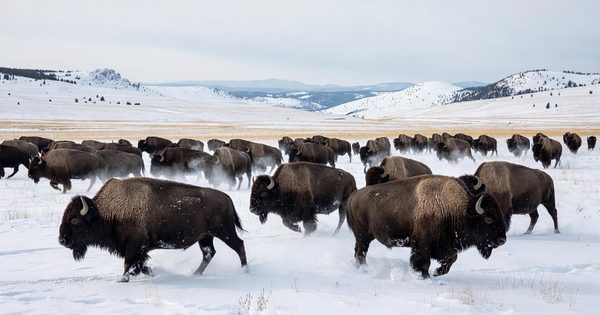
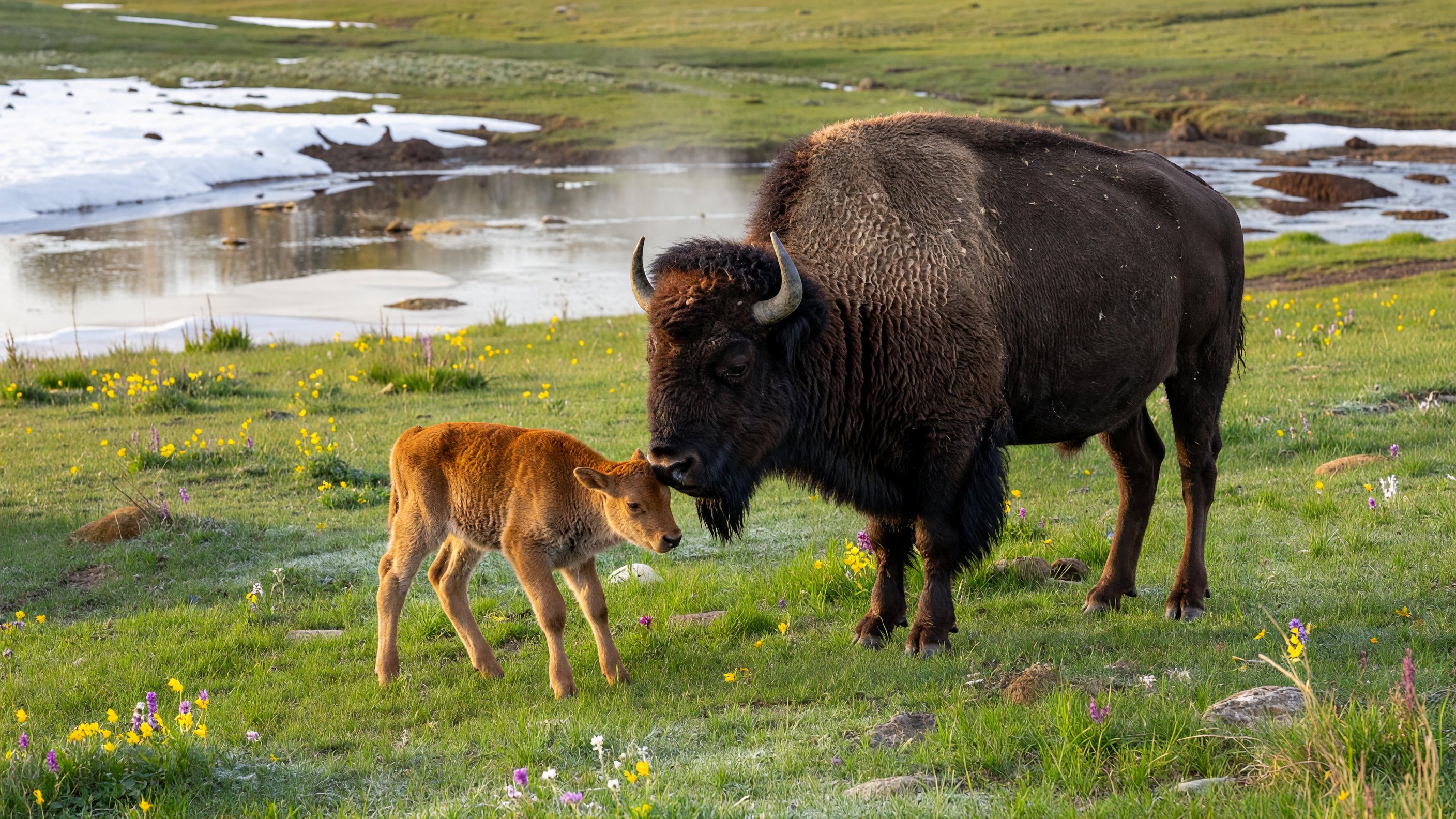
Lamar Valley is described as the Serengeti of North America, and in late April and early May that comparison doesn’t feel like hyperbole. Bison calving peaks across the park from late April through May — newborn calves are rust-red at birth, a color so different from adult bison that first-time visitors sometimes don’t recognize what they’re looking at. Within weeks the calves darken toward the adults’ brown-black, which makes that brief red period both visually distinctive and temporally specific. By June, calves that were born in late April already look like small adults.
Yellowstone’s wolf population — reintroduced in 1995 and now distributed across multiple established packs — is most observable in spring for a straightforward reason: packs are more cohesive in early spring, pup-rearing activity concentrates them at rendezvous sites and den areas, and the lower-elevation forage draws prey animals into open terrain where long-distance visibility is possible. The Lamar Valley corridor from the Northeast Entrance to Tower-Roosevelt Junction is the practical zone for wolf watching; biologist and volunteer “wolf watcher” groups often congregate at roadside turnouts with spotting scopes — their presence is a reliable signal that something is happening.
Grizzly bears emerge from dens in March through May depending on elevation; lower-elevation bears emerge first. In early May, bears are often visible from the road in the Hayden Valley, the Lamar Valley, and on the hillsides around the Mammoth-to-Gardiner corridor as they move through open terrain foraging on winter-killed ungulates, early green grass, and the spawning cutthroat trout that run Yellowstone’s streams in June.
Sandhill cranes return to Yellowstone meadows in late April and early May, arriving in pairs and establishing territories in the wetter meadow sections of the interior valleys.
Best viewing locations: Lamar Valley (Northeast Entrance to Tower Junction), Hayden Valley (Central Plateau, reached from the East Entrance and Canyon areas), Mammoth-to-Cooke City corridor.
Dawn vs. dusk: Dawn is the better window in Lamar Valley — wolf packs are active from first light through mid-morning, and the low-angle light from the east fires across the valley floor beautifully. Hayden Valley bison are active morning and evening; grizzly activity in open terrain peaks in the first two hours of daylight.
Photography gear: A 400-600mm lens is not negotiable for wildlife at Yellowstone roadside distances. Most wolf viewing happens at 300-800 meters from the road; a 600mm prime with a 1.4x converter is what I use most often in Lamar. For bison calving, which can happen within 50 meters of the road, a 200-400mm zoom gives more framing flexibility. A spotting scope (60-80x) is essential if you want to observe behavior rather than just identify animals — it transforms a smudge on a distant hillside into a wolf carrying a pup.
Wildlife distance rules: NPS requires staying at least 100 yards (91 meters) from wolves and bears, and 25 yards (23 meters) from bison and other large wildlife. These are legal requirements, not suggestions. Rangers issue citations and remove visitors who violate them. The 100-yard predator rule has been in place since 2012 and is specific to Yellowstone, where habituation risks are well-documented.
Ranger programs: Yellowstone’s wolf biologist talks run sporadically in early May; check the NPS app for current ranger programs at the Lamar Valley picnic areas.
2. Grand Teton National Park, Wyoming
Peak weeks for spring wildlife: Late April through early June.
Grand Teton in spring is primarily about two things: grizzly bear emergence in the foothills north of the park and moose calving in the willow flats. Grizzlies come down from the Absaroka Range and Yellowstone Plateau as snowpack allows, foraging the sagebrush flats and river bottoms of the Teton valley. The area around Two Ocean Lake and Pacific Creek Road (north of Moran Junction) is consistent grizzly habitat in April and May.
Moose calving peaks in late May in the willow thickets along the Snake River and in the wetlands at Schwabacher Landing. Schwabacher is already well-known as a dawn photography location for its reflection shots of the Teton Range, but in late May it’s also one of the most reliable moose-with-calf viewing locations in the park. Cow moose with calves are among the most dangerous large mammals in the park — they are highly protective and will charge without warning. The standard NPS guidance (25 yards minimum for large herbivores, and more if a cow is with young) is the floor here, not a suggestion.
Beaver activity at Schwabacher Landing also peaks in spring — the beaver dam and pond complex at the lower parking area hosts active colony work from dawn, and beavers moving through their ponds at first light are a surprisingly strong photographic subject if you’re set up before they go diurnal.
Best viewing locations: Schwabacher Landing (moose, beaver, dawn light on Tetons), Two Ocean Lake Road (grizzly), Willow Flats (moose), Oxbow Bend (waterfowl, osprey).
Dawn vs. dusk: Schwabacher Landing is strictly a dawn location — the reflection window requires low-angle light from the east. Moose in the willows are active dawn through mid-morning and again at dusk.
Photography gear: 400-500mm for moose at Schwabacher; 600mm for distant grizzly views on open hillsides. In the beaver ponds at dawn, a 300mm is often sufficient — the animals work close.
3. Olympic National Park, Washington
Peak weeks for spring wildlife: April through early June.
Olympic in spring is defined by the Roosevelt elk — the largest elk subspecies in North America — moving out of their lowland winter ranges as the Hoh River valley greens up. The Hoh Rain Forest trail system provides the most reliable elk viewing in the park; the Hall of Mosses and the lower Hoh River trail both cross active elk travel corridors, and it is genuinely common to encounter elk within 30-50 meters on the trail in the early morning hours of May.
The marbled murrelet — a seabird that nests in old-growth conifers rather than coastal cliffs — is a federally threatened species under the Endangered Species Act, and Olympic’s old-growth forest provides critical nesting habitat. Murrelets are most active near nesting trees at dawn from late April through June; their fast, direct flight through the forest canopy (described as a “bullet” pattern by many birders) is one of the stranger wildlife experiences in any national park. The NPS Hoh Rain Forest staff can sometimes indicate active nesting areas — ask at the visitor center.
Harlequin ducks return to Olympic’s rivers in spring. The Hoh, Sol Duc, and Queets rivers host breeding pairs from April onward. Harlequins in their breeding plumage — males patterned in chestnut, white, and slate-blue — are visually striking birds, and the fast-water habitat they prefer in Olympic’s rivers makes them a photographically engaging subject.
Best viewing locations: Hoh Rain Forest (Roosevelt elk), Olympic coast (harbor seals, shorebirds), Queets and Sol Duc rivers (harlequin ducks), coastal bluffs (pelagic birds).
Dawn vs. dusk: Hoh Rain Forest trails in the first two hours of daylight for elk. Coastal wildlife — seals, birds — is less time-dependent but also more active in low-light conditions with reduced human presence.
Photography gear: 300-400mm for elk at close forest distances; a 500-600mm for coastal birds at tidal rocks. A weather-sealed body is essential in the Hoh — the rain forest receives 12-14 feet of precipitation annually, and April in the Hoh is rarely dry.
4. Everglades National Park, Florida
Peak weeks for spring wildlife: March through early May.
The Everglades operates on an inverted seasonal logic from the mountain parks: spring here is the tail end of the dry season, which runs roughly November through April. As freshwater marshes contract in late dry season, alligators, fish, wading birds, and other wildlife concentrate around the remaining water bodies in densities that make for extraordinary wildlife viewing. The slough systems at Anhinga Trail, the Taylor Slough, and the wetland ponds along the main park road are at their most biologically productive in March and April.
The wading bird colonies at Corkscrew Swamp Sanctuary (a National Audubon Society site adjacent to the park) and within the park’s mangrove and prairie zones nest from December through April. Wood storks, roseate spoonbills, great blue herons, snowy egrets, and tricolored herons nest in dense rookeries at peak dry season, and the activity level — adults returning with food for nestlings, juveniles scrambling in the canopy, nest disputes in real time — is wildlife spectacle at industrial scale.
American alligators nest from April through June. Females are visible building nest mounds along the edges of sloughs and sawgrass marshes. Maintain a minimum of 15 feet from alligators per Florida state guidance — they can move faster than most people expect, and maternal females near nests are particularly reactive.
Best viewing locations: Anhinga Trail (Royal Palm area), Mrazek Pond (wading birds), Pa-hay-okee Overlook (sawgrass prairie with wading birds), Flamingo area (crocodile habitat — American crocodile, not alligator, is the species here).
Dawn vs. dusk: Anhinga Trail at dawn is reliably productive — the low morning light is ideal for anhingas drying their wings on dead snags, and alligators are active at first light before mid-morning heat drives behavioral change. Mrazek Pond is best at mid-morning when light is still workable and birds are still actively feeding.
Photography gear: A 400-500mm is standard for Anhinga Trail; birds at the pond can come within 20 feet in morning hours, making a 100-400mm zoom more practical than a longer prime.
5. Big Bend National Park, Texas
Peak weeks for spring wildlife: March through May.
Big Bend is not usually described as a spring wildlife destination, but it should be. The park’s position in the Chihuahuan Desert — on the U.S.-Mexico border, flanked by the Rio Grande — makes it one of the most important migratory bird corridors in North America. More than 450 bird species have been recorded in Big Bend, a total driven by the park’s position on the Central Flyway and its diversity of habitat: desert scrub, riparian gallery forest along the Rio Grande, and the high Chisos Mountains rising to 7,832 feet.
Spring migration peaks from late March through May. The cottonwood-willow gallery forest at Rio Grande Village is the park’s single most productive birding location during migration; a morning walk in May can produce more species diversity than most birders see in an entire year elsewhere. Painted buntings — arguably the most visually striking bird native to North America, males combining red, blue, and green — pass through in April and May and occasionally remain to nest.
Mountain lions move through Big Bend’s rugged terrain year-round, but spring concentrations of deer and javelina (collared peccary) at lower-elevation water sources increase the probability of observing cougar activity. Javelinas are visible at most times in the Chisos Basin campground area and along the Window Trail — they are habituated to the campground environment and move in groups of 6-15.
Best viewing locations: Rio Grande Village (spring migration birding), Chisos Basin (javelina, hawks), Santa Elena Canyon mouth (riparian migrants), Boquillas Canyon (wading birds, kingfisher).
Dawn vs. dusk: Rio Grande Village at dawn for migration — the first two hours of daylight in the cottonwoods during May migration can be extraordinary. Dawn and dusk are also the productive windows for mammals along the desert washes.
Photography gear: A 400-600mm for bird photography in the cottonwoods; wider angles for javelinas at close range in the Basin. Heat shimmer becomes a problem by mid-morning in April and May at Big Bend — all serious photography is pre-9 a.m.
6. Acadia National Park, Maine
Peak weeks for spring wildlife: Late April through June.
Acadia’s spring wildlife story is primarily about two things: the return of nesting peregrine falcons to Precipice Trail and the offshore marine mammals that appear as Gulf of Maine waters warm.
Peregrine falcons return to nest on the sheer face of Champlain Mountain (the Precipice cliff) from late April. The NPS closes Precipice Trail — the park’s most dramatic ladder-and-iron-rung climb — during nesting season, typically from late April through mid-August, to protect the nest site. The closure is well-posted; rangers sometimes staff the lower trailhead. The nesting pair is visible from the parking area and the lower trail approaches using a spotting scope; adults are sometimes visible hunting over the surrounding forest and ocean.
The view from Precipice trailhead parking area also provides good visibility over the Frenchman Bay shoreline, where harbor seals begin appearing on ledge haul-outs from April. Porpoises — primarily harbor porpoises — are present in Frenchman Bay from May onward. A 90-minute whale watch from Bar Harbor (multiple operators run seasonal tours from early May) often produces harbor seals, porpoises, and in good years, finback or minke whales as they return to the Gulf of Maine following prey fish.
Best viewing locations: Precipice trailhead (peregrine viewing), Frenchman Bay shoreline (seals from Sand Beach and Great Head), offshore (porpoises, occasional whale watch).
Dawn vs. dusk: Peregrines are most visibly active at dawn and dusk. Seal haul-outs are tide-dependent; consult NOAA tide tables for Bar Harbor to plan arrivals at low to mid-tide when ledges are exposed.
Photography gear: Peregrine on a cliff face at 200-300 meters requires at minimum a 500-600mm. Harbor seals from shoreline rocks are more approachable — a 400mm is workable. For offshore marine mammals, you are shooting from a moving boat: a monopod, image stabilization, and a fast shutter speed (at minimum 1/2000) are the priorities.
7. Glacier National Park, Montana
Peak weeks for spring wildlife: Late April through early June.
Glacier’s spring is grizzly season. As snowpack recedes on lower slopes in late April and early May, grizzlies emerge from dens and move to accessible terrain — the open avalanche paths on the east side of the park (the Many Glacier and St. Mary valleys) provide some of the most consistent roadside grizzly viewing in the lower 48 states. Grizzlies foraging spring vegetation on steep avalanche chutes — still patchy with snow at their upper reaches — are visible from the Many Glacier Hotel area and from the Going-to-the-Sun Road east of Logan Pass in May.
Mountain goat kidding season peaks in late May and early June. Mountain goats at Glacier are notably habituated to humans in the visitor areas — the Logan Pass parking lot and the Hidden Lake trail have populations that have learned to seek mineral licks near paved surfaces and trail edges. Do not allow them to approach or lick you; the salt in human sweat is the attractant and the behavior is harmful to the goats. The NPS has specific guidance on goat management at Logan Pass because of the habituation problem.
Bighorn sheep lambs are visible from late May in the Alpine areas above Many Glacier and on the cliffs visible from the Highline Trail.
Best viewing locations: Many Glacier Valley (grizzly, bighorn), St. Mary Valley (grizzly on hillsides), Logan Pass (mountain goat), Swiftcurrent Lake (waterfowl return).
Dawn vs. dusk: Dawn for grizzly on open slopes from the Many Glacier Hotel area — the hotel parking lot is functional as a wildlife observation platform before the day warms. Mountain goats at Logan Pass are accessible throughout the day but most visible when the parking lot is quiet, which means early morning.
Photography gear: 400-600mm for grizzlies on distant avalanche slopes; 200-400mm for mountain goats at Logan Pass where proximity is often the challenge rather than distance.
8. Rocky Mountain National Park, Colorado
Peak weeks for spring wildlife: Late April through late May.
Rocky Mountain’s spring wildlife return centers on two groups: bighorn sheep coming down from high winter ranges to the mountain meadows and wetlands of the east-slope valleys, and moose returning to willow-dominated wetlands around Kawuneeche Valley on the park’s west side.
Bighorn sheep are a year-round presence in Rocky Mountain, but spring concentrations in the Horseshoe Park / Sheep Lakes area (on Trail Ridge Road, about 4 miles from the Fall River Entrance) are predictable enough that the NPS maintains a viewing program there. Ewes and lambs are visible at the mineral lick at Sheep Lakes from late May. The Bighorn Sheep Viewing Area near the lakes is staffed by rangers during peak viewing periods.
Marmots — yellow-bellied marmots — emerge from hibernation in April at Rocky Mountain, and the open boulder fields above the treeline on Trail Ridge Road host active colonies from late April. Marmots are among the most photographically approachable large rodents in the park system; their tendency to pose on prominent rocks for territorial displays produces naturally good compositions.
Best viewing locations: Horseshoe Park / Sheep Lakes (bighorn), Kawuneeche Valley and wetlands (moose), Toll Memorial / Rock Cut area of Trail Ridge Road (marmot), Moraine Park meadows (elk, dawn).
Dawn vs. dusk: Moraine Park meadows at dawn produce the best elk light. Sheep Lakes viewing is most productive mid-morning when mineral lick visits peak. Marmots on Trail Ridge Road are active throughout the day in cool weather.
Photography gear: 300-400mm for bighorn at Sheep Lakes; a 200mm is usable for marmots if you’re patient. Trail Ridge Road above treeline can have significant wind — image stabilization matters more than focal length on windy spring days.
9. Shenandoah National Park, Virginia
Peak weeks for spring wildlife: Mid-May through early June (white-tailed deer fawns), April–May (black bear activity and warbler migration).
Shenandoah is a different spring proposition from the mountain parks — it’s the combination of warbler migration and large mammal activity that makes April and May here worth planning around. The Blue Ridge hardwood forest turns into a wave of neotropical migrants from mid-April through late May as warblers, vireos, and tanagers move through on northward migration. More than 30 warbler species have been recorded in the park during spring migration; birders running Skyline Drive’s overlooks and the Big Meadows area in early May can accumulate 20+ warbler species in a morning.
Black bears are actively foraging throughout the park in spring, visible most often at dawn and dusk on berry-producing shrub edges and in the lower coves. Shenandoah has a dense black bear population — estimated at more than 1 bear per square mile in peak areas. Most bear encounters on Skyline Drive are from vehicles; stay at least 75 feet from black bears per NPS guidance. Do not stop your vehicle in a position that blocks traffic if you encounter a bear on the road.
White-tailed deer fawns begin appearing in mid-May. Doe with fawns are abundant in the Big Meadows area and the open meadow sections along Skyline Drive. Spotted fawns in knee-high grass at morning light are a reliable photography subject for visitors without long telephoto gear — 200mm is often enough at Big Meadows.
Best viewing locations: Big Meadows (deer fawns, warblers at the forest edge, bears at dusk), Skyline Drive overlooks (raptors in thermal migration from mid-April), Hawksbill and Stony Man summit trails (blackpoll and cerulean warblers at treeline).
Dawn vs. dusk: Dawn at Big Meadows for deer fawns in meadow light; mid-morning for warbler activity along the forest edge.
Photography gear: Warbler migration in dense canopy requires patience more than focal length — 400mm is helpful but birds won’t always cooperate. For deer fawns at Big Meadows, a 300mm is workable. For hawks in thermal migration above the ridgeline, a 500-600mm is the practical minimum.
10. Channel Islands National Park, California
Peak weeks for spring wildlife: April through May.
Channel Islands is the most overlooked park in this guide and the one that probably offers the highest wildlife density per acre of any unit in the California NPS system. The five islands — San Miguel, Santa Rosa, Santa Cruz, Anacapa, and Santa Barbara — sit in a productive upwelling zone where cold California Current water meets the warmer Southern California Bight. That upwelling feeds a food chain that, in spring, produces some of the most concentrated marine mammal activity in North America.
Gray whale northward migration runs from mid-February through May as the whales return from their Baja California breeding lagoons toward their summer feeding grounds in the Bering Sea; April typically falls in the heart of the northward passage along the Southern California coast. From Channel Islands Harbor in Ventura, whale watching boats operating through the Channel Islands area regularly encounter gray whale cow-calf pairs in April. Blue whales and humpback whales begin returning to the Santa Barbara Channel in April and May as krill concentrations build.
The Channel Islands fox — a federally listed endangered species endemic to six of the Channel Islands — underwent one of the fastest recoveries in Endangered Species Act history. The species was downlisted from endangered to threatened for the San Miguel, Santa Rosa, Santa Cruz, and Santa Catalina populations in 2016. Island foxes on Santa Cruz Island (accessible by day boat from Ventura) are now remarkably visible; the population on Santa Cruz is the largest of any island and foxes are frequently encountered on the trails near Prisoner’s Harbor and the Scorpion Ranch area.
California sea lions, elephant seals, and harbor seals maintain rookeries on San Miguel and Santa Rosa. The Painted Cave sea cave on the north side of Santa Cruz (accessible by kayak) is an evening roost for thousands of seabirds in spring.
Best viewing locations: Offshore (gray whale, blue whale, humpback — boat required), Santa Cruz Island trails (island fox), Anacapa Island cliff nesting area (western gulls, Brandt’s cormorants — day boat access), sea caves (harbor seals).
Dawn vs. dusk: Offshore whale watching operates on boat schedules rather than biological optima — morning boats typically have calmer seas. Island fox viewing on Santa Cruz peaks in early morning along the trail system before mid-day heat reduces activity.
Photography gear: Marine mammal photography from a moving boat requires image stabilization, fast shutter (minimum 1/2000 for surfacing whales), and ideally a 500-600mm. A gimbal head for shooting from a rocking deck is useful if you’re serious about whale photography. Island fox photography is close-range — 200-300mm is often sufficient on Santa Cruz given the animals’ tolerance of careful observers.
Wildlife Photography Ethics in National Parks
Spring wildlife photography raises ethical responsibilities that summer shooting doesn’t always surface in the same way. A bear with cubs, a wolf near a rendezvous site, a bison cow with a newborn calf — these are situations where photographer behavior can have direct consequences for animal welfare and for the welfare of visitors who follow.
The NPS distance rules:
- Wolves, bears, and mountain lions: 100 yards minimum (Yellowstone-specific rule; NPS general guidance is a similar 100-yard minimum for predators; always check the specific park’s regulations).
- Bison, elk, moose, bighorn sheep, and other large herbivores: 25 yards minimum across the system. In some parks including Yellowstone this is a legal requirement.
- These rules apply regardless of whether the animal approaches you. If an animal is moving toward you, move away — maintaining the minimum distance is your responsibility, not the animal’s.
No approach for frame-filling shots. A 400-600mm lens exists precisely so you don’t need to close distance for a compelling photograph. The “I just needed to get one more step closer” logic that precedes most wildlife incidents starts with the camera and ends with a confrontation. If your lens can’t reach, the photograph isn’t worth the risk.
Do not bait, call, or use recordings to attract wildlife. Playing bird call recordings during nesting season (a common but harmful practice among birders targeting rare species) disrupts territorial and nesting behavior, particularly for sensitive species like the marbled murrelet at Olympic. It is prohibited in National Park Service units.
Do not approach offspring. Baby animals that appear alone are rarely actually alone — the parent is almost always nearby and the approach of a human observer can trigger abandonment or a defensive response. A bison calf that is separated from the herd, a fawn bedded in meadow grass, a black bear cub in a tree — all have adults in the area. Give them the same distance you’d give the adult.
Selfie proximity. The NPS documents wildlife injuries to visitors every year that involve visitors reducing distance to photograph themselves with wildlife. These incidents have prompted park rangers to ask the specific question: “Were you trying to get a selfie?” The answer is often yes. Your personal safety and the welfare of the animal are both at stake in these encounters.
Report behavioral changes. If you observe what appears to be stress behavior in wildlife — a bear moving away rapidly, a bird doing broken-wing displays, a bison lowering its head — move back and give the animal more space, then report the situation to a ranger if staff are nearby. Your observation matters.
The U.S. Fish and Wildlife Service’s wildlife watching guidelines and the NPS general visitor guides both address ethical wildlife observation. The National Parks Conservation Association (npca.org) publishes advocacy updates on wildlife management decisions in specific parks and is worth following for any serious visitor.
Gear Summary for Spring Wildlife Watching
Optics:
- 400-600mm telephoto lens — the baseline for most national park wildlife at legal distances. A 100-400mm f/4.5-5.6 zoom is the practical choice for versatility; a 500mm f/4 or 600mm f/4 prime produces better image quality but requires commitment to a single focal range.
- 1.4x teleconverter — extends reach without the cost and weight of a longer prime, at a cost of one stop of light.
- Spotting scope (60-80x) — essential for wolf watching in Lamar Valley, grizzly viewing on distant avalanche slopes at Glacier and Grand Teton. A 20-60x zoom eyepiece is more practical than a fixed high magnification.
- Binoculars (10x42 or 10x50) — the most-used tool on any wildlife watching trip. Image-stabilized binoculars (Canon, Nikon IS) are worth their premium cost for long observation sessions from a vehicle or at a roadside stop.
Camera body:
- A mirrorless body with a high burst rate (at least 20 fps) and good high-ISO performance matters more in spring than in summer, because dawn light in April at elevation is often below what you’d choose. ISO 3200-6400 with a modern sensor is workable; ISO 800 on an older body often isn’t.
- Fast shutter speeds for action subjects: bison calf bounding, wolves trotting, birds in flight all require 1/1600 to 1/3200.
Clothing:
- Spring weather at high-elevation parks is genuinely variable. Lamar Valley in late April can range from 20°F at dawn to 55°F at midday. Layering matters — merino base, insulated midlayer, hardshell wind/rain layer. Waterproof boots for snowmelt slop on trail approaches.
- Earth-tone colors for wildlife photography reduce the probability that animals will change behavior based on your visual presence — though most park wildlife is habituated to the shape of humans in groups near vehicles.
Other gear:
- Carbon fiber tripod with a Wimberley or similar gimbal head for long telephoto use — handheld 600mm for extended sessions produces images that degrade progressively as fatigue sets in.
- Bean bag for vehicle window mounting — at Lamar Valley, most wildlife photography happens from inside or alongside vehicles. A bean bag on the door frame stabilizes even a 600mm f/4.
Frequently Asked Questions
What is the best month to see wildlife in national parks?
For wildlife variety and activity level, May is the strongest single month across the most parks. Bison calving in Yellowstone peaks in late April and May. Grizzlies are actively visible at Grand Teton, Glacier, and Yellowstone in May. Warbler migration peaks in the eastern parks in early May. The weather is generally cooperative, and the long activity windows — animals stay active past 9 a.m. in May when June heat would have driven them to shade — make the day more productive for observers.
What animals are active in spring in national parks?
Spring activates all large mammal groups. Bears emerge from dens March through May. Ungulates (bison, elk, moose, deer, bighorn sheep) enter calving and lambing season from late April through June. Migratory birds arrive on predictable schedules: shorebirds move through in April, neotropical warblers and tanagers in late April and May, raptors in thermal migration from mid-April. Marine mammals concentrate near nesting and pupping sites at coastal parks from April.
What time of day is best for wildlife viewing in national parks?
Dawn to two hours after sunrise is the most productive window at virtually all parks. In spring, this window is meaningfully longer than summer — animals are often still actively moving until 9-10 a.m. in May, compared to retreating to shade by 7:30-8 a.m. in July. A secondary window occurs in the final two hours before sunset. Midday, from roughly 10 a.m. to 4 p.m. in spring, is the least productive.
How close can you get to wildlife in national parks?
The NPS-recommended minimum distances are: 100 yards (91 meters) from bears, wolves, and mountain lions; 25 yards (23 meters) from bison, elk, moose, deer, and other large wildlife. At Yellowstone, these are legal requirements with citations enforced by rangers. At other parks, they are strong recommendations. A 400-600mm telephoto lens is the correct tool for frame-filling wildlife photography at legal distances; no wildlife photograph is worth violating these rules.
When do bears come out in Yellowstone?
Lower-elevation bears — those that denned in valley and foothill terrain — begin emerging in March. Higher-elevation denning females with cubs typically emerge in April and May when snowpack at den sites permits. By early May, bears are commonly visible in the Hayden Valley, the Lamar Valley corridor, and on the slopes above Mammoth Hot Springs. Peak visibility — in the sense of bears being active in open terrain accessible from roads — is late April through late May before summer heat and vegetation growth reduce open-terrain foraging.
Are there baby animals in national parks in spring?
Yes. Spring is the primary birth season for most large mammals in the national park system. Bison calves (rust-red at birth) are visible in Yellowstone from late April. Moose calves at Grand Teton and Glacier in late May. White-tailed deer fawns at Shenandoah from mid-May. Bighorn sheep lambs at Rocky Mountain and Glacier in late May and early June. Mountain goat kids at Glacier from late May. The specific timing varies by species and by elevation — higher-elevation species typically calve later as snowpack conditions allow.
Is spring a good time to visit national parks for wildlife?
Spring is arguably the best time, with two practical caveats. First, road access at high-elevation parks is limited in early spring — at Rocky Mountain, Trail Ridge Road doesn’t open until late May; at Glacier, Going-to-the-Sun Road may not be fully open until June. Second, spring weather at mountain parks is genuinely unpredictable — a May morning that starts at 60°F at Lamar Valley can produce snow by noon. Plan layering and check road conditions before departure. Within those parameters, the wildlife activity level in April and May exceeds any other season for most major parks.
Spring wildlife timing varies year to year based on snowpack and temperature — an early warm March in Yellowstone can push bear emergence and bison calving a week or two earlier than the averages above. The NPS park conditions pages (accessible through nps.gov) update road conditions and wildlife sighting reports in real time, and the USFWS seasonal migration monitoring reports at fws.gov track migratory bird arrivals for the flyway corridors covered in this guide.
For winter wildlife viewing at the same parks, see our winter national parks guide. For dawn photography at prime Western locations, see the sunrise spots guide.