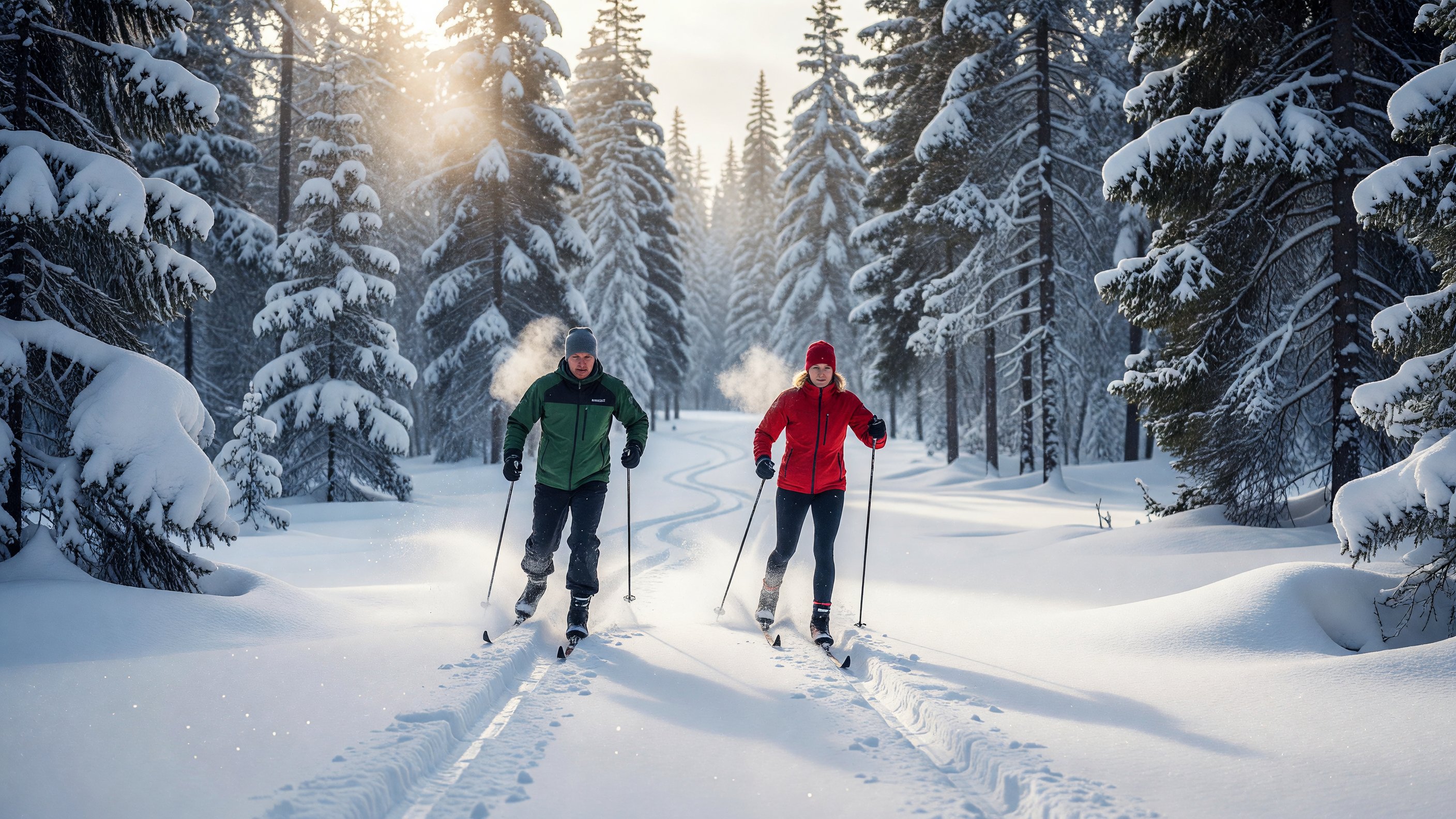
The distinction between a winter national park visit and a winter national park experience often comes down to whether you brought skis or snowshoes. Driving a road and stopping at viewpoints is satisfying. But strapping on a pair of XC skis and pushing into a snow-covered geyser basin — or following a ranger on snowshoes through a silent volcanic caldera rim — is a categorically different interaction with a place.
I’ve spent parts of eight winters in the parks covered in this guide, and I’ve found that the XC ski and snowshoe options in the national park system are far more developed, more accessible, and more varied than most visitors realize. Free ranger-led snowshoe programs run at multiple parks on winter weekends. Groomed Nordic tracks exist at Yosemite, Grand Teton, and Acadia. Backcountry ski routes of genuine consequence wind through Yellowstone’s geyser terrain and Crater Lake’s volcanic rim. And at the accessible end, Cuyahoga Valley in Ohio offers flat, easy trail skiing that works for beginners and families with no mountain access required.
This article is a companion to our general winter parks guide, which covers parks like Death Valley, Joshua Tree, and Grand Canyon — excellent winter destinations where XC skiing and snowshoeing aren’t the primary draw. Here, every park earned its place specifically because of ski and snowshoe terrain. Twelve parks, ranked roughly by the depth and quality of the XC/snowshoe experience.
1. Yellowstone National Park, Wyoming
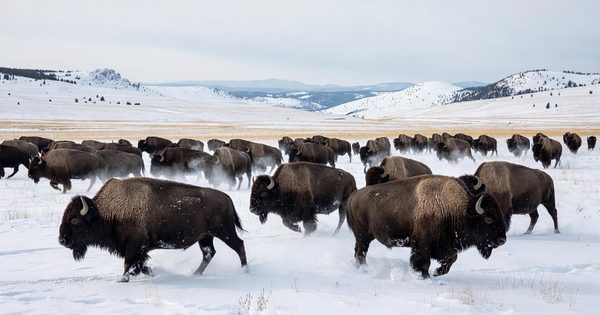
The case for it: Nowhere in the American park system matches Yellowstone for the combination of XC ski terrain, thermal features, and winter wildlife. You are skiing through an active volcanic landscape — geysers erupting around you, bison calf-deep in snow on either side of the trail, steam columns rising from thermal pools in negative-degree air. This is genuinely unlike anything else.
Getting there: From late December through mid-March, interior roads are closed to wheeled vehicles and groomed for oversnow travel. Reaching Old Faithful and the geyser basin terrain requires either a guided snowcoach or a guided snowmobile — there is no driving yourself in a car to the Old Faithful Snow Lodge in winter. Snowcoach tours operate from West Yellowstone and from Flagg Ranch on the south end; the authorized concessioners are Xanterra (operating as Yellowstone National Park Lodges) and Yellowstone Vacation Tours. Book ahead — popular winter weekends fill weeks in advance.
Key XC ski trails:
- Lone Star Geyser Trail — 4.8 miles round-trip from Kepler Cascades, accessible from the Old Faithful area. The trail follows the Firehole River through forest to a backcountry geyser that erupts roughly every three hours. Tracks are not groomed but the route is marked and heavily skied; you’ll likely see other tracks. Difficulty: easy to intermediate.
- Mammoth to Tower-Roosevelt corridor — the road between Mammoth Hot Springs and Tower Junction is plowed for oversnow vehicle access but has skiable shoulders. This is not a designated ski trail; it’s adjacent travel on the maintained road surface. More relevant for the wildlife viewing than for pure ski technique.
- Ranger snowshoe walks at Mammoth and Old Faithful — free ranger-led walks are offered at both locations during the winter season. The Old Faithful program departs from the Snow Lodge; the Mammoth program departs from the visitor center. No prior experience required; snowshoes are provided. Check nps.gov/yell for current season schedule.
Rentals: Ski and snowshoe rentals are available at the Old Faithful Snow Lodge. Bring your own if you prefer a specific fit — rental inventory is limited in peak winter weeks.
Avalanche awareness: Terrain around Old Faithful is relatively flat and below treeline — avalanche risk is low on standard XC routes. Backcountry routes into higher terrain require full avalanche safety awareness and gear. Check the Utah Avalanche Center’s Tetons forecast and the Bridger-Teton National Forest avalanche page before any off-trail travel.
Beginner pick: Lone Star Geyser Trail. Flat-to-gentle grade, marked route, and the payoff is extraordinary.
2. Yosemite National Park, California
The case for it: When it operates, the Nordic center at Badger Pass is the only groomed XC ski network inside a Sierra Nevada national park — 25 miles of groomed track, including the long run out Glacier Point Road to the cliff-edge overlook of Yosemite Valley.
Important caveat for 2025 and beyond: Badger Pass Ski Area and its Nordic Center are snowpack-dependent. In the 2024–2025 season, the ski area did not open at all due to low Sierra snowpack. When the resort is open, Glacier Point Road is groomed for both classic and skate skiing — the Nordic tracks extend the full ~10 miles to Glacier Point itself. When the resort closes due to low snow, the road is neither groomed nor tracked. Check nps.gov/yose/planyourvisit/wintersports.htm and the Badger Pass current-season page before building a trip around Yosemite skiing.
In a good snow year:
- Glacier Point Road Nordic track — ~10 miles one-way from Badger Pass lodge to Glacier Point, with groomed classic and skate lanes. The endpoint — Glacier Point in winter, with Half Dome and Yosemite Valley 3,200 feet below you in snow — is one of the finest viewpoints in the park system. This is a full-day ski; most people ski to Clark Point or Sentinel Dome and return. Total elevation gain to Glacier Point is approximately 1,000 feet. Difficulty: intermediate.
- Badger Pass lower terrain — beginner groomed loops near the ski lodge. These are the correct starting point for first-time classic skiers.
- Ostrander Lake hut ski — 10 miles each way, intermediate-to-advanced backcountry terrain, with a backcountry ski hut at the lake available by lottery reservation through Yosemite Conservancy. Not a groomed route — this is a wilderness ski tour.
Rentals: Classic, skate, and backcountry skis available at the Nordic Center when it operates. Snowshoe rentals also available.
Accessibility: The Badger Pass lodge first floor is wheelchair accessible. Adaptive ski programs, when they have been offered historically, operated through Yosemite Hospitality’s concessioner — verify current availability directly with Badger Pass before planning an adaptive visit, particularly given recent inconsistent operating seasons.
Beginner pick: Badger Pass lower groomed loops (in an open season year).
3. Crater Lake National Park, Oregon
The case for it: An average of 504 inches of snow annually, a volcanic caldera that does not freeze, and a free ranger-led snowshoe program running most winter weekends. Crater Lake is one of the highest-snowfall parks in the Lower 48 and an underrated XC destination.
Ranger-led snowshoe walks: Free walks run Saturdays, Sundays, and holidays from late November through April, plus weekdays during Winter Break (Dec 23–Jan 3) and Spring Break. Walks depart at 1:00 PM, last 2 hours, cover 1–2 miles of moderate terrain, and are off-trail — through forests and meadows along the rim. Snowshoes are provided at no charge. Advance reservations are required; call 541-594-3100. See nps.gov/crla/planyourvisit/ranger-guided-snowshoe-walks.htm for current-season details.
XC ski route — west rim: The west side of Rim Drive, from park headquarters toward Discovery Point, is the primary XC ski route. Approximately 2.5 miles one-way, with continuous lake views. This is not a groomed trail — it’s tracked by prior users on packed snow along the road surface. Intermediate skills required; the rim has exposure along some sections and the return elevation is meaningful. The snow depth here (often 8–12 feet mid-winter) means the lake surface is genuinely below you — the spatial experience of skiing the rim is vertiginous in a wonderful way.
Rentals: No in-park rentals. Bring your own equipment, or rent in Medford or Klamath Falls (both ~1 hour from the park). Diamond Lake Resort, 30 miles north, offers snowshoe and ski access in the surrounding national forest and may have rental equipment.
Avalanche awareness: The rim sections and any travel into the caldera slopes require attention to conditions. Northwest Avalanche Center (nwac.us) publishes Southern Cascades zone forecasts.
Beginner pick: The free ranger snowshoe walk — zero equipment required, professional guide, no route-finding.
4. Grand Teton National Park, Wyoming
The case for it: Groomed XC ski trails, snowshoe access to iconic lake destinations, and proximity to Jackson Hole and Bridger-Teton National Forest backcountry make the Tetons one of the strongest all-around winter ski destinations in the park system.
Groomed trails: Teton Park Road north of the Taggart Lake Trailhead is closed to vehicles in winter and groomed for XC skiing and snowshoeing by the Grand Teton National Park Foundation. The groomed track runs from Taggart Lake Trailhead approximately 9 miles to South Jenny Lake — classic and skate lanes, plus a walking/snowshoe track on the west side. Grooming occurs Tuesday, Friday, and Sunday. This is free to use. The Cathedral Group of the Teton Range frames the entire route from the west; this is one of the most photogenic XC ski routes in the country.
Snowshoe trails:
- Taggart Lake — 4 miles round-trip from the trailhead, gentle terrain, excellent views of the Teton peaks from the lake.
- Phelps Lake via Granite Canyon Trailhead — longer approach, more solitude, moderate terrain.
- Moose-Wilson Road corridor — moose habitat, flat and wide, popular for snowshoe beginners.
Backcountry and Bridger-Teton NF: Granite Hot Springs, accessible via a 10-mile round-trip ski or snowshoe from the Hoback Canyon area, puts you in a 112°F natural hot spring after a backcountry tour through Bridger-Teton National Forest (outside park boundaries — different permit and access rules apply). This is one of the better ski-in hot springs options in Wyoming. Check current conditions and access at the Jackson Ranger District office.
Rentals: No in-park ski rentals. Jackson has multiple outfitters — Skinny Skis, Teton Mountaineering — for classic, skate, and backcountry gear.
Avalanche awareness: The groomed road corridor is safe. Any travel into Teton backcountry — Rendezvous Bowl, Avalanche Canyon, the east faces — requires full avalanche training, beacon, probe, and shovel. The Bridger-Teton Avalanche Center (jhavalanche.org) covers this terrain.
Beginner pick: The Taggart Lake snowshoe — moderate distance, easy terrain, spectacular views, free.
5. Acadia National Park, Maine
The case for it: Forty-five miles of historic carriage roads — built to John D. Rockefeller Jr.’s specifications with broken-stone surfaces and zero motorized traffic — make Acadia the best trail network for XC skiing and snowshoeing in the eastern national park system.
The carriage road network: Groomed by Friends of Acadia volunteers when snowpack permits, the carriage roads cross Acadia’s interior in a network of interconnected loops. The Witch Hole Loop (4.3 miles, or 5.5 via Eagle Lake Connector) from Hulls Cove is a popular ski route. The Eagle Lake circuit, the Jordan Pond area, and the Bubble Pond corridor are all XC-skiable on packed snow. The roads are wide (12–16 feet in most sections), stone-surfaced underneath the snow, and relatively flat compared to the surrounding ridge terrain — appropriate for intermediate skiers and most snowshoers.
Park Loop Road: Closed to vehicles in winter (approximately mid-November through mid-April) but accessible on foot, ski, and snowshoe. The Thunder Hole and Otter Cliffs section of the Loop Road in winter — frozen spray on the rocks, ice formations on the cliff faces, Atlantic surf without a crowd — is one of the more extraordinary winter coastal walks in New England.
Cadillac Mountain: The summit road is not maintained for winter vehicles, but the mountain is reachable on foot and snowshoe year-round. On a clear winter morning, Cadillac remains the first point in the continental US to receive sunrise.
Rentals: Cadillac Mountain Sports in Bar Harbor and Ellsworth rents XC skis, snowshoes, and winter hiking gear. Some outfitters in Bar Harbor provide guided snowshoe tours.
Beginner pick: Witch Hole Pond carriage road loop — flat, well-marked, and close to the Bar Harbor visitor facilities.
6. Rocky Mountain National Park, Colorado
The case for it: The Bear Lake corridor — the most-visited area in the park in summer — transforms into one of the best accessible snowshoe networks in the Rockies when snow accumulates. Flat lake loops, intermediate valley terrain, and dramatic views of Longs Peak and the Front Range from above treeline.
Bear Lake corridor:
- Bear Lake loop — 0.8 miles, flat, paved in summer (signed for snowshoe in winter). Appropriate for all ability levels including families with young children.
- Nymph Lake — 1.1 miles round-trip from Bear Lake, moderate grade, popular with beginners.
- Dream Lake — 2.2 miles round-trip, moderate elevation gain, backcountry feel despite proximity to the trailhead.
- Emerald Lake — 3.6 miles round-trip from Bear Lake, the full corridor end-to-end. The most rewarding view in the sequence.
XC skiing in the park: When snow depth and conditions allow, Wild Basin Road (closed to vehicles in winter) and Old Fall River Road become XC ski routes. These are backcountry-adjacent routes without grooming — tracked by previous skiers, variable quality. The Kawuneeche Valley on the west side of the park offers flatter terrain; Timber Creek Campground access road is occasionally skiable.
Parking: The Bear Lake Road corridor is notorious for filling early. Bear Lake Trailhead parking fills by 7:30 AM on winter weekends. Arrive before 8 AM or use the park’s shuttle from Estes Park.
Rentals: No in-park rentals. Estes Park has several outfitters — Colorado Wilderness Rides and Guides, Estes Park Mountain Shop — for snowshoe and ski rentals.
Avalanche awareness: The park’s backcountry above treeline carries meaningful avalanche risk. Colorado Avalanche Information Center (avalanche.state.co.us) publishes daily forecasts; the Front Range and North zones cover RMNP terrain. For Bear Lake loop and the developed trails below treeline, risk is minimal.
Beginner pick: Bear Lake loop. Under a mile, flat, free, and the Longs Peak view is there on clear days.
7. Bryce Canyon National Park, Utah
The case for it: The hoodoos at 8,000–9,100 feet under a foot of fresh snow, against a December blue sky, are one of the park system’s most distinctive winter compositions. Ranger-led snowshoe walks run from the visitor center when snow is present.
Ranger snowshoe walks: Free walks offered when snowpack permits, typically January through March. Sign up at the visitor center between 8 AM and noon, day-of, first-come basis. The park provides snowshoes and poles at no charge. Walks run approximately 1:00 PM, 60–90 minutes. Participants must have waterproof footwear. Children 8 and older welcome. Full moon snowshoe hikes operate November through March when snow depth exceeds 12–18 inches. See nps.gov/brca/planyourvisit/winter.htm.
XC skiing: The rim trail along the Fairyland section opens as a cross-country ski route when snow depth permits. The terrain is rolling, following the canyon rim with intermittent views into the amphitheater. No grooming — packed snow from prior use. Intermediate skills appropriate.
Rentals: Ruby’s Inn, just outside the park boundary, is the primary winter outfitter for the Bryce area. Snowshoe and ski rentals available; the Ruby’s complex also has lodging, food, and horse-drawn sleigh rides.
Elevation note: The rim at 8,000–9,100 feet produces genuine cold — highs in the teens to low 30s in January, nights in the single digits. The same thin air that makes the light extraordinary also means altitude adjustment is relevant if you’re coming from sea level. Give yourself a day before attempting extended ski or snowshoe outings.
Beginner pick: Ranger snowshoe walk — no rental needed, guided, and the hoodoo terrain under ranger interpretation is worth it regardless of skill level.
8. Glacier National Park, Montana
The case for it: The Lake McDonald area and Going-to-the-Sun Road at lower elevations provide accessible XC terrain when snow conditions cooperate, with the dramatic front ranges of the Rockies visible on clear days.
Key terrain:
- Apgar area and Lake McDonald Valley — the flatter terrain around the foot of the lake is the primary XC ski and snowshoe zone in winter. Unplowed roads in this area — particularly the Camas Road and Fish Creek area — are used for skiing when snow depth allows. Gentle terrain, forested, protected from the wind.
- Going-to-the-Sun Road lower elevations — the Going-to-the-Sun Road is plowed only as far as the winter closure point (typically the Lake McDonald area). The unplowed sections above closure are skiable in sufficient snow, with the caveat that the road gains elevation rapidly and avalanche terrain becomes relevant within a mile or two of the plowed terminus.
- Bowman Lake Road — north fork area, more remote, long flat ski through lodgepole forest to the lake.
Avalanche awareness (mandatory): Beyond the Lake McDonald valley floor and the Apgar campground area, virtually all Glacier backcountry terrain is avalanche terrain. Going-to-the-Sun Road above the lower closure point, any bowl terrain on the park’s west and east sides, and approaches to any of the named peaks carry significant avalanche risk in winter. The Flathead Avalanche Center covers the park; check forecasts before any travel above the valley floor. Do not ski into the Going-to-the-Sun Road upper terrain without an avalanche beacon, probe, shovel, and the skills to use them.
Ranger programs: Glacier does not currently operate a structured ranger-led snowshoe walk program comparable to Crater Lake or Bryce. Check nps.gov/glac for current winter program availability.
Rentals: No in-park rentals in winter. Whitefish, the nearest ski resort town (~30 miles from the west entrance), has outfitters for ski and snowshoe equipment.
Beginner pick: Apgar/Lake McDonald valley flat terrain — gentle grade, forested, minimal avalanche exposure.
9. Olympic National Park, Washington
The case for it: Hurricane Ridge provides the highest snowshoe and XC ski access in the Olympic Peninsula, with views south toward the Olympic Range and north toward the Strait of Juan de Fuca. The ski area operates on winter weekends; snowshoe terrain is available on the ridge above the lodge site.
Hurricane Ridge status — updated: The Hurricane Ridge Day Lodge burned on May 7, 2023, and was declared a total loss. As of 2025, the rebuild is at an impasse — Congressional funding has been allocated but the NPS project review process has stalled, and no rebuild timeline has been confirmed. The Hurricane Ridge Ski and Snowplay Area has operated in a limited capacity since 2024, with portable restrooms and a ranger station replacing the lodge. The ski area has been open on a weekend-only basis when snowpack permits.
For winter 2025–2026: Check nps.gov/olym/hurricane-ridge-post-fire.htm and hurricaneridgeski.com directly before planning a trip. Operational status changes based on funding, snowpack, and utility construction. The ridge road is typically plowed on winter weekends and some holidays but is not guaranteed open on weekdays.
XC skiing and snowshoe terrain at the ridge: When the ridge is accessible, the snowshoe and ski terrain radiates from the parking area across open meadows with views of the Elwha River valley and the Olympic peaks to the south. The NPS publishes cross-country skiing and snowshoeing routes for the ridge area — these do not require lodge facilities and remain valid regardless of Day Lodge status.
The Hoh Rain Forest alternative: For snowshoers who don’t want to deal with ridge road uncertainty, the Hoh Rain Forest is open year-round and accessible via US-101. The old-growth Sitka spruce and bigleaf maple in winter — no leaves, visible moss systems, grey Pacific light — are excellent snowshoe terrain when the valley floor receives accumulation.
Rentals: Snowshoe rental availability at the ridge is uncertain post-fire; check with the park directly. Hurricane Ridge Ski and Snowplay Area may offer limited rental equipment when operating.
Beginner pick: Hoh Rain Forest valley floor snowshoe when snow is present — flat, spectacular old-growth, no altitude.
10. Voyageurs National Park, Minnesota
The case for it: Voyageurs is a water park that becomes an ice park. In winter, the interconnected lakes freeze hard enough to support vehicles (ice roads are maintained across the main lakes), and the Kabetogama-Ashawa (Kab-Ash) Trail — a 27.9-mile trail system — opens as a marked XC ski route connecting the Kabetogama and Ash River areas through backcountry forest and wetland terrain.
Kab-Ash Trail: At approximately 28 miles total length, this is the most substantial marked XC trail system in the national park system east of the Rockies. The trail is strenuous in its full extent and takes 1–5 days to complete with overnight camping. Day sections are accessible from multiple trailheads. The terrain is hilly boreal forest — not flat, not technical by alpine standards, but legitimately challenging in winter conditions. Trail is marked but not groomed. See nps.gov/voya/planyourvisit/winter-activities.htm.
Ice travel: Voyageurs also maintains groomed snowmobile corridors across the frozen lakes, and some of this infrastructure is available for XC skiing when conditions are right. The park’s visitor centers — Rainy Lake VC near International Falls, Kabetogama Lake VC near Ray — are the starting points for ice access information. Check with rangers about current ice thickness before venturing onto lake surfaces.
Rentals: No in-park equipment rentals. International Falls (near the Rainy Lake entrance) has limited outfitter presence; bring your own gear.
Beginner pick: Day sections of the Kab-Ash Trail near the Kabetogama trailhead — shorter loops accessible from the parking area.
11. Cuyahoga Valley National Park, Ohio
The case for it: Cuyahoga Valley is the most accessible XC ski and snowshoe destination in the national park system. Free entry, within 30 miles of Cleveland and Akron, flat Towpath Trail terrain appropriate for absolute beginners, and in-park snowshoe rentals when conditions permit.
Ohio & Erie Canal Towpath Trail: The Towpath is the primary XC ski and snowshoe corridor — flat, wide, paved-under-snow, running 20+ miles through the park from north to south. Classic skiing technique on the Towpath is appropriate for first-timers. When 4+ inches of packed snow are on the ground, the park rents snowshoes and cross-country skis at Boston Mill Visitor Center (call 440-717-3890 to verify snow conditions and rental availability before making the drive).
Other trails: Ledges and Brandywine Falls trail systems are closed to snowshoeing (uneven terrain and waterfall hazard); most other park trails permit snowshoe use. The Bike & Hike Trail is an additional XC ski route option.
Limitations: Ohio winters are variable — a significant snowfall can be followed immediately by a warm spell and rain. This is not a destination you can plan months ahead for skiing conditions. Check conditions 24–48 hours before your visit. The flip side: when conditions are right after a good Ohio snowfall, Cuyahoga Valley is as good as local XC skiing gets without leaving the state.
No avalanche concerns whatsoever. Maximum elevation in the park is under 1,300 feet.
Beginner pick: Towpath Trail from the Boston Store Visitor Center — flat, free, in-park rentals available on snow days.
12. Grand Teton’s Extended Season: Bridger-Teton National Forest
The Teton area winter scene extends well beyond the park boundary into Bridger-Teton National Forest, particularly relevant for backcountry skiers and snowshoers looking for touring options beyond groomed corridors. The Rendezvous Ski Trails network near Wilson, WY — maintained by the Teton Valley Ski Education Foundation — is a free, volunteer-groomed network of 25+ miles of tracked trails that serves as a complement to the park’s groomed road terrain. This system is outside park boundaries (no park fee) and is often the better choice for intermediate XC skiers who want actual grooming rather than tracked powder.
For the full Teton ski picture, including Jackson Hole Mountain Resort lift-served terrain and backcountry Teton Pass routes, the JH Nordic Alliance publishes current grooming and conditions reports across the entire Jackson Hole area.
Gear: XC Ski vs. Snowshoe vs. AT Ski
These three disciplines are frequently confused. Here’s how they differ and when each makes sense in a national park context.
Cross-country (Nordic) skiing uses lightweight skis with a free-heel binding system — the heel lifts off the ski with each stride, allowing a gliding forward motion. There are two primary styles: classic (kick-and-glide, requires groomed classic tracks or packed snow) and skate skiing (pushing off the edge of the ski in a V-shaped motion, requires groomed skate lanes). For national park use, classic XC skiing is the more versatile choice — it works on groomed tracks and on packed backcountry terrain.
Snowshoes distribute your weight across a larger surface area, allowing you to walk on top of packed or unpowered snow without postholing. Modern aluminum-frame snowshoes are lightweight, strap over any boot, and require no technique. Virtually anyone who can hike can snowshoe. The tradeoff: you walk, not glide. Coverage is slower, but terrain flexibility is higher — snowshoes work on off-trail slopes, steep terrain, and uneven surfaces where skis would be impractical.
Alpine touring (AT) / backcountry ski combines downhill capability (metal edges, stiffer boots) with a touring mode (free heel for uphill travel). AT gear is appropriate for terrain with significant elevation change where you want to ski downhill as well as travel uphill. This is the choice for Crater Lake’s rim, Glacier’s Going-to-the-Sun backcountry, and any Teton backcountry with descent terrain. AT setups are heavier and more expensive than classic XC gear.
For first-timers in a national park context: start with snowshoes. The rental cost is lower, the learning curve is minimal, and you can access virtually all terrain that the ranger-led programs cover. Graduate to XC skis once you understand the conditions and distances involved.
Layering for XC Ski and Snowshoe Conditions
XC skiing generates significant body heat — you’ll be warm within five minutes of starting and cold the moment you stop. The classic mistake is overdressing for the start temperature and ending up soaked in sweat by mile two.
Base layer: Merino wool or synthetic moisture-wicking fabric. No cotton, ever — wet cotton loses all insulating value. A midweight long-sleeve merino is appropriate for most XC conditions; if you’re skiing aggressively, start lighter.
Mid layer: Thin fleece or light insulated jacket that packs into your pack easily. You’ll put this on every time you stop and take it off five minutes after you start moving again.
Shell: Wind-resistant, breathable (ideally waterproof). Softshell works well for XC skiing — more breathable than hardshell, adequate water resistance for typical conditions. Full hardshell for heavy snowfall days or exposed terrain.
Hands: A light liner glove for active skiing, an insulated glove or mitten for breaks and descents. Pole grip heat transfer to bare poles in sub-zero temperatures is real — insulated grips help.
Feet: Waterproof, insulated boots for snowshoeing (standard hiking boots often work). XC ski boots are specific to your binding system — rent boots with skis if you’re trying it for the first time.
Emergency gear in your pack: Always carry a 500mL water bottle (even in winter — dehydration happens faster in cold dry air than most people expect), a high-calorie snack, a headlamp (winter days are short), an emergency bivy or space blanket, and a map of the route. Cell coverage is limited to nonexistent in most park backcountry. A personal locator beacon (PLB) or Garmin inReach is advisable for any multi-hour solo outing.
Hand warmers: Chemical hand warmers (HeatMax, Grabber) are worth keeping in your pack even if you think you won’t need them. They weigh nothing, take zero space, and on a four-hour ski in January conditions they make the difference between a comfortable experience and a shortened one.
Safety: The Five Things That Send People Home Early
1. Starting too warm and sweating through your base layer. See the layering section above. Start cold; you’ll warm up.
2. Underestimating distance in snow conditions. A trail described as “3 miles round-trip” covers that distance in summer. In knee-deep snow without packed tracks, the same route can take 3x as long and use 3x the energy. Match your planned distance to snow conditions, not trail signs.
3. Not accounting for the return trip. Skiing or snowshoeing to a destination uses roughly the same energy as returning. Arrive at your halfway point with enough energy and daylight to get back. Winter days are short — 4 to 5 hours of usable daylight in December at many parks.
4. Avalanche terrain without gear or training. If you’re going above treeline or into any bowl terrain at parks like Glacier, Grand Teton, Crater Lake, or Olympic, you need a beacon, probe, and shovel — and the knowledge to use them. The American Avalanche Association publishes course listings for avalanche Level 1 certification, which covers the fundamentals.
5. Forgetting that temperature drops with elevation. It can be 35°F at the visitor center parking lot and 15°F at the trailhead 1,000 feet above. Check the ridge-level forecast, not the gateway town forecast, before you dress for the day.
Frequently Asked Questions
Which national parks have free ranger snowshoe programs?
Several parks run free ranger-led snowshoe walks in winter. Confirmed current programs: Crater Lake (Saturdays, Sundays, and holidays Dec–April, plus Winter and Spring Break weekdays; reservations required at 541-594-3100), Bryce Canyon (when snowpack permits, roughly January–March; sign up at the visitor center day-of), Yellowstone (Old Faithful and Mammoth areas; check nps.gov/yell for schedule). Some parks, including Rocky Mountain, also periodically offer ranger-led winter walks — check individual park websites each season as programs change with staffing and funding.
Do you need to book snowcoach tours to reach Old Faithful in winter?
Yes. Interior Yellowstone roads are closed to wheeled vehicles from approximately late November through mid-March. Old Faithful is accessible in winter only by snowcoach (guided van-style oversnow vehicle) or guided snowmobile — there is no option to drive your own car to the Old Faithful Snow Lodge. Tours must be booked in advance through Xanterra or Yellowstone Vacation Tours; do not show up at the West Entrance in December expecting to drive in.
Is Badger Pass Nordic Center open every winter?
No. Badger Pass is snowpack-dependent, and in low-snow years like 2024–2025 it does not open. When it does operate, the Nordic Center offers 25 miles of groomed track including the full Glacier Point Road run. Check nps.gov/yose and the Badger Pass current-season page in October–November to determine if the season will operate before planning travel around it.
What is the difference between the Kab-Ash Trail and regular XC ski trails?
The Kab-Ash Trail in Voyageurs NP is a 28-mile backcountry trail system for hiking in summer and XC skiing or snowshoeing in winter. It is not groomed — it’s a marked route through boreal forest with variable snow conditions. It requires multi-day planning in its full extent. Most groomed XC ski trails in the national park system (Yosemite’s Glacier Point Road, Grand Teton’s Teton Park Road, Acadia’s carriage roads) are shorter, maintained, and day-trippable. The Kab-Ash is a more serious undertaking.
Do national parks allow dogs on XC ski and snowshoe trails?
Rules vary by park. Grand Teton’s groomed Teton Park Road corridor allows dogs on leash on the snowshoe/walking track on the west side of the road. Acadia’s carriage roads allow leashed dogs on most trails year-round. Yellowstone prohibits dogs on all trails except paved roads and parking areas. Rocky Mountain prohibits dogs on all unpaved trails. Check individual park pet policies at nps.gov before bringing dogs.
How early should I arrive at Bear Lake in Rocky Mountain NP in winter?
Before 8:00 AM on winter weekends. The Bear Lake parking area fills by 7:30 AM on popular Saturdays and Sundays — this is not an exaggeration. Arrive after 9 AM and you’ll be parking along the road a mile or more from the trailhead. The park does not currently operate a winter shuttle to Bear Lake in the off-season the way it does in summer.
The National Park Conservation Association tracks access and funding issues affecting winter recreation programs — including the Hurricane Ridge rebuild at Olympic and staffing impacts on ranger programs — at npca.org. For gear selection questions, the American Alpine Club’s resources page covers layering systems, avalanche safety education, and backcountry travel skills.
For parks where winter means a different experience — canyon views in snow, desert solitude, minimal crowds — without the skiing focus, see our full winter national parks guide. The two articles cover different territory: this one is built around ski and snowshoe terrain specifically; that one covers the broader winter park experience including parks like Death Valley, Joshua Tree, and the Great Smoky Mountains where snow-travel gear isn’t the point.