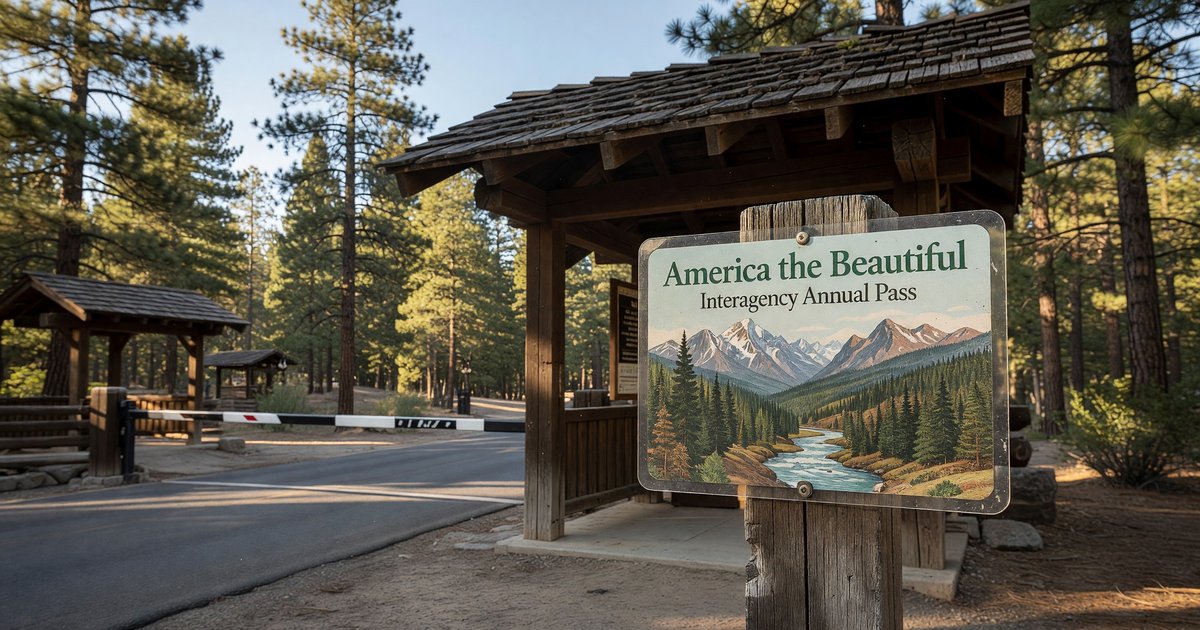
If you are planning your first national park trip — or your fifth — the America the Beautiful Interagency Annual Pass is the first logistical question worth settling. At $80 for twelve months of unlimited entry to over 2,000 federal recreation sites across all 50 states, it is the single best-value purchase most park visitors will make. Whether it is right for you depends on which parks you are visiting, how many trips you have planned, and whether you qualify for one of the several free or reduced-price versions. This guide covers all of it.
What the Pass Actually Is
The America the Beautiful pass is officially called the America the Beautiful — National Parks and Federal Recreational Lands Pass. It is an interagency pass, meaning it is honored not just at National Park Service sites but across six federal land-management agencies:
- National Park Service (NPS) — national parks, monuments, recreation areas, historic sites, seashores, and more
- US Forest Service (USFS) — national forests and grasslands
- Bureau of Land Management (BLM) — public lands including popular recreation destinations in Utah, Nevada, and the West
- US Fish & Wildlife Service (USFWS) — national wildlife refuges
- Bureau of Reclamation (BoR) — reservoirs and recreation areas including Lake Mead and Glen Canyon
- US Army Corps of Engineers (USACE) — lakes, reservoirs, and waterways with recreation fee areas
The standard $80 annual pass covers the pass holder plus up to three additional adults (16 and older) at per-person fee sites, and covers the entire private vehicle plus occupants at per-vehicle fee sites. Children 15 and under are always admitted free at all federal fee sites — they do not need the pass.
The pass is valid for 12 months from the first date of use, not from the date of purchase. That distinction matters: if you buy the pass in October but do not use it until January, your 12-month clock starts in January. The pass is signed by the pass holder on the back and is non-transferable — the signature requirement is the only enforcement mechanism, and staff at most parks will check it at entry.
The Eight Pass Variants
1. Annual Pass — $80
The standard America the Beautiful Annual Pass is available to anyone regardless of age, citizenship, or residency status. You do not need to prove eligibility — you can walk up to an entrance station or order online, pay $80, and start using it the same day.
Valid for 12 months from the date of first use at a fee site. The pass admits the pass holder and up to three additional adults at per-person fee sites; at per-vehicle fee sites it admits all vehicle occupants. Children 15 and under are always free.
This is the right pass for most visitors planning two or more trips to national parks or federal lands in a year. A single visit to a major park like Yellowstone ($35/vehicle), Grand Canyon ($35), or Yosemite ($35) recovers nearly half the cost.
Best for: Any visitor planning multiple park visits in a 12-month window.
2. Non-Resident Annual Pass — $250
Introduced in 2024, the Non-Resident Annual Pass is for visitors who are not US citizens or permanent residents. It costs $250 and provides the same coverage as the standard Annual Pass. US citizens and lawful permanent residents should purchase the standard $80 Annual Pass, not this one.
Best for: International visitors making multiple park stops during an extended US trip.
3. Senior Annual Pass — $20
US citizens and permanent residents age 62 and older qualify for the Senior Annual Pass at $20. It provides the same coverage and vehicle/per-person benefits as the $80 Annual Pass but is valid for 12 months rather than lifetime.
To qualify you must show proof of age (driver’s license, passport, or government ID) and US citizenship or permanent residency. The pass can be purchased in person at any federal fee area or by mail through the USGS Store. Mail orders require submitting a copy of your proof of age and citizenship along with payment; allow up to three weeks for processing. The processing fee for mail orders is typically a few dollars — check the current USGS Store listing for the exact amount, as it can change.
For seniors who visit parks regularly but are not yet certain they will use a lifetime pass, the $20 annual pass is a low-risk entry point. If you subsequently decide to upgrade, you can exchange an existing Senior Annual Pass for a Senior Lifetime Pass at any federal fee site, in person, without paying again (the upgrade converts your remaining coverage to lifetime).
Best for: Seniors who are new to park visiting or want to test whether lifetime access is worth it before committing. For guidance on which parks make the best use of the Senior Pass — ranked by shuttle access, lodge quality, and manageable itineraries — see Best National Parks for Senior Travelers.
4. Senior Lifetime Pass — $80
The Senior Lifetime Pass is available to US citizens and permanent residents age 62 and older for a one-time fee of $80. It provides the same coverage as the Annual Pass but never expires — one purchase covers unlimited federal land entry for the rest of your life.
The math is straightforward: if you visit a park whose standard per-vehicle fee is $35, two visits recoups most of the cost. Anyone who plans to make even a handful of park visits over the coming years almost certainly comes out ahead with the lifetime pass over repeated annual passes at $20 each. Four annual passes cost $80 — the same as a single lifetime pass — so the lifetime version breaks even by year five if you renew annually.
Proof of age and citizenship or permanent residency is required for purchase. The pass can be purchased in person at any federal fee area or by mail through the USGS Store (same process as the Senior Annual).
Best for: Any eligible senior who visits federal lands more than a few times per year, or who anticipates regular park travel going forward.
5. Access Pass — Free
The Access Pass is available at no charge to US citizens and permanent residents who have a permanent disability. The pass provides the same coverage as the Annual Pass plus an additional benefit: a 50% discount on some amenity fees (camping fees, boat launch fees, swimming fees, and some interpretive services). The 50% amenity discount does not apply at all sites, and fee structures vary — ask at the fee booth or visitor center whether the discount applies to the specific fee you are paying.
To qualify, you must present documentation of permanent disability at the time of purchase. Acceptable documentation varies but generally includes a letter from a licensed physician, documentation from a federal agency (such as a Social Security disability determination), or a state-issued disability license plate or placard. The specific documentation requirements are listed on the USGS Store website and at most federal fee areas.
The Access Pass can be purchased in person at any federal fee site. Mail purchase is also available through the USGS Store; the processing fee for mail orders covers shipping and handling.
Best for: Any eligible US citizen or permanent resident with a permanent disability who visits federal recreation lands. For a full breakdown of which parks offer the best accessible trails, ADA lodging, and accessible shuttle systems, see Best Accessible National Parks: ADA Trails, Lodging, and Ranger Programs.
6. Military Annual Pass — Free
Current members of the US military and their dependents receive the annual pass free of charge. The Military Annual Pass is valid for 12 months and provides the same access as the $80 Annual Pass.
Eligibility extends to active duty, National Guard, and Reserve members across all branches, as well as their dependents. A valid Common Access Card (CAC) or Uniformed Services ID card is required for purchase. The pass is available at federal fee sites; it is not available for purchase online or by mail.
Best for: Active duty service members and their families making park trips.
7. Military Lifetime Pass — Free
Gold Star Family members and veterans who have a service-connected disability rating of 100% permanent and total receive a free lifetime pass. The pass never expires and provides the same coverage as the standard Annual Pass.
Gold Star Family members must present documentation confirming Gold Star Family status. Veterans with 100% permanent and total (P&T) disability ratings must present documentation from the Department of Veterans Affairs confirming the rating. As with the Military Annual Pass, this pass is issued in person at federal fee sites.
Best for: Gold Star Families and 100% P&T disabled veterans planning regular federal lands visits.
8. Every Kid Outdoors — 4th Grade Pass (Free)
The Every Kid Outdoors program provides free federal lands access to all US 4th graders for the 4th-grade school year (September through August). The pass covers the 4th grader and all accompanying adults in the same vehicle at per-vehicle fee sites, or the 4th grader plus up to three adults at per-person fee sites.
The pass is obtained through the Every Kid Outdoors website — 4th graders (or their parents) complete a short activity about public lands and receive a printable paper pass or a digital pass voucher. The pass is then activated into a physical Interagency Pass at any federal fee site by presenting the voucher to staff.
Not all sites accept the paper voucher directly; in most cases you present it at the fee booth and receive or have your pass validated on the spot. Some sites may require the physical pass rather than the printed voucher for entry — if you are traveling somewhere remote or planning an early-morning entry, activate the pass in person at a visitor center or entrance station beforehand.
The program is active for the 2025–2026 school year. Participation has been consistent since the program launched in 2016; check everykidoutdoors.gov for the current year’s enrollment window and any updates to the redemption process.
Best for: Any family with a child currently in 4th grade.
9. Volunteer Pass — Free
Federal land management agency volunteers who complete 250 service hours with any participating federal agency — NPS, USFS, BLM, USFWS, BoR, or USACE — receive a free annual pass. The hours must be documented and certified by the agency where you volunteered.
If you are already volunteering at a national park or national forest, ask your volunteer coordinator whether your hours qualify and how to obtain the pass. Hours do not need to be accumulated at a single site or in a single year in all cases — check with the specific agency for how they count cumulative service time.
Best for: Existing federal lands volunteers who have reached or are approaching the 250-hour threshold.
What the Pass Covers — and What It Doesn’t
This is the most important section for avoiding frustration at the entrance booth.
What the Pass Covers
- Entrance fees at NPS, USFS, BLM, USFWS, BoR, and USACE fee sites
- Standard day-use amenity fees at covered sites (boat launches, swimming areas, some day-use areas)
- At per-person fee sites: the pass holder plus three additional adults; children 15 and under always free
- At per-vehicle fee sites: all occupants of the private non-commercial vehicle
What the Pass Does NOT Cover
Understanding these exclusions prevents real surprises at check-in:
Camping fees. The pass does not waive campsite reservation fees. You still pay the standard campground fee per night. The Senior Pass (annual and lifetime) and Access Pass provide a 50% discount on camping at some federal campgrounds — but even that discount is not universal and does not apply at all sites.
Timed-entry reservation fees. An increasing number of high-demand parks — Glacier, Rocky Mountain, Zion, Arches, and others — require advance timed-entry reservations during peak season, booked through Recreation.gov. The reservation carries a small fee (typically $2 per vehicle). The pass does not waive or reduce this reservation fee.
The Great Smoky Mountains parking tag fee. Beginning in 2023, Great Smoky Mountains National Park introduced a per-vehicle parking tag requirement for vehicles parking at most developed trailheads within the park. This is technically a parking fee, not an entrance fee, and is not waived by the America the Beautiful Pass. As of 2024, the fee is $5/day or $15/week; annual parking tags are also available. Check the NPS Great Smoky Mountains site for current rates before your visit, as the program is relatively new and details have continued to evolve.
Special recreation permit fees. Backcountry permits, river permits (Grand Canyon, Rogue River, etc.), OHV permits, and similar special-use permits are not covered. These are issued through Recreation.gov or individual park systems and carry their own fees.
Concessioner fees. Tours, shuttles, lodges, and services operated by park concessioners are private businesses and not covered by the pass.
Parking fees at non-federal facilities. Parking in nearby towns, private lots, or any non-federal facility is not covered.
Non-resident surcharges. Starting in 2024, 11 flagship parks (including Grand Canyon, Zion, Arches, and Yellowstone) began charging an additional $100 non-resident fee for visitors age 16 and older who are not US citizens or permanent residents. This surcharge is not waived by the standard Annual Pass — it is waived by the Non-Resident Annual Pass ($250).
Where to Buy
In Person at a Federal Fee Site
The most straightforward option. Present payment at any entrance station, visitor center, or fee booth at a national park, national forest, BLM recreation area, or USFWS refuge that charges an entrance fee. Payment methods vary by site — most accept credit cards; some more remote stations may prefer cash or check. For passes requiring eligibility documentation (Senior, Access, Military), bring your ID and documentation.
One practical note: if you arrive at a very busy park during peak season, purchasing the pass at the entrance station means doing it in line. Many parks sell passes at the visitor center or online to avoid the gate delay; if you know you want a pass, buy it before your trip.
Online — USGS Store
The standard Annual Pass and Non-Resident Annual Pass can be purchased online at store.usgs.gov. You can also purchase Senior and Access passes by mail through the USGS Store, with documentation submitted by mail or electronically. Online and mail orders can take up to three weeks for delivery — plan accordingly for any upcoming trip.
Digital annual passes are also available through Recreation.gov for the standard Annual Pass. The digital pass can be used at most fee sites immediately after purchase.
REI
REI sells the standard $80 America the Beautiful Annual Pass in-store at many locations and occasionally online. This is a convenient option if you are already shopping for gear and want to pick up the pass in one trip. Availability varies by store and season — call ahead to confirm stock. REI does not sell the discounted senior, military, access, or free passes.
By Mail (Senior and Access Passes)
The Senior Annual, Senior Lifetime, and Access passes can be obtained by mail by submitting a completed application form with a copy of qualifying documentation (proof of age, citizenship, and/or disability) to the USGS Store. Download the current application form from the USGS Store website. A processing fee covers shipping and handling. Mail purchases typically take two to three weeks; do not plan a trip around a mail-ordered pass without accounting for delivery time.
Pass Value by Park — When It Pays Off
The $80 annual pass covers itself quickly at parks that charge per-vehicle fees. Here is a quick reference:
| Park | Per-Vehicle Fee | Visits to Break Even |
|---|---|---|
| Yellowstone | $35 | 3 |
| Grand Canyon | $35 | 3 |
| Yosemite | $35 | 3 |
| Zion | $35 | 3 |
| Arches | $30 | 3 |
| Rocky Mountain | $30 | 3 |
| Acadia | $35 | 3 |
| Great Smoky Mountains | Free (but parking tag $5/day) | N/A for entrance |
Parks with no entrance fee — Great Smoky Mountains, Cuyahoga Valley, Shenandoah (no vehicle fee on Skyline Drive for pass holders), Congaree — add value if you are visiting multiple fee parks on the same trip.
For a single-park trip to any park charging $30 or more, the pass pays for itself in three visits. One visit to both Yellowstone and Grand Teton — which share a single pass area — returns $35 in value per trip. One Western road trip hitting Arches, Canyonlands, Capitol Reef, Bryce Canyon, and Zion, all within the Four Corners region, covers the pass cost in a single weekend.
When the pass does not make financial sense: If you are making exactly one trip to a single low-fee or free park and have no other federal lands visits planned in the next 12 months, the math may not favor the pass. Most parks with per-vehicle fees charge $20–35; a single visit to a $20-fee park means you need additional visits within the year for the pass to break even.
State Park Reciprocity
The America the Beautiful Pass covers federal lands only. It does not automatically extend to state parks, which operate under separate fee structures managed by each state’s parks department.
However, a small number of states have independent reciprocity agreements with the federal pass program. These arrangements change over time and are managed at the state level, not by the NPS. A few examples that have historically offered some form of reciprocity or complementary access:
- Vermont: State parks have historically offered free day-use for Vermont residents who also hold certain federal passes under some programs — verify with Vermont State Parks before your trip.
- Kentucky: Kentucky State Parks have at times offered reciprocal day-use benefits for federal pass holders — check with Kentucky State Parks directly.
- Montana: Residents 62 and older have historically had access to Montana State Parks under programs that may complement the federal senior pass — verify current terms with Montana State Parks.
These arrangements are not guaranteed, vary year to year, and are not administered by the NPS. Before counting on state park access from your federal pass, check directly with the specific state park system you plan to visit. The list of participating states, where current, can sometimes be found on the state’s parks department website.
Tracking Your Expiration
The pass has no electronic expiration indicator. The 12-month period is determined by the date printed or written on the pass at time of purchase. A few habits that help:
Write the expiration date on the pass itself. When you purchase, add “Expires MM/YYYY” somewhere visible on the front or in a designated field. Many passes have a space for this.
Set a calendar reminder. A reminder 30 days before expiration gives you time to purchase a renewal before a planned trip. Purchasing the new pass before the old one expires does not extend the old pass — the new 12 months starts from first use of the new pass.
Keep the pass with your vehicle documents or in your glove compartment. The most common source of pass frustration is arriving at a fee booth and not having the pass accessible. Since the pass is tied to the vehicle’s occupants at per-vehicle sites, it makes sense to store it with the car.
For digital passes: Digital annual passes purchased through Recreation.gov are tied to your Recreation.gov account and can be accessed from the app. Check the app before a trip to confirm the pass is still current.
Frequently Asked Questions
Can I use the pass for multiple people in different vehicles?
No. The pass is non-transferable and is only valid for the vehicle it enters with (at per-vehicle fee sites) or for the pass holder plus three adults traveling together (at per-person fee sites). Each vehicle needs its own pass.
Does the pass work at state parks?
Not by default. The America the Beautiful Pass covers federal lands only — NPS, USFS, BLM, USFWS, BoR, and USACE fee sites. Some states have independent reciprocity programs, but these are managed at the state level and change frequently. Verify with the specific state park before your visit.
Does the Senior Pass give me a discount on camping?
The Senior Lifetime and Senior Annual Passes (as well as the Access Pass) provide a 50% discount on amenity fees at some federal recreation sites. This can include camping fees at federal campgrounds, but the discount is not universal — not all campgrounds participate, and the discount applies at each site’s discretion. Ask at the campground or check the NPS/USFS site page for that specific campground before counting on the discount.
Can I give my pass to a family member?
No. The pass is signed by the pass holder and is non-transferable. The person whose signature is on the pass must be present for the pass to be valid.
What happens if my pass is lost or stolen?
Federal interagency passes are non-refundable and non-replaceable if lost or stolen. If you purchase a new pass, the clock starts fresh from first use. Keep your pass somewhere secure and accessible in your vehicle.
Do I need the pass if my park has no entrance fee?
No entrance fee means no admission savings from the pass. However, if you visit fee-charging parks at other points in the same 12-month window, the pass may still make sense to have. Some parks with no entrance fee charge for parking, camping, or permit fees that the pass also does not cover.
Is the Every Kid Outdoors pass still active?
Yes, the Every Kid Outdoors program was active through the 2025–2026 school year as of this writing. Check everykidoutdoors.gov for the current year’s program status, enrollment window, and pass redemption instructions.
Where is the best place to buy the pass before a road trip?
Online at the USGS Store or through Recreation.gov is the most convenient option — you can purchase before you leave home and either receive the physical pass by mail (allow two to three weeks) or use a digital pass immediately. For same-day purchase, any national park entrance station will sell the standard Annual Pass. REI is a useful backup if you are gearing up for a trip.
How do I know if a specific site accepts the pass?
The NPS’s find a park tool and the individual park websites note fee structures and pass acceptance. The vast majority of NPS, USFS, BLM, USFWS, and BoR sites that charge entrance fees accept the America the Beautiful Pass. Some small day-use areas and certain fee sites managed by local agreements may not participate — when in doubt, check the specific site’s fees page before your visit.
Official pass information and purchase links: nps.gov/planyourvisit/passes.htm and the USGS Store. For Every Kid Outdoors 4th grade passes, visit everykidoutdoors.gov. For timed-entry reservations and digital pass purchase, visit Recreation.gov. For USFS recreation area pass acceptance, see fs.usda.gov/visit/passes-permits. For BLM recreation fees, see blm.gov/programs/recreation.