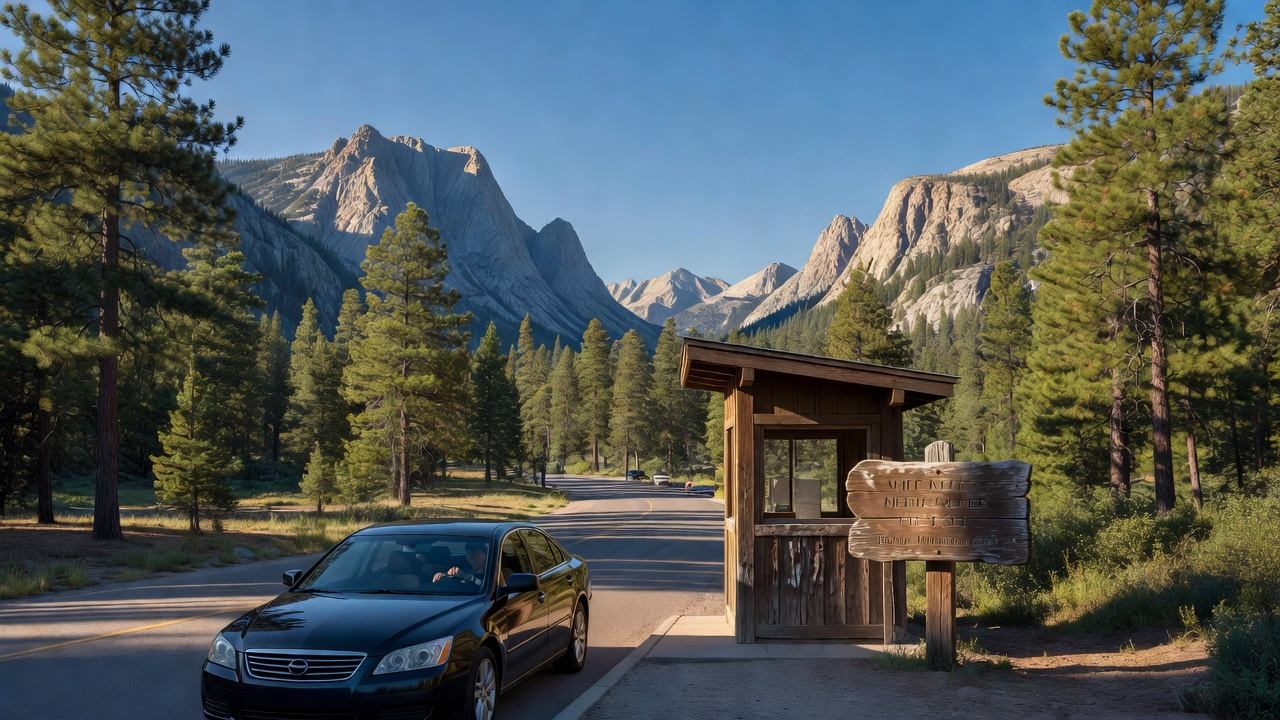
If you are visiting from outside the United States this summer, the cost of getting into the country’s most famous national parks changed on January 1, 2026 — and it is the biggest shift in park-access pricing in years. A new $250 nonresident version of the America the Beautiful pass now exists alongside the $80 resident pass, and at eleven of the most-visited parks, every nonresident age 16 and older pays an extra $100 per person on top of the standard entrance fee. If your trip routes through Yellowstone, the Grand Canyon, Yosemite, or Zion, this directly affects your budget. Here is exactly how the new structure works and how to keep your costs down.
What Changed and Why
The new fees trace back to Executive Order 14314, signed July 3, 2025, which directed the Department of the Interior to raise certain National Park Service fees for nonresidents and to create a higher-priced multiagency pass for non-US visitors. The National Park Service rolled the changes out beginning January 1, 2026 (NPS Nonresident Fees).
Two things came out of it that matter to international travelers:
- A new America the Beautiful Non-Resident Annual Pass priced at $250, versus the $80 resident annual pass.
- A $100 per-person nonresident surcharge at eleven flagship parks, charged on top of each park’s normal entrance fee.
One related detail worth knowing: starting in 2026, the National Park Service’s fee-free days apply to US residents only. Non-US residents pay the standard entrance fee and the nonresident surcharge as normal even on those dates (Department of the Interior). So the old strategy of timing an international trip around a free-entrance day no longer applies.
The 11 Parks Where the $100 Surcharge Applies
The surcharge is not nationwide. It applies at eleven specific parks, all among the most heavily visited in the system:
- Acadia
- Bryce Canyon
- Everglades
- Glacier
- Grand Canyon
- Grand Teton
- Rocky Mountain
- Sequoia & Kings Canyon
- Yellowstone
- Yosemite
- Zion
How the surcharge is charged
The $100 fee is per person, not per vehicle, and it applies to every nonresident aged 16 and older. Children under 16 are exempt. That distinction is the one that surprises families: a couple visiting the Grand Canyon by car pays the standard vehicle entrance fee plus $100 each — $200 in surcharges before the gate fee. A family of four with two teenagers over 16 would pay four surcharges.
The surcharge stacks on top of the park’s regular entrance fee, which for these parks generally runs $20–$35 per vehicle for a seven-day pass. At every park outside this list of eleven, no nonresident surcharge applies at all — you pay the same entrance fee a US resident would.
When the $250 Pass Saves You Money
This is where most international visitors will make or lose money, so it is worth doing the arithmetic before you arrive.
The pass waives the surcharge
A nonresident who holds the $250 America the Beautiful Non-Resident Annual Pass is not charged the individual $100 surcharge when entering any of the eleven parks. The pass also covers the nonresident fees for up to three additional adults traveling in the pass holder’s party (NPS Nonresident Fees).
The break-even math
Because the pass eliminates both the surcharge and standard entrance fees at federal sites, the calculation is simpler than it looks:
- Two adults visiting one surcharge park would pay roughly $200 in surcharges plus the entrance fee — already close to the $250 pass price.
- Two adults visiting two or more surcharge parks come out clearly ahead with the pass. A single road trip through, say, Grand Teton and Yellowstone, or through Zion and Bryce Canyon, easily exceeds $250 in surcharges alone.
- A solo traveler visiting just one surcharge park is the one case where paying the single $100 surcharge plus the standard entrance fee may be cheaper than the $250 pass.
The pass also covers entry at the other 2,000-plus federal recreation sites nationwide for twelve months from first use, so if your itinerary includes additional parks, forests, or monuments, the value climbs further. As with all America the Beautiful passes, the 2026 versions now cover two motorcycles per pass (roadtrippers).
How to Buy the Pass and Prove Residency
Buying the $250 nonresident pass
Anyone may purchase the Non-Resident Annual Pass — there is no eligibility screening, since by definition it is the version for visitors who cannot prove US residency. It is available for $250 through Recreation.gov, including as a digital pass that can be saved to a mobile device and used immediately. That immediacy matters for international travelers who do not have a US mailing address for a physical pass to ship to.
If you (or a travel companion) are a US resident
The $80 resident pass requires proof of US citizenship or residency. Acceptable documents include a US passport, a US state- or territory-issued driver’s license or ID, or a Permanent Residency card (green card). Photo ID matching the name on the pass must be presented on entry — passes bought online carry a notice to that effect (NPS Nonresident Fees). If you cannot produce one of those documents, you are treated as a nonresident.
Buying at the gate
You can still pay the surcharge or buy a pass on arrival at an entrance station, but during peak summer at parks like Zion or Yosemite that means doing it in line at the gate. Buying the digital nonresident pass on Recreation.gov before you leave home avoids the delay and locks in your cost before you arrive.
Practical Notes for Planning Your Trip
A few things to settle before your trip rather than at the booth:
- Map your itinerary against the list of eleven. If even two of your stops are surcharge parks, the $250 pass almost certainly wins. If none are, the surcharge never applies and you only need the standard $80 resident pass — or no annual pass at all for a single short visit.
- Count travelers 16 and older. The surcharge is per person, so group size drives the math more than trip length.
- Buy the digital pass ahead of time through Recreation.gov so it is on your phone before you reach a remote entrance with a long line and weak signal.
- Check the official page close to departure. Fee structures introduced this year are still settling, and individual park entrance fees vary. Confirm current amounts at the NPS Entrance Passes page and the Nonresident Fees FAQ before you finalize a budget.
For most international visitors planning a multi-park summer, the decision is straightforward: if your route touches more than one of the eleven surcharge parks, buy the $250 nonresident pass before you leave home and carry it digitally. For a single quick stop at one park, run the per-person surcharge math first — it may be the cheaper path. Either way, settle it before you reach the gate, because in 2026 there is no longer a free-entry day that lets nonresidents skip the bill.
Official information and purchase links: NPS Nonresident Fees, NPS Entrance Passes, and Recreation.gov. National Parks Gallery is not affiliated with the National Park Service or any government agency; confirm current fees on official sites before your visit.