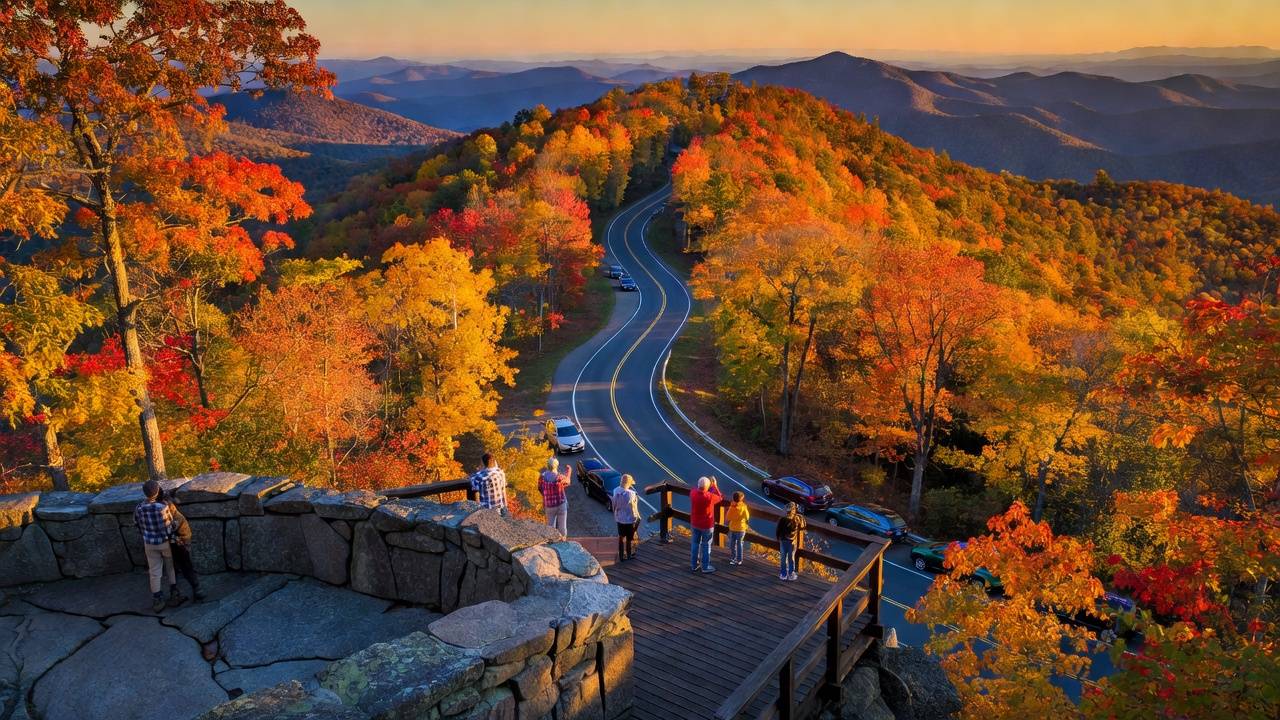
Washington, D.C. is one of the most visited cities in the world, and most of its visitors never realize they are a 90-minute drive from one of the most beautiful stretches of mountain terrain on the East Coast. Shenandoah National Park runs along the crest of the Blue Ridge Mountains through northwestern Virginia, protecting more than 200,000 acres of forest, ridgeline, and river valley. For city residents needing a weekend reset and for travelers looking to add a scenic detour to a mid-Atlantic itinerary, Shenandoah delivers consistently.
The Blue Ridge in Every Direction
The park’s defining feature is Skyline Drive, a 105-mile road that follows the mountain crest from one end of the park to the other, never straying far from the ridge and rarely dropping below sweeping views of the Shenandoah Valley to the west and the Virginia Piedmont to the east. More than 70 overlooks punctuate the route. At the right time of year — late October in particular — the forest below blazes in red, orange, and gold as far as the eye can see.
The mountains here are ancient, worn smooth over hundreds of millions of years into rounded ridges and gentle hollows rather than the jagged peaks of younger ranges. The result is a landscape that feels approachable and intimate rather than imposing. Families with young children hike here. So do serious backpackers logging sections of the Appalachian Trail, which runs the full length of the park along the ridge — the same trail that continues south through Virginia, crosses into Tennessee, and traverses Great Smoky Mountains National Park along 71 miles of high ridgeline.
Four distinct seasons give Shenandoah a different character each time you visit. Spring brings trillium and dogwood blooming along the lower trails. Summer turns the forest dense and green but adds humidity that can make mid-day hikes uncomfortable — mornings are best. Fall draws crowds for the foliage, deservedly. Winter strips the leaves and reveals views that the canopy hides all summer, and snow on the ridgeline makes for quiet, memorable hiking.
Top Trails and Experiences
Dark Hollow Falls — The most popular short hike in the park, and for good reason. The 1.4-mile round-trip trail descends to a 70-foot waterfall tumbling over mossy basalt ledges. Plan to go early; the small parking area fills quickly on weekends.
Old Rag Mountain — Shenandoah’s signature challenge. This 9.1-mile circuit includes a rocky scramble along the summit ridge that requires using both hands and feet to navigate boulder fields. The payoff is a 360-degree panoramic view with nothing blocking the horizon. Old Rag is one of the most-hiked peaks in the mid-Atlantic, and timed entry reservations are required on busy days.
Hawksbill Mountain — The highest point in the park at 4,051 feet, reached via a moderate 2.8-mile round-trip trail. Hawks and ravens frequently ride thermals off the summit, and the views extend south along the Blue Ridge on clear days.
Limberlost Trail — One of the few accessible trails in the park, this 1.3-mile loop through old-growth hemlocks and open meadow is a good choice for visitors with mobility limitations or those hiking with young children.
The park also maintains horse-accessible trails and designated equestrian camping areas, making it one of the better national park options for riders in the eastern United States.
When to Visit
Spring (April–May) is consistently excellent. Wildflowers carpet the understory, temperatures are mild, and the park is less crowded than summer. Early May is prime for trillium.
Summer (June–August) brings full green foliage and the busiest season. Early morning hikes before the heat and humidity build are ideal. The Skyline Drive can back up on summer weekends, and reservations for Skyland and Big Meadows lodges are essential.
Fall (October–November) is peak season for foliage, typically peaking between mid-October and early November. Weekends in late October see the park at its most crowded, but the scenery justifies it.
Winter (December–March) is quiet and often beautiful. Skyline Drive may close temporarily during ice or snow events, but reopens quickly when conditions allow. Winter hiking with a clear sky and bare trees offers some of the longest views of the year.
Practical Information
Entrance Fee: $30 per vehicle (valid 7 days); $25 per motorcycle; $15 per person on foot or bicycle. The America the Beautiful annual pass is accepted.
Hours: The park is always open. Skyline Drive may close temporarily during severe weather; check current conditions at the park’s website or call ahead in winter.
Getting There: Shenandoah has four entrance points along Skyline Drive. Front Royal (northern entrance) is approximately 75 miles from Washington, D.C. via I-66 west. Thornton Gap (US-211) and Swift Run Gap (US-33) provide mid-park access from the Shenandoah Valley. Rockfish Gap at the southern end (I-64/US-250 near Waynesboro) connects to the Blue Ridge Parkway.
Lodging Inside the Park: Skyland and Big Meadows Lodge operate from spring through fall and are popular with visitors who want to stay along the crest of the ridge. Campgrounds at Mathews Arm, Big Meadows, Lewis Mountain, and Loft Mountain are open seasonally; reservations are recommended.
For complete current information, visit the official Shenandoah National Park website. If you are building an East Coast parks itinerary, browse our full parks directory for nearby destinations.
Frequently Asked Questions
Is Shenandoah suitable for first-time national park visitors? Yes, it is one of the most accessible national parks in the country. Skyline Drive alone provides an excellent introduction with no hiking required. Short, well-marked trails like Dark Hollow Falls and Limberlost are manageable for nearly any fitness level, and the proximity to major metro areas means good cell coverage and well-maintained facilities throughout.
Are there bears in Shenandoah? Black bears are common throughout the park and are frequently spotted, especially in spring and fall. They are generally not aggressive toward humans but should never be fed or approached. Store food, scented items, and trash in bear boxes at campgrounds. When hiking, make noise to avoid surprising a bear on the trail.
Can I drive Skyline Drive in a day? Technically yes — 105 miles at the 35 mph speed limit takes around three hours without stops — but that would be a waste. Plan for a full day minimum, stopping at overlooks, taking at least one short hike, and having a meal at one of the lodge dining rooms. Two days allows a much more relaxed experience.
Does the park allow pets? Dogs on leashes of six feet or shorter are permitted on most trails and in campgrounds. They are not allowed in lodge buildings, picnic shelters, or on a handful of specific trails. The park’s website lists pet-restricted areas by trail name.