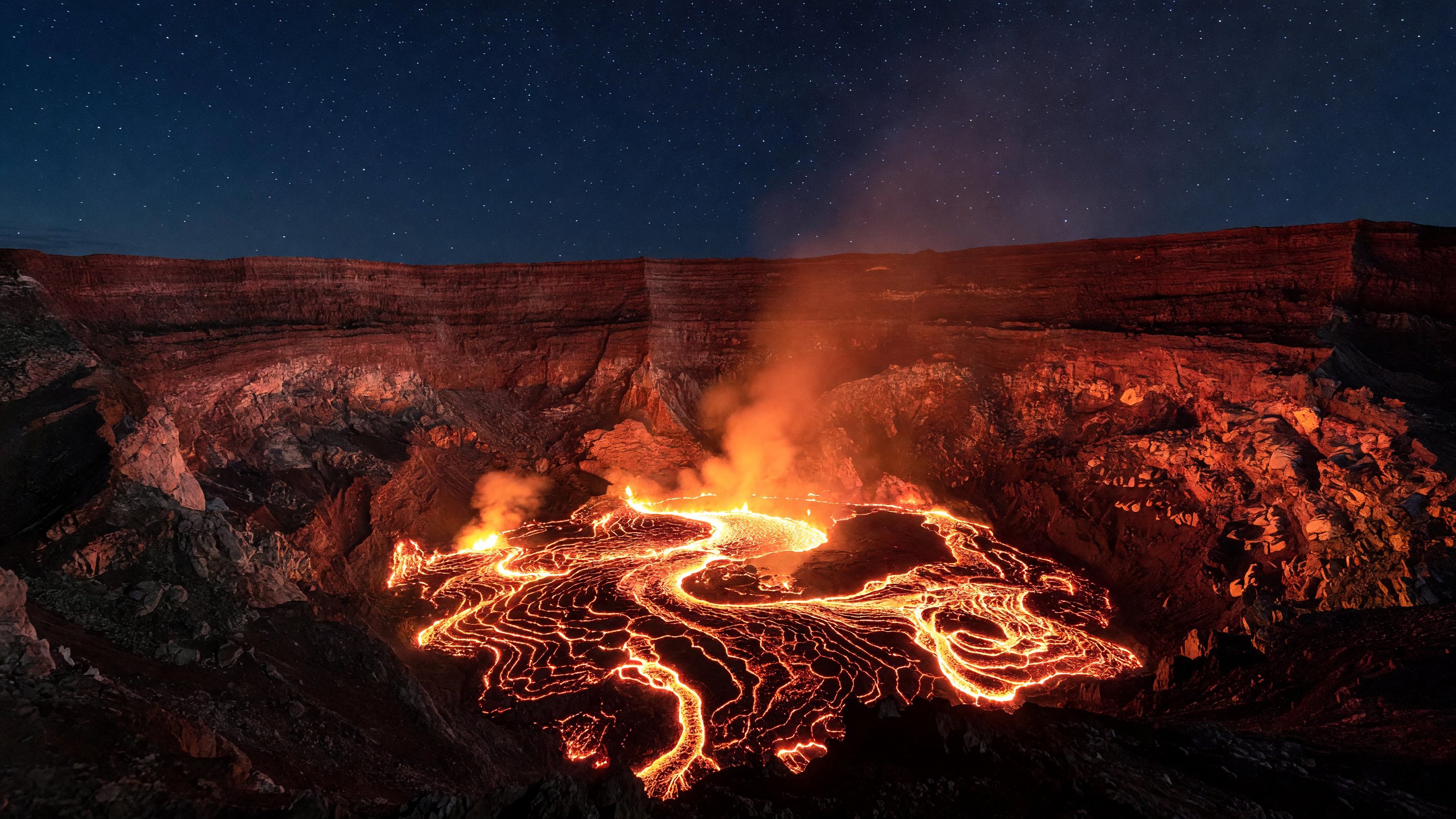
There is no checklist that prepares you for your first night at the Kīlauea caldera rim when the volcano is erupting. The glow from inside Halemaʻumaʻu — a deep, pulsing orange against the dark caldera walls — looks less like something geological and more like something the island is doing deliberately. Intellectually you know you’re watching an open lava lake. Viscerally, you understand why Native Hawaiians have called this place home to Pele for thousands of years.
Hawaii Volcanoes National Park covers approximately 323,431 acres on the Big Island of Hawaiʻi, encompassing the summits and rift zones of two of the world’s most active volcanoes: Kīlauea and part of Mauna Loa. The park sits on land that is literally, actively growing — lava has added hundreds of acres to the island’s southeastern coast over the past several decades. No other national park puts you this close to ongoing planetary geology, and no other national park requires you to do quite this much pre-trip homework on current conditions. Whether you see active lava on any given visit is genuinely uncertain. That uncertainty is part of what makes planning here different from planning a trip to Zion or Yellowstone.
This guide is built around that central variable: the volcano’s current status is more determinative of your experience than weather, season, or any other factor. Start with the real-time situation, then plan everything else around it.
Understanding Eruption Status Before You Go
The single most important resource for any Hawaii Volcanoes visit is the USGS Hawaiian Volcano Observatory — the scientists who monitor Kīlauea and Mauna Loa around the clock. HVO publishes daily activity updates, webcam feeds of the summit and rift zones, and formal alert-level notices whenever activity escalates or decreases. Bookmark this site before you book flights.
Kīlauea’s activity is episodic. The volcano entered a period of renewed summit activity in December 2024 with intermittent eruptions at Halemaʻumaʻu Crater, the summit caldera vent, continuing in episodic bursts into 2025 and 2026. Each episode produces lava fountaining within the caldera, lava lake filling and draining, and emission of volcanic gases — primarily sulfur dioxide (SO₂) — that can affect air quality in the park and surrounding downwind communities. HVO’s alert-level system uses two parallel scales: a ground-based volcano alert level (Normal → Advisory → Watch → Warning) and an aviation color code (Green → Yellow → Orange → Red). During active fountaining episodes, the alert level rises; between episodes it typically drops back to Yellow/Advisory. Check both before your travel dates.
What eruption status means practically for your visit:
- Watch or Warning level during active fountaining: Summit viewing areas accessible; Halemaʻumaʻu overlooks often crowded; night viewing of the lava glow is extraordinary and worth planning an evening around. Some overlooks may be restricted depending on gas levels and fountaining height.
- Advisory level (between episodes): The caldera may show little or no visible lava, though fresh lava flows and steam emissions remain visible. Still a compelling landscape — the scale of the 2018 collapse and subsequent flows is impressive regardless of whether active lava is visible.
- Vog and SO₂ concerns: Volcanic emissions create volcanic smog (“vog”) that affects air quality across the island. Visitors with asthma, heart conditions, or respiratory sensitivities should monitor SO₂ forecasts via the NPS conditions page and the Hawaiʻi Department of Health’s vog advisories. Children and pregnant visitors should also exercise caution near active emission areas. The park posts air quality advisories at the visitor center.
The NPS park conditions page cross-references HVO data with current trail and road closures. Check both sites the day before you drive in.
Park Overview: Two Active Volcanoes, One Extraordinary Landscape
Kīlauea is the world’s most active volcano by almost any measure — it erupted nearly continuously from 1983 to 2018 in what geologists called the Pu’u ‘Ō’ō eruption, one of the longest and largest in Kīlauea’s modern history. The 2018 eruption that ended that episode was a different animal: a summit collapse that dropped the floor of Halemaʻumaʻu Crater by approximately 1,600 feet, destroyed the beloved Jaggar Museum and surrounding infrastructure, and permanently altered what the summit area looks like. The crater is now significantly larger and deeper. Post-collapse eruptions since 2020 have partially refilled the caldera floor with fresh lava.
Mauna Loa — technically the world’s largest active volcano by volume and mass — occupies the western and southern portions of the park. Its summit reaches 13,678 feet above sea level, and its flanks extend far below sea level on the ocean floor. Mauna Loa last erupted in November–December 2022, sending lava flows toward the Saddle Road in what was the volcano’s first eruption since 1984. The park contains portions of Mauna Loa’s summit, rift zones, and lava flow fields, though most visitor infrastructure is concentrated in the Kīlauea summit area.
The park is a UNESCO World Heritage Site and a UNESCO Biosphere Reserve, recognizing both its geological significance and the biodiversity of its native ecosystems — from subalpine desert at the summit elevations to lush Hilo-side rainforest.
Crater Rim Drive: The Summit Loop
Crater Rim Drive is an 11-mile loop road that circles Kīlauea Caldera. Prior to the 2018 eruption it offered continuous access to caldera overlooks, sulfur banks, and the former Jaggar Museum. The 2018 collapse closed approximately half the loop — the southwestern section that passed closest to the most active venting — and that section remains closed as of early 2026 due to ongoing safety assessments and the active eruption. Construction work on damaged summit infrastructure is ongoing; expect closures and delays in the summit area consistent with the park’s multi-year rebuild project.
The currently accessible portion of Crater Rim Drive runs approximately 6.5 miles from the Kīlauea Visitor Center eastward to Keanakākoʻi Overlook, passing several key stops:
Kīlauea Visitor Center — Start here every visit. Rangers post current eruption status, air quality readings, and trail conditions daily. The bookstore stocks USGS publications and the best geological interpretation materials available anywhere on the island. Plan 20–30 minutes here before heading out.
Halemaʻumaʻu Overlook — The primary viewpoint for the summit lava lake. Access depends on current activity and gas levels — during active eruption episodes with elevated SO₂, the overlook may be restricted or require a self-contained breathing apparatus for extended stays. Rangers will advise. During lower-activity periods, this is the most dramatic viewpoint in the park: a vast collapsed caldera with the newer, smaller eruption crater nested inside.
Kīlauea Overlook and Wahinekapu (Steaming Bluffs) — Steam vents line the caldera rim here, where groundwater meets hot volcanic rock and emerges as steam. Accessible along the crater rim trail section. These steam plumes are visible year-round regardless of eruption status.
Thurston Lava Tube (Nāhuku) — A well-lit lava tube accessible via a short loop trail through native ohia and tree-fern rainforest. The tube itself is approximately 0.3 miles long and gives an immediate sense of the underground plumbing that transports molten rock. The surrounding rainforest is excellent habitat for native Hawaiian birds — slow down and watch for the ʻapapane and ʻiʻiwi in the ohia canopy.
Keanakākoʻi Overlook — The current end of accessible Crater Rim Drive. A large pit crater, Keanakākoʻi was a major source of volcanic glass used by Native Hawaiians for tool-making — the name translates as “the adze quarry.” Excellent views across the east rift zone.
Chain of Craters Road: The Descent to the Coast
Chain of Craters Road is among the most dramatic paved drives in the national park system. The road descends 19 miles from the summit caldera area to the coast, dropping approximately 3,700 feet in elevation along the way, passing a sequence of pit craters, lava shield formations, and the broad Mauna Ulu lava field before reaching the ocean at the Hōlei Sea Arch.
The road ends abruptly where lava flows from the Kalapana eruption of 2003 covered the original coastal road, cutting off the through-route. The pahoehoe lava that buried the old road is now hardened and visually striking — you can walk out onto it from the road terminus, though the surface is extremely uneven. There is no through-road, and the road does not connect back to the Puna coast communities.
Key stops along Chain of Craters Road:
Mauna Ulu area — A large lava shield formed by the 1969–1974 eruption. The Pu’u Huluhulu short hike (2.5 miles round trip from the Mauna Ulu parking area) climbs a forested cinder cone with panoramic views over the lava field and across to the summit area. Strong sunrise light from this elevation.
Pu’u Loa Petroglyphs Trail — A 1.4-mile round trip across ancient lava fields to the largest petroglyph field in the Hawaiian Islands. The site contains more than 23,000 individual rock carvings — images of humans, canoes, geometric forms, and thousands of small circular pits called “puka” that were used to deposit piko (umbilical cords of newborns) in a practice of dedicating children to the land. This is a deeply sacred site. Stay on the marked boardwalk; do not touch any carvings, step off the boardwalk, or walk on the petroglyph field. The fragility of the basalt and the sacredness of the site both require it.
Hōlei Sea Arch — At the end of Chain of Craters Road, a short walk reaches this dramatic natural arch, where wave action has carved through a lava lobe extending into the Pacific. The contrast — black lava meeting deep blue ocean — is visually stunning at any time of day, but the late-afternoon light that hits the arch from the west at roughly a 45-degree angle makes for the strongest photography. This coastline is actively eroding; sea arches are temporary on geological timescales, and the cliff edge is genuinely dangerous. The park posts closure notices when lava benches are actively collapsing.
Key Hikes: The Three Worth Knowing
Kīlauea Iki Trail (4 miles, loop)
The Kīlauea Iki Trail is the single best hike in the park for understanding what these volcanoes actually do. The loop descends into the Kīlauea Iki Crater — a pit crater adjacent to the main Kīlauea Caldera — and crosses the floor of what was a lava lake during the 1959 eruption. That eruption produced lava fountains reaching 1,900 feet — the highest ever recorded at Kīlauea — and filled the crater floor with approximately 400 feet of molten rock that has since solidified into the rough pahoehoe surface you hike across today. The crater floor is still warm. Steam rises from cracks. In some spots you can feel radiant heat through your boot soles.
The loop is approximately 4 miles with 400 feet of elevation change — the descent into the crater is steep and requires sure footing on rocky, uneven terrain. Allow 2–3 hours. The upper rainforest rim section is lush and bird-rich; the crater floor crossing is stark and otherworldly. Trekking poles help on the descent but are not mandatory. Bring water; there is no water source on the crater floor.
Devastation Trail (1 mile, out-and-back)
Devastation Trail crosses the pumice field deposited by the 1959 Kīlauea Iki eruption — the same event that created the lava lake you walk across on the Kīlauea Iki Trail. The 1-mile paved trail is accessible for wheelchairs and strollers, making it one of the more inclusive options in the park. The landscape is striking: skeletal ohia trees killed by the pumice fall, new vegetation slowly colonizing the pumice field, and the bowl of the Kīlauea Iki Crater visible above. A good option if time is limited or conditions are not suitable for the full Kīlauea Iki loop.
Pu’u Loa Petroglyphs (1.4 miles, out-and-back)
Covered in the Chain of Craters Road section above. Note the cultural weight of this site and the importance of the boardwalk-only rule. The flat, exposed lava field approach can be disorienting — follow the ahu (cairns) carefully. Sun exposure is total; bring sun protection, water, and a hat.
Volcano House: In-Park Lodging on the Caldera Rim
Volcano House is the only lodging option inside the park, and its position — directly on the rim of Kīlauea Caldera, with the Halemaʻumaʻu Crater viewable from the property — is genuinely irreplaceable. The historic main lodge building, managed by Aramark under a national park concessionaire contract, has operated on this site in various forms since the 1840s, making it one of the oldest hotels in Hawaiʻi.
Rooms in the main lodge face the caldera and can be booked well in advance, particularly during active eruption periods when visitors want the caldera-rim vantage point for after-dark lava glow. The lodge also includes Uaoa Bay Cabins and a hostel-style option (the ʻŌhiʻa Wing) for lower-cost stays. Dining at the Rim Restaurant is accessible to day visitors and offers the most dramatic table views anywhere in the national park system — eating breakfast while lava steams across the caldera is not something that becomes ordinary.
Book early. During eruption episodes, availability disappears within days of activity announcements. The park’s concessioner booking site is the direct channel; third-party resellers sometimes show availability that isn’t accurate.
Gateway alternatives: The village of Volcano sits immediately outside the park entrance on Highway 11, with bed-and-breakfasts, vacation rentals, and small restaurants. The elevation (~4,000 feet) and frequent mist give Volcano village a cooler, wetter character than the rest of the Big Island — bring layers even in summer. Hilo, the closest city, is approximately 30 miles northeast via Highway 11 and takes about 45 minutes. Kailua-Kona (on the dry western side of the island) is approximately 100 miles northwest — a 2.5 to 3-hour drive — and represents a considerably less convenient base unless you’re combining a park visit with Kohala Coast resorts.
Photography: Working With the Volcano’s Light
Hawaii Volcanoes is a challenging photography environment — the best opportunities are largely dependent on eruption timing, gas levels, and the volcanic landscape’s own shifting moods. Here is what I’ve learned works.
Halemaʻumaʻu summit glow at night — During active lava lake or fountaining episodes, the glow from inside the caldera is visible from the overlooks after sunset. This is your primary night-photography target in the park. The glow intensifies against a dark sky — aim for astronomical twilight and later. The challenge is the SO₂: gas levels near the overlook can be elevated at night when winds shift. Keep your time at the rim calibrated against how the air feels — the throat irritation is an early warning. Use a wide-angle lens, tripod, and shoot at ISO 800–3200 depending on the intensity of the glow. A 20–30 second exposure will capture the glow and any crater steam dramatically.
Mauna Ulu sunrise — The Pu’u Huluhulu overlook on Chain of Craters Road catches the first light across the lava field beautifully. The frozen pahoehoe surface picks up warm orange and gold tones at sunrise that read as almost molten in an image. Arrive at the Mauna Ulu parking area before first light — it’s a 1.25-mile walk to the top of the cinder cone. The summit views extend across the rift zone toward Kīlauea and out to the ocean.
Hōlei Sea Arch at sunset — The arch faces roughly west-southwest, which means late afternoon is the optimal time. The ocean light at this latitude is vivid and shifts quickly. I’ve had my best results in the 45 minutes before sunset when the sky is still bright enough to render the blue water while the lava foreground has warm shadow detail. A polarizing filter deepens the ocean color significantly.
Lava tube and rainforest — The Thurston Lava Tube trail shoots well in flat overcast light. The rainforest canopy diffuses the harsh tropical sun into even illumination — this is actually the condition you want for lush green shots. Overcast is not a failure condition at this park; it’s frequently ideal for the vegetated sections.
Gear notes: Salt air, humidity, and SO₂ are hard on optics and gear. Keep lenses in bags when not shooting. Bring more lens cloths than you think you need. Humidity can cause fogging of cold lenses brought into warm air — let gear acclimate gradually when moving between air-conditioned vehicles and the humid outdoor environment.
Cultural Framing: Pele, Sacred Land, and the Responsibility of Visiting
Hawaii Volcanoes National Park is Native Hawaiian land — ʻĀina, land that is alive and holds identity. This is not a metaphor. The volcanic landscape here is understood through Native Hawaiian cosmology not as geological process but as the ongoing work of Pele, the deity of volcanoes, fire, and creation. Pele resides in Halemaʻumaʻu Crater. The lava flows are her movements. The eruptions are her expression.
Native Hawaiians have inhabited and cared for this landscape since the arrival of Polynesian voyagers to the islands roughly 1,500 years ago. The petroglyph fields at Pu’u Loa, the heiau (ceremonial sites) throughout the park, the piko-dedication practice embedded in the carving field — these are continuous expressions of a living culture, not archaeological artifacts of a dead one. The Hawaiian sovereignty movement is active and vocal, and the appropriate relationship for a visitor is one of guest — not owner, not consumer.
The rock removal taboo — Do not take rocks, lava, sand, or any natural material from the park. This is federal law (removing natural resources from national parks is prohibited), but in Hawaii it carries additional cultural weight. The tradition of “Pele’s curse” — that misfortune befalls those who take lava rocks from the island — is widely known, and the Hilo post office reportedly receives packages of returned rocks from former visitors regularly, mailed back with notes of apology. Whether or not you hold a belief in Pele’s curse, the rock removal prohibition reflects a genuine cultural principle: the land belongs to itself, and removing pieces of it is a form of harm. Leave everything where you find it.
Language and place names — The Hawaiian language was suppressed during the colonial period and has been actively revived over the past several decades. Place names in the park carry pronunciation and meaning that matter to Native Hawaiians. Kīlauea, Halemaʻumaʻu, Keanakākoʻi, Pu’u Loa — pronouncing these with care, learning the macrons (kahakō) and glottal stops (ʻokina), is a small act of respect that is noticed and appreciated. The visitor center’s interpretive materials use the correct orthography; follow that usage.
Sovereignty perspective — The island of Hawaiʻi was an independent kingdom until the illegal overthrow of Queen Liliʻuokalani in 1893 and formal U.S. annexation in 1898. The Hawaiian sovereignty movement seeks various forms of self-determination, from cultural revitalization to land rights to full independence. As a visitor to a federally-administered park on Hawaiian land, being aware of this history contextualizes what “the park” means here in a way that’s different from visiting a park on the continental United States.
Accessibility
The park has meaningful accessible options alongside its challenging volcanic terrain:
- Devastation Trail is fully paved and accessible for wheelchairs and strollers (1 mile, level).
- Crater Rim Trail sections near Wahinekapu (Steaming Bluffs) and the Kīlauea Overlook are largely accessible with paved surfaces.
- Kīlauea Visitor Center is fully accessible, as is the Volcano House lobby and Rim Restaurant.
- Halemaʻumaʻu Overlook has accessible viewing areas; approach terrain and parking vary — check current NPS conditions for specific accessibility details given construction.
- Kīlauea Iki Trail and Chain of Craters Road hikes involve uneven lava and are not accessible for most mobility devices.
Seasonal Considerations
The park is open year-round, 24 hours a day. Entry fees apply; America the Beautiful annual passes are accepted.
Weather pattern: The summit area sits at approximately 4,000 feet elevation on the windward (Hilo) side of the island, which means it is frequently overcast and rainy — sometimes dramatically so. Summer (May–September) is drier and more settled; winter (November–March) brings more frequent rain and higher wind. Rain gear and layers are appropriate year-round regardless of what the Hilo or Kona forecasts say — the summit can be soaked while the coast is sunny.
Eruption status is more determinative than weather. The question of whether active lava is visible matters more to your experience than any seasonal factor. Check HVO in the days before your visit and again the morning you drive in. Eruption episodes at Kīlauea can begin and end with hours of notice, and rangers at the visitor center have the most current situation.
Night visits — The park’s 24-hour access is worth using. During eruption episodes, night visits to the caldera overlooks for lava glow viewing are some of the most profound experiences available anywhere in the national park system. Bring warm layers — the summit cools significantly after dark even in summer — and a headlamp for any walking on uneven terrain.
Frequently Asked Questions
Is Kīlauea currently erupting?
Kīlauea’s status changes frequently. The USGS Hawaiian Volcano Observatory is the authoritative real-time source — check their daily activity updates and the volcanic alert level before your visit. As of early 2026, Kīlauea had been in an episodic eruption pattern with intermittent lava lake activity at the summit Halemaʻumaʻu Crater since December 2024. Individual eruption episodes last hours to days, with pause periods between them.
Can I see lava flowing into the ocean?
Not currently from any accessible area. The last coastal lava entry ended when the 2018 eruption stopped. Active ocean entry requires lava flowing from the rift zone to the coast, which has not been occurring at accessible locations as of early 2026. When coastal lava entry is active, the NPS establishes special viewing areas — check conditions before visiting if this is your primary goal.
What is the Halemaʻumaʻu 2018 collapse?
In May 2018, a prolonged eruption on Kīlauea’s lower East Rift Zone (the Leilani Estates eruption that destroyed approximately 700 homes in the Puna district) was accompanied by the collapse of the summit caldera. Halemaʻumaʻu Crater dropped approximately 1,600 feet as magma drained from the summit reservoir to feed the lower rift eruption. The resulting crater is dramatically larger and deeper than the pre-2018 configuration. Several park facilities were destroyed, including the Jaggar Museum. Post-2018 eruptions have partially refilled the collapsed caldera with fresh lava.
Why can’t you drive all the way through the park on Chain of Craters Road?
Chain of Craters Road ends at the coast because a 2003 lava flow from Kīlauea’s ongoing East Rift Zone eruption covered the coastal highway, cutting off the through-route to the Puna coast communities. There has been no restoration of the road since — the lava that covered it is now a permanent part of the landscape. The Kalapana area, once a residential community, was buried by eruptions in 1990.
Is it safe to visit if the volcano is erupting?
Generally yes. The NPS manages public access carefully during eruption events. Most Kīlauea eruption activity occurs within the caldera and rift zones, and the NPS opens or closes specific viewpoints and trails based on real-time safety assessments — gas levels, lava flow behavior, and structural stability. Follow all posted closures and ranger guidance. The primary health concern for most visitors is volcanic gas (SO₂ and vog) — those with respiratory sensitivities should monitor air quality advisories.
Should I take a rock or piece of lava home?
No. Removing any natural material — rocks, lava, sand, soil, plants — from a national park is a federal violation. In the cultural context of Hawaiʻi, it is also a significant transgression against the principle that the ʻāina belongs to itself. The “Pele’s curse” belief that misfortune follows those who take rocks is widely held; many returned-rock packages arrive at the Hilo post office each year. Leave everything in place.
What gear do I need?
Closed-toe shoes with solid grip on uneven lava are essential — the surface is jagged, irregular, and can be deceptively soft in places where thin lava crust covers hollow tubes. A rain jacket and warm layer for the summit area. Water — there are no water sources on crater-floor or coastal hikes. Sun protection for exposed lava field hiking. If you have respiratory sensitivities, check current SO₂ levels before hiking near active vents.
For current Kīlauea and Mauna Loa eruption status, webcam feeds, and volcanic alert levels, the definitive source is the USGS Hawaiian Volcano Observatory. Official park information including trail and road conditions is at nps.gov/havo. For advocacy, conservation context, and broader Hawaii park coverage, the National Parks Conservation Association covers current issues affecting Hawaii Volcanoes and the national park system.
For other volcanic park destinations, our guides to Crater Lake National Park (Oregon’s caldera lake formed by a volcanic collapse 7,700 years ago) and Yellowstone National Park (the Yellowstone Caldera supervolcano and the park that started the system) round out the volcanic and geothermal category in this gallery.