Most national parks are remote in the sense that they require driving past convenience stores and cell towers to reach them. Glacier Bay is remote in the sense that there is no road connecting it to anywhere else in North America. You arrive by floatplane, by scheduled jet from Juneau, by Alaska state ferry, or — as the majority of visitors do — aboard a cruise ship passing through on a pre-set itinerary. The park has no entrance fee and no highway junction. What it has is 3.3 million acres of marine wilderness in Southeast Alaska’s Inside Passage, a bay that was buried under thousands of feet of glacier ice as recently as 250 years ago, and a concentration of tidewater glacier faces, humpback whale feeding grounds, and Huna Tlingit cultural history that has no equivalent in the American park system.
If you are planning an independent visit — meaning you want to arrive under your own power, stay overnight, and have some say in what you do — the planning details matter a great deal. Glacier Bay rewards that effort. But the logistics are different from any other park in the lower 48 or in Alaska, and the window for independent visitor services is narrowly defined.
Understanding the Park: 3.3 Million Acres, One Gateway
Glacier Bay National Park and Preserve covers 3.3 million acres of mountains, fjords, ice fields, and marine waters in the Alaska Panhandle, roughly 50 miles west of Juneau. The entire park is accessible only by air or sea — no road connects Glacier Bay to the Alaska highway system or to any other town. Within the park, one paved road of about ten miles runs between the town of Gustavus and the Bartlett Cove visitor complex. That road is the park’s entire ground transportation infrastructure.
Bartlett Cove, at the park’s southern entrance where the bay opens into Icy Strait, functions as the hub for nearly all visitor activity. The park visitor center, Glacier Bay Lodge (the sole in-park lodging concession), the dock for the daily boat tour and private vessels, the backcountry permits office, and the Xunaa Shuká Hít Tribal House are all clustered at Bartlett Cove. Everything further up the bay — the glaciers, the fjords, the wildlife — is accessed by water.
The glaciers have been retreating dramatically since the mid-1700s. When Captain George Vancouver mapped the area in 1794, the bay was almost entirely filled by a single massive glacier. By 1890, when John Muir arrived by canoe, the ice had retreated roughly 40 miles. Today the main glacier faces — Margerie, Lamplugh, Johns Hopkins, Reid — are at the upper end of the bay, 65 miles or more from Bartlett Cove, reachable by the concessioner’s day boat tour or by kayak with a water taxi drop-off. The exposed terrain left behind is now a living laboratory of ecological succession, with marine forests, tidal flats, and wildlife communities filling in behind the retreating ice.
How to Actually Get There: Access Realities
The majority of people who see Glacier Bay see it from a cruise ship deck. A strict permit system limits cruise ships to one or two entries per day into the bay during the summer season, and a rotating group of major cruise lines cycle through these permits. If your goal is to see the glaciers from a large ship without any independent planning, a cruise is the most straightforward path and the one most visitors take.
For independent travelers, there are two primary access points:
Gustavus Airstrip via Alaska Airlines. Alaska Airlines operates daily jet service between Juneau and the Gustavus airstrip during the summer season, with the flight taking approximately 30 minutes. This is the fastest and most reliable independent access option. Gustavus is a small community of a few hundred year-round residents; the airstrip is about ten miles from Bartlett Cove. Glacier Bay Lodge operates a shuttle between the lodge and the airport, and taxi service is available. Air charter services operate year-round for off-season access.
Alaska Marine Highway ferry. The Alaska state ferry system provides twice-weekly service between Juneau and Gustavus during summer months. The ferry dock is about nine miles from Bartlett Cove. This is a slower option — the ferry passage from Juneau takes several hours — but it’s scenic, it carries vehicles (useful if you’re bringing kayaks or camping gear), and it’s considerably cheaper than airfare. Ferry schedules vary year to year; check the Alaska Marine Highway System website for current timetables before booking.
Once in Gustavus, you need ground transportation to Bartlett Cove. The ten-mile road is flat and bikeable (bicycle rentals are available from some local lodges), and the lodge shuttle and taxis cover it reliably in summer. Weather windows matter: Juneau-area weather is unpredictable, and both the Alaska Airlines flight and small-plane charters are weather-dependent. Build at least one buffer day into any independent itinerary.
Bartlett Cove: What the Gateway Actually Offers
For an independent traveler, Bartlett Cove is not a staging ground for unlimited park exploration — it’s the park, at least on land. The facilities are real but modest. Glacier Bay Lodge operates as the sole in-park lodging from late May through early September, with rooms ranging from basic lodge units to more comfortable suites. The lodge dining room is the only in-park restaurant. Reservations book up well in advance for July and August; plan to reserve three to four months ahead.
The Bartlett Cove Campground is free and operates on a first-come, first-served basis. There are no RV hookups or vehicle camping — this is a tent campground in a spruce-hemlock forest setting, and it requires a free backcountry camping permit during peak season (May 1 through September 30). The permits are issued at the visitor center on the day of arrival. A food-storage cache is available.
The visitor center runs interpretive programs and ranger talks throughout the summer. A small network of hiking trails starts from Bartlett Cove: the Forest Loop Trail (about one mile through old-growth spruce and hemlock) and the Bartlett River Trail (four miles round-trip through forest and wetland to a river estuary where brown bears and moose are commonly spotted). These trails are the land-based park experience for day visitors who don’t go on the boat tour. They’re genuinely worthwhile — the succession forest at Bartlett Cove, growing on land exposed only in the last two centuries, has an eerie, freshly-minted quality — but the glaciers and the full marine wilderness experience require getting out on the water.
The Day Boat Tour: The Core Experience
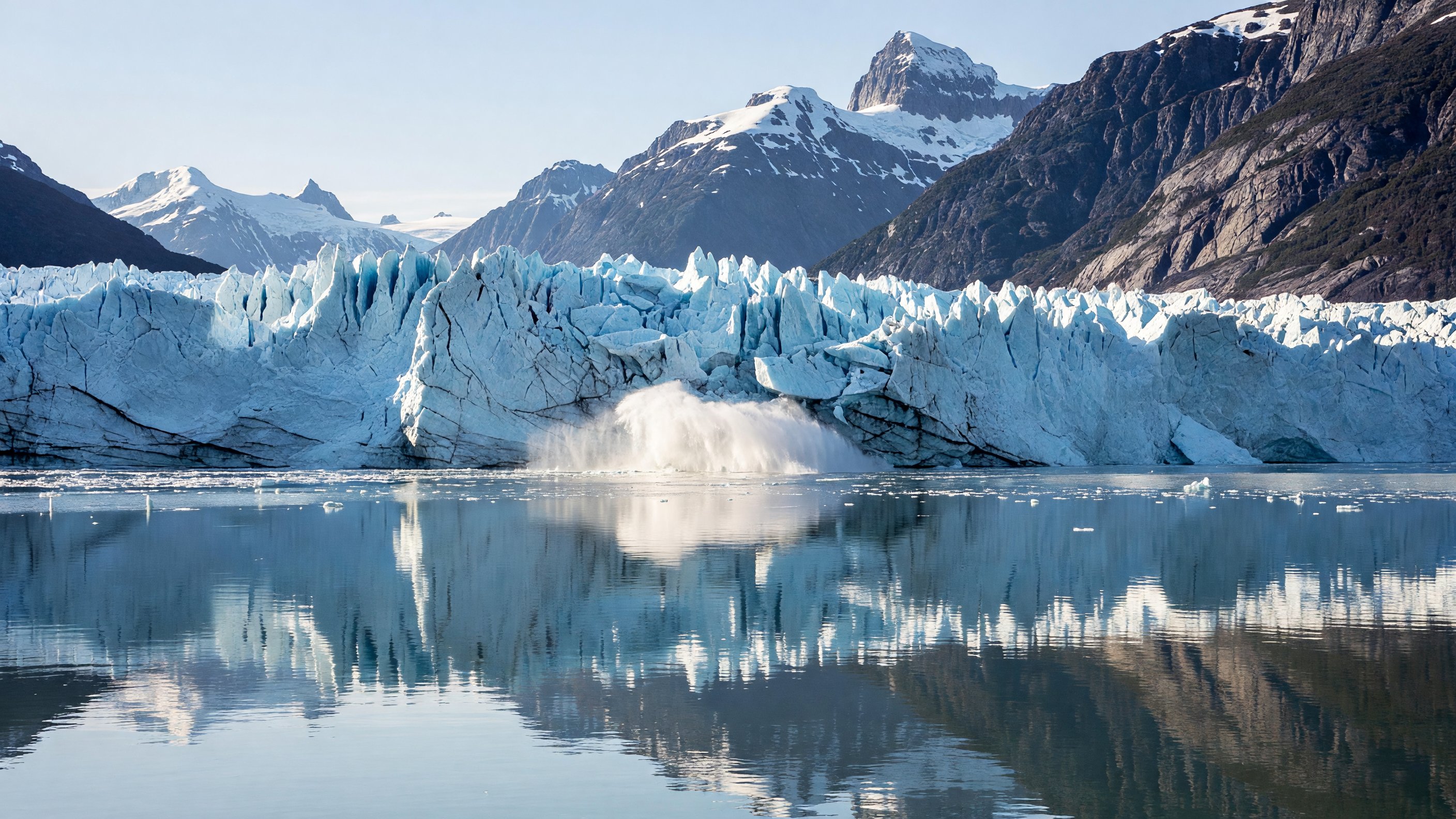
The concessioner-operated day boat tour out of Bartlett Cove is the single most efficient way to see Glacier Bay’s glaciers and marine wildlife. The boat travels roughly 65 miles up the bay to the upper fjords, spending time in both the Tarr Inlet (where Margerie Glacier and Grand Pacific Glacier face each other across the water) and Johns Hopkins Inlet (where Johns Hopkins Glacier calves large blocks of ice with a regularity that makes boat positioning a tactical art). A National Park Service ranger accompanies every tour and provides interpretation on glaciology, ecology, and Huna Tlingit history.
The glaciers themselves demand presence. Margerie Glacier’s face rises roughly 250 feet above the waterline and extends another 100 feet below the surface. The active calving — a slow structural crack running down through blue ice, followed by an explosive release and a wall of water — produces waves that the boat must respect at distance. Lamplugh Glacier, in Johns Hopkins Inlet, is notable for its deep blue ice coloration, which results from the extreme compression of air bubbles out of the ice over time. Reid Glacier, south of the upper inlets, is more accessible to kayakers and smaller charter vessels.
Wildlife viewing on the day tour is consistently excellent by any reasonable standard. Humpback whales are frequently encountered in the lower and middle bay — Glacier Bay has been a center of humpback research for decades, and individual whales return year after year to exploit the park’s productive feeding grounds. Steller sea lions haul out on ice chunks and rocky outcroppings throughout the bay. Harbor seals rest on calved icebergs, often with pups, in a behavior that has been studied here since the 1970s. Sea otters float in the kelp beds of the lower bay. Brown bears are sometimes visible from the water on shorelines. Mountain goats inhabit the steep terrain above the upper fjords.
Reserve the day tour through the park concessioner at visitglacierbay.com as early as possible. Peak-season dates fill up. The tour departs from the Bartlett Cove dock.
Backcountry Kayaking: What Independent Paddling Requires
Glacier Bay’s upper fjords are a serious kayaking destination for experienced paddlers, and the park permits kayaking throughout the bay. There are no entrance fees for private vessels, but boats entering the park from June 1 through August 31 require a free permit issued at the visitor center.
Most independent kayakers use a water taxi service to drop them at a point deep in the bay — typically Johns Hopkins Inlet or the Tarr Inlet area — and then paddle back to Bartlett Cove over five to seven days. This approach avoids the logistical grind of paddling the full length of the relatively open lower bay, which is exposed to wind and chop in ways the upper fjords are not.
The hazards are genuine. Glacier calving generates waves without warning at distances that can surprise unprepared paddlers. Water temperatures are in the high 30s to mid-40s Fahrenheit year-round; capsizing without immersion protection is quickly fatal. The park asks kayakers to maintain a half-mile distance from active glacier faces. Tidal fluctuations are significant, and coastal camping requires attention to tide cycles. Some areas of the upper bay have seasonal restrictions to protect harbor seal pupping beaches — the park visitor center provides current closure maps.
All backcountry campers, including kayakers, require a free permit during peak season. The permit process involves a short orientation at the Bartlett Cove visitor center covering bear safety, food storage, and glacier travel protocols. This is not bureaucratic overhead — the orientation is genuinely useful, and the rangers give it efficiently.
For a less technically demanding kayaking experience, guided day trips and overnight expeditions operate out of Gustavus and Bartlett Cove during summer. These are well-suited to paddlers without cold-water expedition experience.
Huna Tlingit Homeland: The Cultural Layer You Shouldn’t Miss
Glacier Bay is Huna Tlingit homeland. The Huna Tlingit — Xunaa Hít people, whose name translates roughly as “people of the fortress of the bears” — occupied this area for countless generations before the Little Ice Age advance forced their ancestral villages under the ice sometime in the 1700s. When the glacier retreated and the bay opened again, the Huna Tlingit returned to reclaim their homeland, a return that NPS management in the early twentieth century complicated by restricting access.
The Xunaa Shuká Hít — the Huna Tribal House — stands at Bartlett Cove as a result of decades of work by the Hoonah Indian Association and the National Park Service to restore the Huna Tlingit presence at the park. Built using traditional Tlingit construction methods in collaboration with master carvers, the tribal house opened in 2016 and is a functioning clan house, not a museum exhibit. The cedar carvings and painted panels inside represent specific Huna Tlingit clan histories. When the tribal house is staffed by Huna Tlingit cultural interpreters, the conversations that happen there reframe the entire park experience — the bay is not a glaciological curiosity awaiting scientific description; it is a homeland that was forcibly depopulated, documented, and has been partially reclaimed. Visit the tribal house. The interpretive programs offered there are among the most substantive in any national park.
For further reading on the Huna Tlingit cultural relationship with Glacier Bay, the National Park Conservation Association has published extensive reporting on the tribal house project and the ongoing NPS-Hoonah Indian Association partnership.
Photography Planning: Light, Access, and Gear Reality
Glacier Bay’s photography conditions are defined by two factors that work in opposite directions: the light is exceptional, and your physical access to the best subjects is genuinely constrained.
The light: Southeast Alaska in summer runs on a long-day schedule that other landscape photographers can only envy. At Glacier Bay’s latitude (roughly 58° N), mid-June brings 18 to 19 hours of daylight, with the sun rising before 4:30 a.m. and setting after 10:00 p.m. More importantly, the sun angle at sunrise and sunset sweeps low across the fjords, producing extended golden-hour light that can last two hours on either end of the day. The quality of that light on glacier faces — the way it picks up the blue ice and throws long shadows across the calved debris field — is unlike anything in the lower 48. If you’re doing landscape photography seriously, the 4:00 a.m. alarm is the single most important gear decision you make.
The access constraint: you photograph what you can reach, and the glacier faces are 65 miles from Bartlett Cove. On the day boat tour, you’re on a tour vessel with 200 other passengers and a fixed itinerary. The boat captain positions for safety, not composition. If you want a kayak-level glacier perspective — shooting across a debris field of calved ice toward a 250-foot face in low-angle morning light — you need either a charter vessel or a multi-day kayak trip that gets you to the upper fjords overnight. That’s achievable, but it requires planning, physical preparation, and a flexible schedule.
Gear notes for Alaska marine conditions: sensor-safe silica gel packets in every bag (maritime humidity is extreme and persistent), lens cloth changes more frequently than you expect, a waterproof bag or dry sack inside your camera pack for spray events, and longer focal lengths for wildlife — humpback whale behavior is most photogenic at distance with compression. A 400mm equivalent at minimum; 500mm or longer if you’re serious about sea mammal work. For glacier photography, wide angles work from the boat but mid-range focal lengths (70–200mm) let you isolate the blue-ice structures that actually read in print.
When to Go: The Visitor Season and Its Edges
Glacier Bay’s independent visitor services operate narrowly. Glacier Bay Lodge and the concessioner day boat tour run from late May through early September — roughly Memorial Day weekend through Labor Day weekend. The Alaska Airlines summer schedule from Juneau operates over a similar window. Outside that window, the park remains open and can be accessed by air charter or private vessel, but in-park lodging, the day tour, and the ranger-staffed visitor center operate on limited or closed schedules.
July and August are peak season for wildlife activity — humpback whales are most reliably present, harbor seal pupping is active, and brown bears are visible on salmon streams in the upper bay. Weather is also most reliably clear (though “clear” in Southeast Alaska means a different thing than it does in the Southwest). June is slightly less crowded than July and August and offers the longest daylight windows.
May and early September are shoulder season in the best sense: lodge rates are lower, day-tour boats are less crowded, and the weather remains workable. Late August and September see brown bears feeding heavily before denning, which produces excellent viewing from the day-boat and from shore around Bartlett Cove.
For multi-park Alaska itinerary planning, Glacier Bay pairs naturally with Juneau as a base (there are excellent day hikes on the Juneau Icefield) and with Katmai National Park and Preserve for a complete Southeast and Southwest Alaska wilderness experience. For the coastal marine wilderness combination, see the Kenai Fjords National Park guide. Trip-planning logistics for independent Alaska travel are covered in our Planning Tips section.
Frequently Asked Questions
How do you get to Glacier Bay National Park? No road connects Glacier Bay to the highway system. Alaska Airlines flies daily from Juneau to Gustavus (about 30 minutes) during summer. The Alaska Marine Highway ferry runs twice weekly from Juneau. Most visitors arrive on cruise ships. From Gustavus, a shuttle or taxi covers the 10-mile road to Bartlett Cove.
Is there an entrance fee? No. Glacier Bay charges no entrance fee. Backcountry camping permits are free but required from May 1 through September 30. Private vessels require a free permit from June 1 through August 31.
What is the best way to see the glaciers? The concessioner day boat tour from Bartlett Cove — traveling 65 miles to Margerie Glacier, Grand Pacific Glacier, and Johns Hopkins Glacier — is the most accessible option. Experienced paddlers can arrange water taxi drop-offs for multi-day kayak trips to the upper fjords.
What glaciers can you see at Glacier Bay? The day boat tour visits Margerie Glacier and Grand Pacific Glacier in Tarr Inlet, and Johns Hopkins Glacier in Johns Hopkins Inlet. Lamplugh Glacier is notable for its deep blue ice. Reid Glacier is further south and accessible to kayakers.
When is Glacier Bay Lodge open? Late May through early September. Book three to four months in advance for July and August dates.
What wildlife can you see? Humpback whales, Steller sea lions, harbor seals, sea otters, brown bears, mountain goats, and seabirds including tufted and horned puffins. The park’s marine waters are among the most productive wildlife-viewing environments in the national park system.
What is the Xunaa Shuká Hít? The Huna Tribal House at Bartlett Cove, opened in 2016 in partnership between the Hoonah Indian Association and the NPS. Built using traditional Tlingit construction methods, it is a functioning clan house with carved panels representing Huna Tlingit clan histories. Cultural interpreters offer programs there in summer.
Official park information: nps.gov/glba. Conservation and advocacy: National Park Conservation Association (npca.org). Alaska visitor services and air access: alaskacenters.gov. Humpback whale research and population data: U.S. Fish & Wildlife Service.