The first time I walked out to the Big Stump at Florissant, I stood there longer than I expected. It’s not a dramatic landscape in the way that Arches or the Grand Canyon grabs you — no thousand-foot walls, no signature arch framed against red rock. What you get instead is a meadow at 8,400 feet, ringed by pine and open sky, with a circle of petrified wood in the grass that measures up to 14 feet across. It was once a tree. It’s now stone. It has been stone for roughly 34 million years. That math takes a moment to settle.
Florissant Fossil Beds National Monument is one of Colorado’s most under-visited federal lands and, scientifically, one of the most significant fossil sites in the world. The monument protects about 6,000 acres in the Teller County valley near the small town of Florissant, roughly 35 miles west of Colorado Springs. Most visitors from the Springs treat it as a half-day trip; if you have the full day and a geology-curious traveler with you, you’ll use it. But even three hours here is three hours well spent.
What Happened Here 34 Million Years Ago
The fossil record at Florissant tells the story of a catastrophe, preserved in extraordinary detail.
In the late Eocene epoch — roughly 34 million years ago — this part of what is now Colorado was not a high mountain valley but a warm, subtropical basin supporting a forest of giant redwoods, broad-leafed trees, and a richly populated lake ecosystem. Then the Guffey Volcano system, roughly 15 miles to the southwest, began erupting. Successive volcanic lahars — fast-moving flows of ash and volcanic debris mixed with water — poured down through the valley and dammed the existing stream, creating a broad, shallow lake that scientists now call Lake Florissant.
That lake became a trap and a preserving agent. Volcanic ash continued to fall across the basin for an extended period. Fine-grained ash settled onto the lake’s surface in thin layers, and anything that fell or blew onto that surface — insects, leaves, seeds, the occasional fish or bird — was buried in near-perfect conditions. Over millions of years, the lake sediments compressed into paper-thin shale layers; the organic material within them mineralized, leaving extraordinarily detailed fossil impressions.
The petrified redwood stumps are a different preservation story. As the lahars flowed through the valley, they engulfed the bases of the standing Sequoia affinis trees — ancient relatives of today’s coast redwood — burying the root crowns and lower trunks in volcanic debris. Silica-rich groundwater slowly replaced the wood’s organic material with stone, a process called silicification. What remains above the current ground surface are the silicified stumps: their original dimensions intact, their cellular structure often preserved in geological detail.
Over 1,800 invertebrate species have now been documented at Florissant, along with more than 1,500 plant species and over 30 vertebrate species. The Smithsonian Institution’s paleontology resources and the USGS National Geologic Map Database both reference Florissant as a benchmark Eocene-era fossil site. The NPS Florissant paleontology page at nps.gov/flfo is the best starting point if you want to read about specific specimen discoveries before your visit.
The monument was formally designated in 1969, created specifically to prevent housing development from destroying the fossil beds. A grassroots campaign called the Defenders of Florissant successfully lobbied Congress, and President Nixon signed the designation in August of that year — a relatively rare instance of conservation advocacy winning on a tight timeline.
The Big Stump and the Petrified Forest Loop
The Petrified Forest Loop is a 1.1-mile paved, flat trail that begins near the visitor center and takes you past the main concentration of exposed petrified redwood stumps. It’s accessible to wheelchairs and strollers, making it genuinely one of the most visitor-friendly walks in any Colorado national monument.
The Big Stump, just off the trail near the loop’s far end, is the monument’s headline feature. At up to 14 feet in diameter, it’s a stump you walk around rather than step over. Its surface texture shifts between smooth, root-beer-colored silica and rougher gray stone depending on where you look. Interpretive signage explains the silicification process and the original height of the Sequoia affinis trees — some estimated at over 200 feet tall before the lahars buried them.
A short distance from the Big Stump, the Trio — the only known example of three petrified redwood trunks growing as a single, interconnected plant — is worth slowing down for. It doesn’t photograph as dramatically as the Big Stump, but the science behind it is unusual enough to read the panel carefully.
Plan 45 minutes to an hour for the Petrified Forest Loop if you stop at each interpretive station. It runs a little longer if you’re shooting — the stumps catch golden light well in late afternoon when the low sun rakes across the silicified surfaces at a low angle, emphasizing the texture. The mountain backdrop to the west adds depth to wide compositions. Bring a polarizer.
The Geologic Trail and the Geology Story Underfoot
The Geologic Trail is a 1-mile loop that picks up where the Petrified Forest Loop’s geology story leaves off. It crosses the meadow on a natural-surface path and passes several interpretive stations explaining the landscape’s layered history: the Eocene lake deposits, the underlying volcanic flows, and the erosional processes that gradually exposed the stumps visible today.
This trail has more uneven footing than the Petrified Forest Loop and isn’t accessible, but it’s appropriate for any reasonably fit hiker. The open meadow section offers the widest views of the surrounding valley and is a reliable spot for watching elk in early morning or evening. In November, the meadow grasses go golden and the stumps catch the low-angle light particularly well — it’s a quieter visit than summer but the photography conditions reward the trip.
Hornbek Wildlife Loop: Four Miles of Colorado High Country
If you have more than a couple of hours and want to stretch your legs in genuine mountain terrain, the Hornbek Wildlife Loop is a 4-mile trail through pine forest and open meadow on the monument’s northern end. The trail passes near the Hornbek Homestead site, crosses seasonal creek drainages, and enters forest sections where mule deer and pronghorn antelope are regularly sighted.
The loop’s total elevation gain is modest — this is a broad mountain valley, not rugged canyon terrain — but the 8,400-foot base elevation means first-time visitors arriving from lower altitudes will notice the thinner air. Don’t push hard on your first Colorado high-elevation hike. Go slower than you think necessary. Drink water before you feel thirsty.
The wildlife loop is an out-and-back in some sections and is best done in the morning, both for cooler temperatures and better wildlife odds. Elk move through the northern meadows regularly during fall rut season, which in this elevation range runs approximately mid-September through October.
The Sawmill Trail
The Sawmill Trail is a shorter, forested walk of roughly 1 mile (out-and-back) that branches from the monument’s trail system through mixed conifer woodland. It takes its name from the nineteenth-century sawmill operation that once cut timber in this valley before the homesteaders arrived. The trail is quieter than the meadow routes and provides a different ecological perspective — the forest understory, the creek drainage, the birdlife in the pines.
It’s worth combining with the Geologic Trail on a longer half-day visit to cover varied terrain.
The Hornbek Homestead
In 1878, a widow named Adeline Hornbek filed a homestead claim in this valley under the Homestead Act and built what would become one of the most substantial ranch structures in Teller County. The main house — a two-story log structure — still stands near the park road and is among the best-preserved late-nineteenth-century homestead buildings in Colorado.
What’s notable about the Hornbek Homestead beyond its preservation is the story it tells about women’s land rights in the post-Civil War West. Adeline Hornbek managed the ranch independently for years, raising cattle and operating the property in a era when that was genuinely unusual. The NPS preserves the house and several outbuildings, and ranger-led tours run seasonally — call ahead or check the official nps.gov/flfo site for current tour schedules.
Even outside of a guided tour, the homestead buildings and their interpretive signage make a 20-minute stop that most visitors find rewarding. The human scale of the history — one family, one valley, 1878 — sits in interesting contrast with the 34-million-year geological story unfolding just down the road.
Visitor Center and Exhibits
The Florissant visitor center is small but well-organized. The exhibit space displays fossil specimens from the site’s collection, including insect fossils that demonstrate the level of detail preserved in the Florissant shale — wing venation, compound eye structure, leg segments. There’s a short orientation film. Rangers at the desk are knowledgeable and worth talking to; this is not a high-traffic monument and the staff tends to have time for real conversation about the site’s science.
The bookstore stocks scientific literature on Eocene paleontology alongside more accessible trail guides and natural history titles. The National Parks Conservation Association has written about Florissant in the context of broader fossil protection advocacy — worth a read if you want background on why monument boundaries matter.
Visitor center hours vary by season. Hours are typically 9 a.m. to 5 p.m. daily in summer and are reduced in winter — the visitor center may operate on limited days or hours from late fall through early spring. Verify current hours at nps.gov/flfo before making a long drive from Colorado Springs in the off-season.
Photography Notes
Florissant rewards patience more than dramatic positioning. The monument’s visual vocabulary is subtle: bleached stone against dry grass, open sky over a broad valley, the rusted colors of silicified wood against mountain green.
For the Big Stump and the other stumps along the Petrified Forest Loop, late afternoon light (roughly 3–5 p.m. in summer, earlier in fall and winter) produces the best texture-revealing raking light. The stumps face in multiple directions, so there’s almost always at least one catching good directional light at any hour. Wide compositions work better than tight shots — including the meadow, fence line, and mountain backdrop contextualizes the stumps’ scale in a way that a tight macro shot doesn’t.
The Geologic Trail meadow section is the best location for capturing the valley’s open character with the surrounding mountains. Early morning, before any haze builds, gives you the clearest mountain definition. November visits in particular offer crisp, clear air and golden grass tones that make for more dramatic compositions than the green of summer.
The visitor center interior is well-lit and the fossil exhibit cases can be photographed without flash.
Seasonal Conditions and What to Expect
Summer (June–August): The most popular season, though “popular” is relative — Florissant never gets the crowds of Rocky Mountain or Arches. Highs are typically in the low 70s Fahrenheit, with cool nights. Afternoon thunderstorms build reliably from July through August; plan to be off the open meadow trails by early afternoon or be prepared to shelter. The monument sits at 8,400 feet, so UV exposure is high. Sun protection and more water than you think you need are mandatory.
Fall (September–November): My preferred season. Temperatures cool, the crowds thin further, the elk rut brings wildlife activity to the northern meadows, and the grasses go amber in October. The monument is rarely visited in November, when the valley takes on a stark, quiet character that suits its deep-time atmosphere. Dress in layers — temperatures can drop fast and afternoon wind is a factor.
Winter (December–March): The monument is open year-round, but the visitor center operates on reduced hours and some trails may be snow-covered or icy. High-elevation winter driving between Colorado Springs and Florissant requires appropriate tires and awareness of conditions. The petrified stumps in a snowy meadow are genuinely striking photographically — but confirm road conditions and visitor center status before making the drive.
Spring (April–May): Wildflowers appear in the meadows from mid-May onward. Mud can be a factor on natural-surface trails after snowmelt. Good season for birdlife; the monument supports a variety of raptors and songbirds through the breeding season.
Getting There and Gateway Towns
Florissant Fossil Beds sits 35 miles west of Colorado Springs via US-24 West. From Colorado Springs, the drive is straightforward — US-24 climbs through Woodland Park and continues into the mountain valley. Allow about an hour.
Colorado Springs (35 miles east) is the primary gateway with full services — lodging, dining, gear, fuel. The city also offers logical add-ons: Garden of the Gods, Pikes Peak, and the Colorado Springs area’s extensive trail network.
Woodland Park (20 miles east on US-24) is a smaller town with fuel, a grocery store, and several restaurant options. Useful if you want to eat closer to the monument without driving all the way back to the Springs.
Cripple Creek (12 miles south on CO-67) is a former gold-mining town now operating as a small casino and gaming destination. Worth a quick drive-through for the historic architecture if you’re making a day of the Teller County area — but it’s background, not destination.
Divide (8 miles east) is the junction point for CO-67. Small community with a gas station.
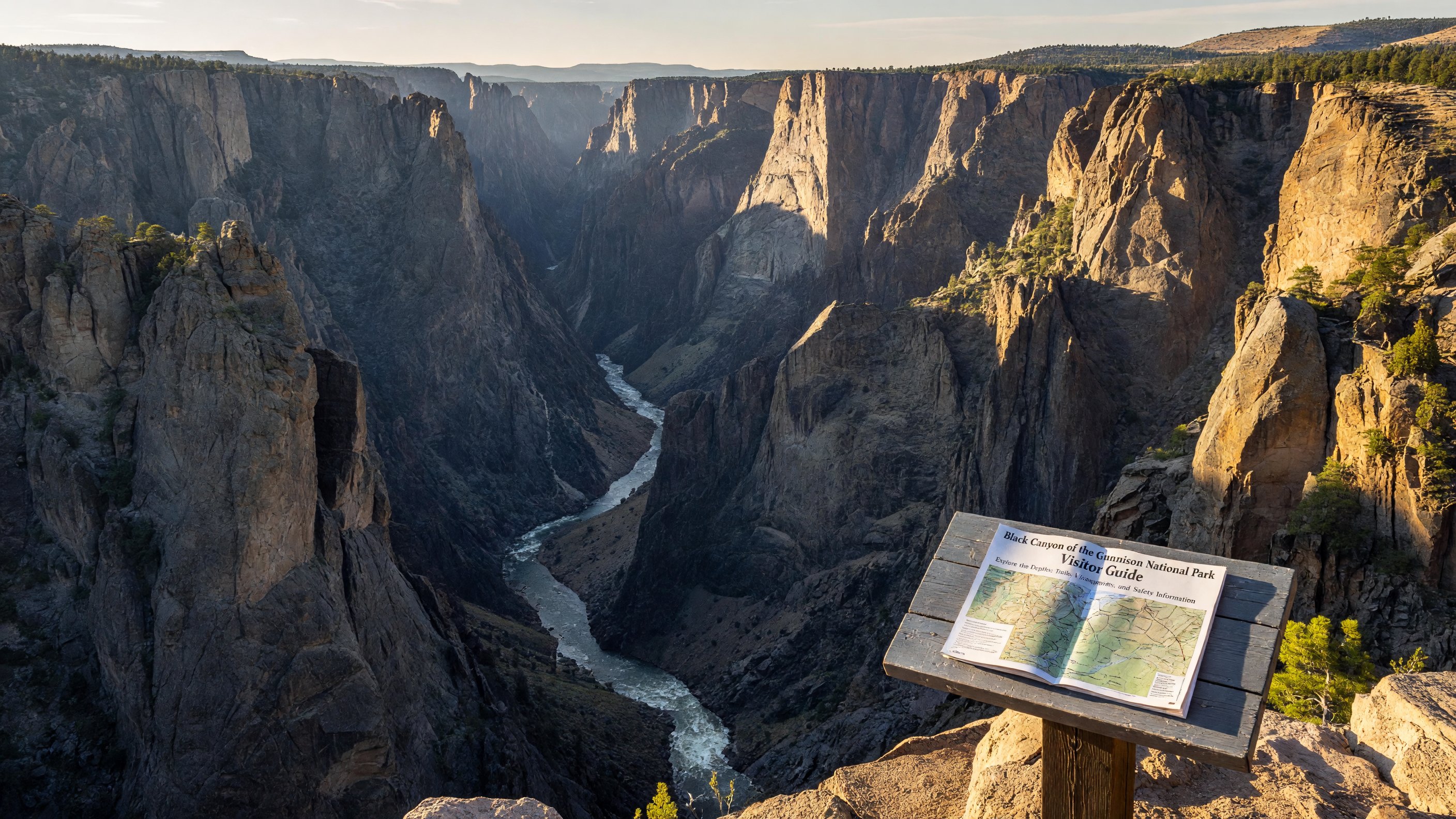
For broader Colorado trip planning with parks in this region, the Rocky Mountain National Park visitor guide covers the mountains to the north, and the Black Canyon of the Gunnison National Park guide covers another extraordinary western Colorado monument worth pairing with a Florissant visit on a multi-day swing.
Is Florissant Worth a Special Trip?
Honest answer: Florissant doesn’t compete with the headline Colorado parks for sheer visual drama. It earns its place differently. If you travel with any interest in deep time, paleontology, or the geological history of the West, this is a site that delivers genuine scientific weight in an accessible package. The Big Stump alone — that 14-foot circle of stone in a mountain meadow — is one of the stranger and more humbling things you can stand next to in a Colorado national park.
If you’re already in the Colorado Springs area, it’s an easy decision. If you’re routing through on the way west, it’s worth the detour off US-24. What it isn’t is a substitute for a full mountain park experience — pack realistic expectations for a compact, accessible monument rather than a vast wilderness destination, and you’ll leave satisfied.
Frequently Asked Questions
How big is Florissant Fossil Beds National Monument? About 6,000 acres in Teller County, Colorado, at roughly 8,400 feet elevation. A compact site most visitors cover in a half-day to full day.
How old are the fossils at Florissant? Approximately 34 million years old — late Eocene epoch. Over 1,800 invertebrate species and 1,500 plant species documented, making it one of the world’s most significant Eocene fossil deposits.
When was it designated a national monument? August 1969, when President Nixon signed the designation following the Defenders of Florissant conservation campaign that stopped planned housing development over the fossil beds.
How wide is the Big Stump petrified redwood? Up to 14 feet in diameter. It’s a silicified remnant of a Sequoia affinis tree buried by volcanic lahars roughly 34 million years ago.
Is the Petrified Forest Loop wheelchair accessible? Yes. The 1.1-mile Petrified Forest Loop is paved and flat — one of the most accessible trails in any Colorado national monument. Other trails are natural surface.
Can you collect fossils? No. All specimens are federally protected. Fossil collecting is strictly prohibited throughout the monument.
What is the best time of year to visit? Fall (September–November) for cooler temperatures, minimal crowds, elk activity, and excellent photography light. Summer is comfortable but bring layers for afternoon thunderstorms.
How far is it from Colorado Springs? About 35 miles west via US-24 West, roughly a one-hour drive. Woodland Park is the closest town at about 20 miles east of the monument.