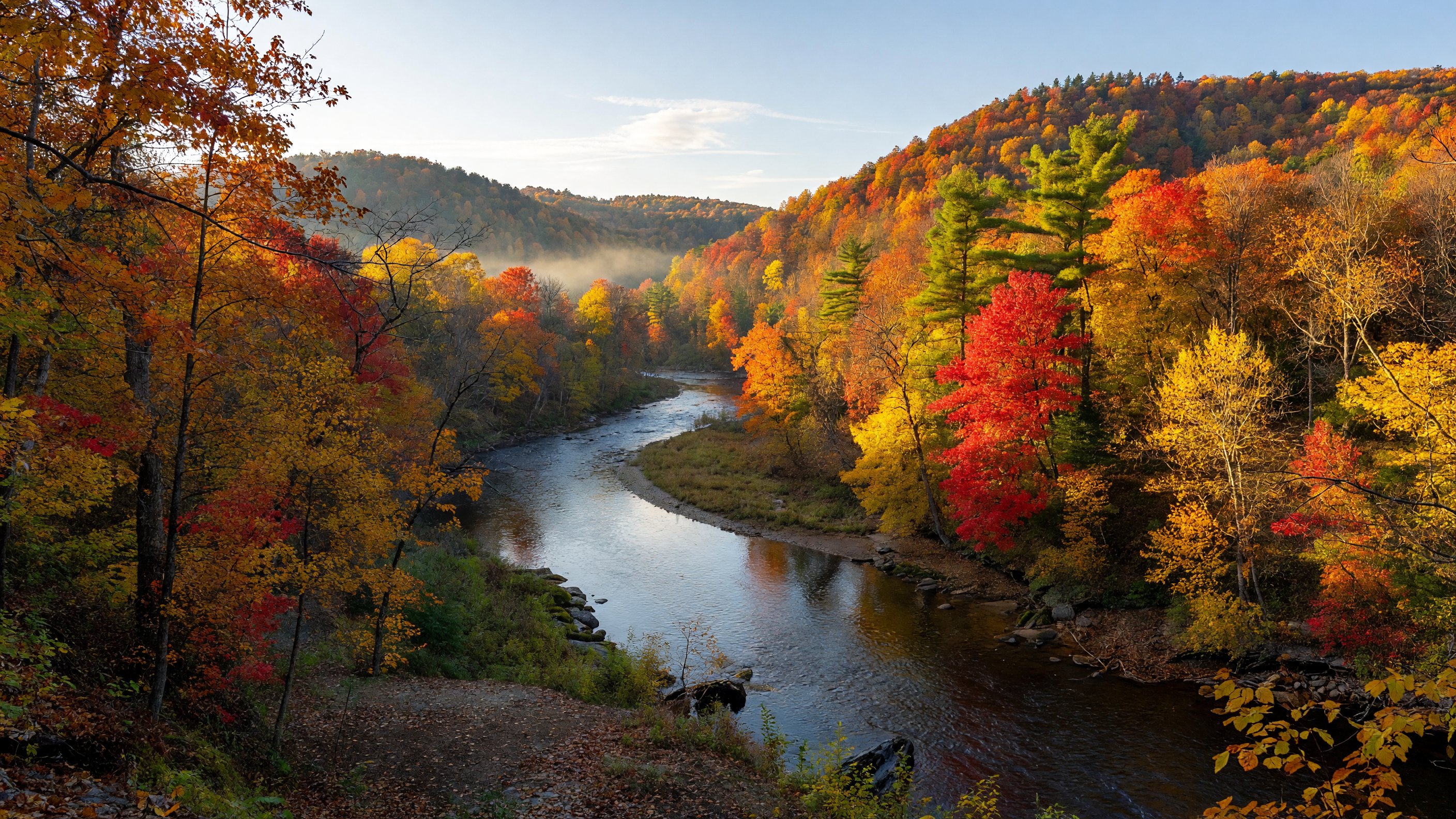
There’s a persistent myth that experiencing a national park means booking flights to Utah or driving across three states to reach a wilderness trailhead at dawn. Cuyahoga Valley National Park exists to disprove that myth. Tucked between Cleveland and Akron in northeastern Ohio, it sits within an hour’s drive of more than four million people — and it charges no entrance fee, requires no timed-entry permit, and offers the kind of layered, come-back-repeatedly landscape that most parks spread across a week-long itinerary.
This is Ohio’s only national park, and it punches well above its geographic weight. More than 125 miles of trails cover forested ravines, restored wetlands, historic canal corridors, and open farmland. A vintage scenic railroad runs through the valley floor. Several waterfalls — including one of the most photographed cascades in the state — are accessible within a short walk of the parking lot. And for families navigating a first national park visit, Cuyahoga Valley offers something genuinely rare: a full national park experience without the logistical gauntlet of a backcountry permit system, a 14-hour drive, or a $35-per-vehicle fee at the gate.
The short version: you don’t need a 2,000-mile road trip to visit a national park. You might just need a tank of gas and a Tuesday.
What to Know Before You Go: Free Entry, No Permits Required
Cuyahoga Valley does not charge an entrance fee. No pass is required, no reservation is needed for the park itself, and parking is free at all trailheads. This is not a temporary policy or a special event weekend — the park has been free since its establishment. If you have an America the Beautiful annual pass from visiting a fee-charging park, it works here too, but you don’t need it.
The park covers approximately 33,000 acres along the Cuyahoga River corridor between the two cities. It is open year-round, 24 hours a day. There are no gates and no checkpoints. You can simply park and walk. This makes Cuyahoga Valley one of the most genuinely accessible national parks in the country — both in terms of geographic proximity and in terms of cost, which is zero.
The nearest major gateway areas are Brecksville, Peninsula, and Valley View. Interstate 77 and Interstate 80 (the Ohio Turnpike) both provide access, making the park reachable on a weekday lunch hour from downtown Cleveland or a Saturday morning from Akron. The park’s main visitor contact facilities are the Canal Exploration Center in Valley View and the Boston Mill Visitor Center in Peninsula — both are worth a brief stop for current trail conditions, maps, and ranger recommendations.
Brandywine Falls: The Park’s Signature Waterfall
If you only have two hours, go to Brandywine Falls. The 65-foot cascade where Brandywine Creek drops over a ledge of sandstone and shale is one of the most photographed spots in Ohio, and it earns the reputation. A surrounding canopy of hemlocks and hardwoods frames the falls year-round, and a boardwalk trail makes it approachable for almost every visitor.
The Brandywine Gorge Loop is 1.4 miles round-trip and takes about an hour. The NPS has confirmed that the trail is wheelchair accessible to the first boardwalk overlook — this initial viewing platform provides a direct sightline to the full cascade. A spur off the main boardwalk descends closer to the base via numerous steps, which is not accessible to all visitors, but the overlook view from the accessible section is genuinely excellent and does not feel like a consolation prize.
A few practical notes on timing: spring brings the strongest flow, fed by snowmelt and rain, and the sound of the falls carries further through the still-bare trees. Fall foliage surrounds the falls with color from mid-October through early November. Winter visits, when the cascade partially freezes into ice columns and formations, are underrated — the gorge is quieter, and the ice transforms the scene entirely. Summer mornings are beautiful but can bring crowds by 10 a.m.; plan to arrive by 8 or 9 if you want the boardwalk to yourself.
Parking at the Brandywine Falls lot fills on popular weekend mornings from May through October. If it’s full, the Inn at Brandywine Falls (see lodging section) has an overflow area, and there are additional trailhead lots within a short drive.
Cuyahoga Valley Scenic Railroad: The Ride Worth Planning Around
The Cuyahoga Valley Scenic Railroad is one of the most unusual national park amenities anywhere in the system. A heritage rail line operating as an official NPS concessioner, it runs through the heart of the park and offers a genuinely different perspective on the valley — slow, elevated, moving through forest corridors and wetland edges that roadside visitors never see.
The practical case for the train is this: ride one-way in one direction, then hike or bike the Towpath Trail back to your starting point. The railroad and the Towpath run parallel through much of the park’s length, which means you can effectively cover 10 or 15 miles of the valley without any shuttle logistics or a second car. It’s one of the best self-guided trip designs in the Eastern national park network.
The standard excursion run is a relaxed experience suitable for all ages. But the railroad’s seasonal special excursions are what fill the calendar: fall foliage trains in October, holiday-themed runs in December, breakfast excursions, and the Steam in the Valley events featuring the restored Nickel Plate Road locomotive No. 765. These sell out. Book ahead through CVSR’s website — the railroad is a nonprofit and works directly with the park, but tickets are not sold through NPS or recreation.gov.
Multiple boarding stations serve the park, including Rockside Station in Independence, Peninsula Depot (the most central), and Akron Northside. This flexibility makes it easy to design a one-way trip without backtracking.
The Ohio & Erie Canal Towpath Trail: Biking and Walking Through History
The Towpath Trail is the park’s workhorse — the trail that rewards both casual walkers and serious cyclists, and the one that makes the most sense for a half-day or full-day outing. The trail runs 19.5 miles through the park on a flat, firm, crushed-limestone surface that is wheelchair accessible along its paved sections. It traces the original route of the Ohio & Erie Canal, which opened in 1832 and connected Cleveland’s Lake Erie port to the Ohio River at Portsmouth, transforming the state’s interior economy within a generation.
The trail passes through a mix of forest, restored wetland, open meadow, and small historic villages. Interpretive panels explain the lock system that lifted and lowered canal boats through the terrain changes, the lives of the boatmen and lock-keepers, and the engineering ingenuity of a pre-industrial society moving enormous tonnage by mule power. You don’t need to cover all 19.5 miles to feel the history — even a 4-to-6-mile stretch between two trailheads gives you the corridor.
For cyclists, the Towpath is one of the finest urban-edge trail experiences in the Midwest: smooth enough for a road bike, scenic enough to hold your attention for hours, and connected enough to downtown Akron and Cleveland that some commuters use segments of it daily. Bike rentals are available at several locations near Peninsula. The trail connects beyond the park’s boundaries to a much longer regional trail network extending north into Cleveland and south toward Akron and beyond — check the Canalway Ohio trail corridor information for the full regional picture.
Other Trails Worth Your Time
The Towpath and Brandywine Falls get most of the attention, but Cuyahoga Valley has a deeper trail menu worth exploring.
Ledges Trail (2.2 miles, approximately 1.5 hours): This loop through the Ritchie Ledges area is the park’s best geological hike. Sharon conglomerate rock formations — ancient sandstone riddled with rounded quartz pebbles — form low cliffs and overhangs that create cool, shaded corridors even in midsummer. The trail includes some rocky sections and steps; it is not accessible to all visitors but is manageable for most able-bodied hikers including older kids. The Ledges Shelter area at the trailhead is a good picnic spot.
Blue Hen Falls (1.6 miles round-trip): A shorter waterfall hike on the Boston Run Trail, leading to a tiered cascade in a quieter section of the park. It lacks the drama of Brandywine Falls but draws smaller crowds and makes a worthwhile add-on if you’re already in the southern portion of the park.
Bridal Veil Falls: A smaller, more intimate cascade accessible via a short spur near the Tinkers Creek Gorge area. It’s easy to add to a broader hike through that section of the park and rewards visitors who venture beyond the two main waterfall destinations.
Beaver Marsh (accessible from Towpath Trail near Ira Road): Not a trail in its own right, but one of the best wildlife-watching stops in the park. A reclaimed canal area where a beaver colony transformed overgrown scrubland into an active wetland, the marsh consistently produces wood ducks, great blue herons, great egrets, and on lucky days, a beaver itself moving through the water. Bring binoculars.
Wildlife: What You’ll Actually See
Cuyahoga Valley’s location in a heavily developed corridor makes its wildlife diversity genuinely surprising. The park supports over 200 bird species, more than 30 mammal species, and a full complement of the reptiles and amphibians characteristic of Ohio’s mixed hardwood forest ecosystem.
For birders, the park is excellent across seasons. Bald eagles have nested here in recent years — the Cuyahoga River corridor provides hunting territory for a bird that was nearly extirpated from Ohio by the mid-twentieth century. Great blue herons fish the shallows year-round. Beaver Marsh and the restored wetlands along the Towpath are reliable for waterfowl during migration, and barred owls are vocal residents in the forest segments. Spring migration brings warblers, vireos, and thrushes through the valley in numbers.
White-tailed deer are so abundant as to be nearly guaranteed on any visit. Red foxes are regularly spotted at dawn and dusk along the Towpath. The river otter population, reestablished through conservation efforts, appears occasionally in the Cuyahoga itself and in wetland areas — an unexpected sighting that tends to stop hikers in their tracks.
The park’s conservation story is partially one of water quality. The Cuyahoga River gained infamy when its heavily polluted lower section caught fire in 1969, an event that helped galvanize the passage of the Clean Water Act in 1972. Today the river running through the national park is substantially cleaner, and the return of wildlife sensitive to water quality — otters, bald eagles, native fish species — is a measurable marker of that recovery. The NPCA’s information on Cuyahoga Valley provides context on the park’s conservation history for visitors interested in the larger story.
Fall Foliage: Timing and What to Expect
Cuyahoga Valley is a legitimate fall foliage destination, and the combination of rolling forested terrain, waterfalls, and the Scenic Railroad makes October visits particularly rewarding. The NPS confirms that fall foliage typically peaks in mid-October — roughly the second and third weeks of the month — when the mixed hardwood canopy of maples, oaks, beeches, and hickories turns in overlapping waves.
The Brandywine Falls gorge, framed by the surrounding hemlocks and maples, shows fall color well even in partial foliage. The Ledges area is excellent because the open rock formations give you elevated vantage points into the canopy below. And the Scenic Railroad’s fall foliage excursions — specifically designed for the color season — sell out weeks in advance, so book in October as soon as the schedule is released, not the week before.
Peak foliage coincides with the park’s busiest weekend crowds of the year. Popular trailhead lots at Brandywine Falls and the Ledges can fill by 9 a.m. on October weekends. Weekday visits during foliage season are a genuine advantage — same color, a fraction of the people.
Winter Activities: An Underrated Season
Winter turns Cuyahoga Valley into a different park. When snow conditions allow, the Towpath Trail and several connecting loops become cross-country ski and snowshoe routes — the flat, wide surface of the Towpath is ideal for classic skiing and beginners on snowshoes. The park does not groom trails, but packed snow on the Towpath provides serviceable conditions after significant snowfall. Check recent conditions with the park before driving in specifically for skiing.
Brandywine Falls in winter, when the cascade partially or fully freezes, is worth a separate trip. Ice formations build up over the viewing platforms and cascade walls in extended cold stretches, and the boardwalk remains open when safe. Blue Hen Falls and Bridal Veil Falls also freeze in hard winters. These winter waterfall visits are free, uncrowded, and photographically excellent — exactly the kind of experience that justifies keeping this park on rotation year-round rather than treating it as a summer-only destination.
Wildlife watching is arguably better in winter than summer: the bare trees eliminate the leaf cover that hides birds from August through September, and many species are more active and visible in the cold. Bald eagles, in particular, are regularly spotted from the Towpath in winter months when open water in the river supports hunting.
Lodging: Plan to Stay Nearby
Cuyahoga Valley is unusual among national parks in that the majority of visitors stay outside the park entirely — in Cleveland, Akron, or the smaller communities that ring the valley. This is not a criticism; it’s a function of the park’s geography and the density of accommodation options within a short drive.
Within the park boundaries, two lodging options exist, and both require advance planning.
Stanford House is a historic property managed by Hostelling International USA, offering hostel-style lodging in a restored nineteenth-century farmhouse. It’s a genuinely distinctive experience — inexpensive, rustic, and positioned directly on the Towpath Trail. Reservations are essential; the property is small and fills for weekends throughout the spring and fall. Check availability directly through HI USA.
Inn at Brandywine Falls is a private bed-and-breakfast operating in a historic Greek Revival farmhouse adjacent to the Brandywine Falls trail. It offers six rooms, books up months in advance for fall foliage season, and is run independently of the NPS. This is not a park concessioner property — it’s a private B&B operating on land adjacent to the park. Booking directly through the inn’s own channels is the only path; it does not appear on the major travel booking platforms.
For most visitors — especially families with young children, larger groups, or those traveling on a standard hotel budget — Cleveland and Akron provide abundant options within 30 to 45 minutes of any part of the park. Both cities offer the full range of chain hotels and independent properties, and neither city’s accommodation market is particularly expensive by national-park-gateway standards.
Accessibility Summary
Cuyahoga Valley is one of the more accessible national parks for visitors with mobility limitations, though the level of access varies significantly by trail.
- Brandywine Falls boardwalk: Wheelchair accessible to the first viewing overlook. The spur trail to the base includes numerous steps and is not accessible.
- Ohio & Erie Canal Towpath Trail: The paved sections are wheelchair accessible; the full 19.5-mile crushed-limestone surface is firm and flat with minimal elevation change (135 feet total), making it accessible for many mobility-aid users.
- Ledges Trail: Rocky terrain with steps; not accessible.
- Beaver Marsh viewing area: Accessible from the Towpath Trail, which is flat and firm.
- Cuyahoga Valley Scenic Railroad: The railroad provides accessible boarding; contact CVSR directly for current accommodation specifics and accessibility options.
The official NPS accessibility page for Cuyahoga Valley has current details, including accessible parking locations and facility information for the visitor centers.
Frequently Asked Questions
Is there an entrance fee for Cuyahoga Valley National Park? No. The park is completely free to enter year-round. No pass, reservation, or timed-entry permit is required. Parking is also free at all trailheads.
How big is Cuyahoga Valley National Park? Approximately 33,000 acres along the Cuyahoga River corridor between Cleveland and Akron. It is Ohio’s only national park.
What is the Cuyahoga Valley Scenic Railroad? An NPS concessioner operating a heritage rail line through the park. It offers standard excursions and seasonal themed runs (fall foliage, holiday trains, steam events). Book through cvsr.org.
Is Brandywine Falls accessible for wheelchair users? The boardwalk to the first overlook is wheelchair accessible. The spur to the base involves steps and is not accessible. The overlook provides a full view of the 65-foot cascade.
When does fall foliage peak? Mid-October, typically the second and third weeks of the month. Weekday visits avoid the heaviest weekend crowds.
Can I ski or snowshoe in winter? Yes. The Towpath Trail and connecting loops are used for cross-country skiing and snowshoeing when snow conditions allow. Trails are not groomed; check conditions before visiting specifically for winter sports.
Is there lodging inside the park? Stanford House (hostel-style, on the Towpath) and the Inn at Brandywine Falls (private B&B) are the two options. Both fill quickly. Most visitors stay in Cleveland or Akron.
How close is the park to Cleveland and Akron? About 15 miles from downtown Cleveland and 10 miles from downtown Akron. Easily accessible via I-77 and I-80.