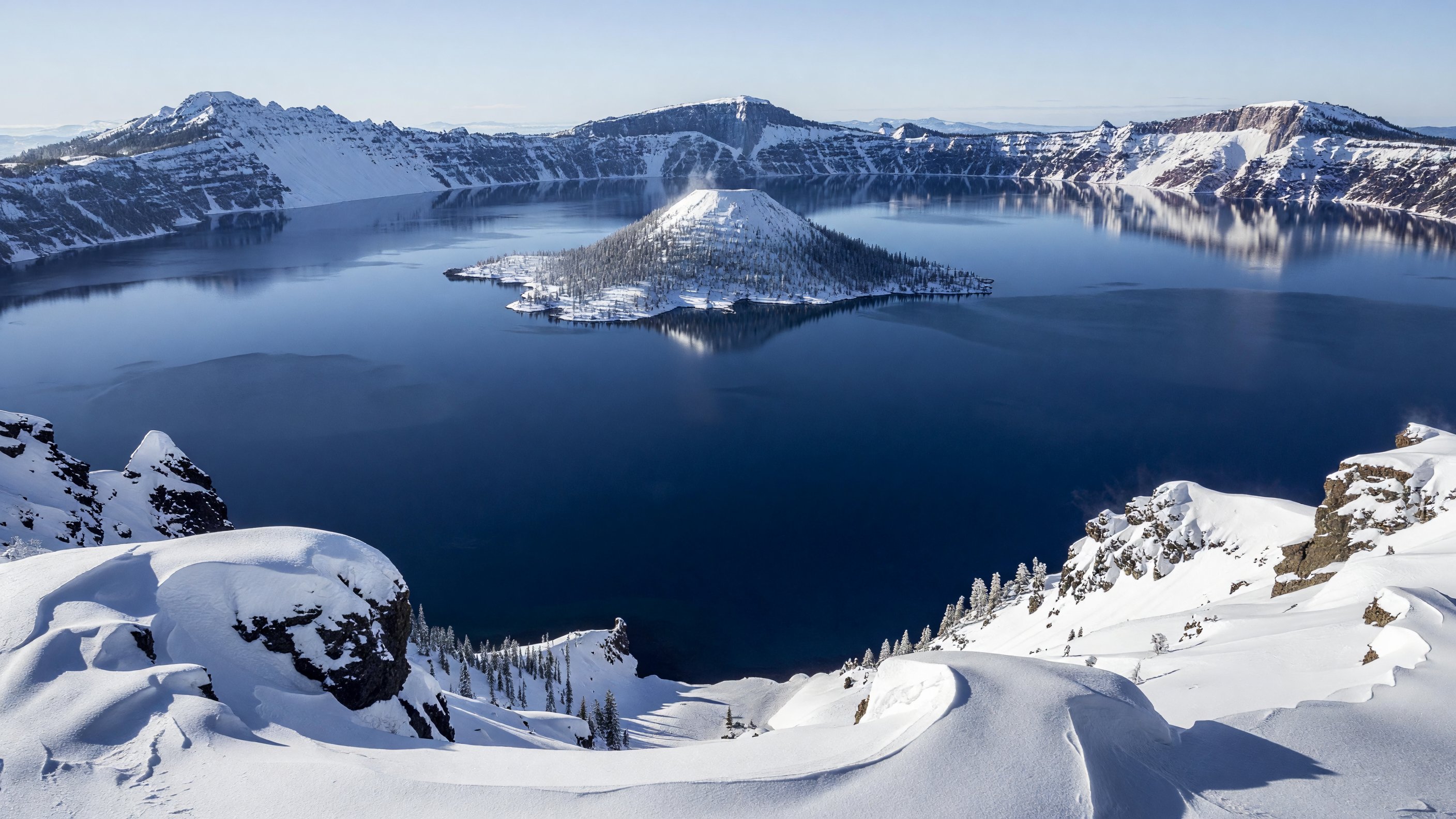
The lake doesn’t freeze. That’s the first thing worth knowing about Crater Lake in winter — beneath whatever depth of snow blankets the rim, beneath whatever grey sky rolls in off the Pacific, the water stays its impossible blue. I’ve photographed a lot of national parks in winter, and most of them turn monochromatic — brown-grey desert, white-grey alpine. Crater Lake in December does something different. The snow on the caldera rim makes the lake look even more vivid by contrast, and the absence of crowds means you can stand at a viewpoint for thirty minutes and hear nothing except wind and the occasional raven.
That said, winter at Crater Lake requires specific preparation. Rim Drive closes. Most facilities close. Chain laws apply. The nearest year-round hotel is 30 miles away. If you arrive expecting a summer-style visit and haven’t accounted for these realities, you’ll spend an afternoon in a snowed-in parking lot wondering what went wrong. This guide covers what’s actually open, what you can do, how to photograph the place in its best season, and how to stay safe.
What Actually Opens in Winter: South Entrance Only
The north entrance to Crater Lake closes for winter — typically by late October or November — and does not reopen until the snowpack clears, usually late May or June depending on the year. The south entrance off Highway 62 is open year-round, and this is your only way into the park from late fall through late spring.
Rim Drive, the 33-mile road that circles the caldera, closes to vehicles when winter snowfall arrives — typically by November. Sections of the west rim are plowed for winter recreation (more on that below), but you cannot drive the full loop. The park headquarters building and the Steel Visitor Center, both located near the south entrance, remain open year-round with limited hours. Check nps.gov/crla for current hours before your visit — reduced winter staffing means hours can vary.
Road conditions on Highway 62 approaching the south entrance can change rapidly in storm cycles. The ODOT TripCheck tool shows current conditions on Oregon state highways and is the most reliable real-time source before you leave for the park. Search for Highway 62 and the Crater Lake junction.
The Snow: What to Expect
Crater Lake National Park receives an average of approximately 504 inches of snow annually — roughly 42 feet — making it one of the snowiest places in the contiguous United States. The Cascades intercept Pacific moisture systems throughout fall and winter, and the park’s elevation (the rim sits between 7,000 and 8,000 feet) means that precipitation which falls as rain at lower elevations often arrives as heavy, wet Pacific Northwest snow at the caldera.
Snowfall is not evenly distributed across the season. December typically sees the snowpack building rapidly — it’s not uncommon to arrive in early December when the access road is clear and return a week later to find 3 or 4 feet of new accumulation. By mid-winter the snowpack regularly exceeds 10 feet in depth at the rim. The south entrance road is plowed continuously, but the last few miles approaching the rim can have significant snowpack on the margins and occasional drifting.
What this means practically: carry chains and know how to put them on. Oregon law requires chain controls on mountain highways when conditions warrant, and the Crater Lake access road triggers these controls regularly. Check ODOT TripCheck before departure every time, not just on the first day of a trip.
Winter Activities
Ranger-Led Snowshoe Walks
The park runs free ranger-led snowshoe walks on weekends through the winter season, typically from late November through early April depending on snowpack. These walks depart from the rim near park headquarters and last approximately 2 hours, covering one to two miles of moderate terrain. Snowshoes are provided at no charge — you don’t need your own gear.
These walks are genuinely well done. Rangers cover the park’s geology, winter ecology, and the physical processes that produce the lake’s color — the same information is available in the visitor center, but hearing it at the rim edge with the lake below you in snow silence is different. Walk availability and departure times are posted at nps.gov/crla/planyourvisit/winter-activities.htm. Advance reservations are required — check the NPS page for the booking link for your visit dates. Space is limited, so book as early as possible once the seasonal schedule is posted.
Cross-Country Skiing the West Rim
A section of the west rim of Crater Lake is groomed or tracked for cross-country skiing during winter. The route runs from the rim area near park headquarters toward Discovery Point, roughly 2.5 miles one-way. It follows the same alignment as the summer Rim Drive, meaning the lake views — directly below you as you ski — are continuous.
This is not a groomed Nordic center with rental equipment and a lodge. It’s a backcountry-adjacent ski route in a remote mountain environment. You should be a competent skier, carry emergency gear (extra layers, food, water, navigation), and understand avalanche basics before attempting the full run. The route has some exposure along the rim edge. That said, the lower portions near the parking area are accessible to intermediate skiers, and the payoff — skiing the rim of a volcanic caldera with almost no one else around — is genuinely hard to find anywhere else in the Lower 48.
Snowshoeing and Sledding at Discovery Point
Beyond the ranger walks, the area around Discovery Point on the west rim serves as the primary winter recreation hub. The open snow fields between the parking area and the rim are popular for snowshoeing, and the hill near Discovery Point functions as an informal sledding area. This is a designated sledding spot — bring a sled or a snow disc. Backcountry snowshoeing is permitted throughout the park without a permit, though you should carry a map and check in with rangers about current conditions and avalanche risk before heading into unmarked terrain.
The north side of the caldera rim, which you cannot drive to in winter, is also accessible on foot or skis — rangers can advise on the current snowpack and whether the route to the north rim overlooks is reasonable given conditions on your visit dates.
Accommodations: What’s Closed, What Isn’t
This is where many visitors get into trouble. The two options most associated with staying inside Crater Lake National Park both close for winter:
Crater Lake Lodge — the historic rim-top lodge with direct lake views — closes in early October and does not reopen until mid-May. This is not a soft close with some rooms available; the building shuts completely. If you’ve seen photographs of the lodge with snow on the grounds, they were taken in early October or after reopening in spring.
Mazama Village — the campground and cabin complex near the south entrance — also closes for the season, typically by late September, reopening in late May depending on snowpack.
Your year-round accommodation options require leaving the park entirely:
Diamond Lake Resort (approximately 30 miles north, near Highway 138) is the closest year-round lodging to the park. The resort offers cabin and lodge accommodations, and Diamond Lake itself is a winter recreation destination — snowmobiling, ice fishing, and cross-country skiing are all available in the surrounding Umpqua National Forest. This is the most logical base for a multi-day Crater Lake winter visit.
Klamath Falls (approximately 60 miles south on Highway 97) is the largest city near the park and has the full range of hotel options. The drive up Highway 62 to the park is scenic and straightforward on a clear day, though it requires chain preparedness in storm conditions.
Union Creek, a small community on Highway 62 about 23 miles from the park’s south entrance, has a historic lodge and a few rental cabins that are worth checking — they’re closer than Klamath Falls and quieter than Diamond Lake in winter.
Photography: What Winter Does to the Light
Crater Lake is one of the most photographed landscapes in the Pacific Northwest, and most of those images were made in summer. Visiting in winter gives you access to something most photographers haven’t shot: Wizard Island under snow, the deep blue of the lake against a white caldera rim, and winter light on the volcanic rock formations that summer’s green and blue palette tends to obscure.
Light Direction and Timing
In December, the sun tracks low across the southern sky. At Crater Lake’s latitude (42.9° N), sunrise in December comes around 7:45 AM and sunset around 4:30 PM. The sun never gets very high — by solar noon it’s only about 24° above the horizon — which means you get extended golden-hour quality light rather than the harsh overhead midday sun that makes summer photography harder.
The best light comes from the south and southwest rim overlooks in the morning, when the low sun comes over your shoulder and rakes across Wizard Island and the caldera walls. By afternoon the sun is dropping toward the western horizon, and the north and east rim areas (if reachable on foot or skis) catch the warm late light well.
Composition for Winter Crater Lake
The standard approach — shoot across the lake toward Wizard Island — works in any season. In winter, add foreground snow patterns: wind-sculpted snowdrifts along the rim edge, boot tracks in fresh snow leading toward a viewpoint, the contrasting texture of dark volcanic rock emerging from white snow. The color separation between the snow and the lake is your key compositional asset.
A polarizing filter makes a meaningful difference at Crater Lake in any season by deepening the blue of the water, and it remains useful in winter even with overcast skies to control glare from snow. For long exposures in low winter light, a sturdy tripod is essential — the rim is exposed and wind can be strong.
Fog and partial cloud cover produce some of the most dramatic Crater Lake images. When a cloud layer sits just above the rim level, you can shoot the lake from above the cloud with blue sky and clear water against grey mist — this happens more frequently in winter than summer when weather systems are more active.
Gear Considerations for Cold-Weather Shooting
Batteries drain significantly faster in cold weather. Carry at least two fully charged batteries for any serious photography session and keep the spares in an inside pocket against your body. Memory cards perform fine in cold but can become stiff — avoid swapping cards in gloves when possible.
Moisture condensation is a real concern when you bring cold equipment into a warm car. Give your gear time to warm up gradually in a bag before exposing it to the warm interior environment, or use a sealed bag to control the transition.
Hand warmers in your gloves extend the time you can comfortably operate a camera at the rim on a cold day. Shooting in thin liner gloves rather than heavy mitts gives you better dial control; keep the heavy mitts accessible for when you’re not actively shooting.
Safety: Chains, Avalanche Risk, and Winter Driving
Chain and 4WD Requirements
Oregon requires chains or traction tires on mountain roads when chain controls are in effect. On the Highway 62 approach to Crater Lake, chain controls are common throughout winter and essentially certain during and immediately after snowstorms. All-wheel drive or 4WD alone does not satisfy chain requirements under Oregon law when controls are active — you need either chains or approved traction tires (with the three-peak mountain snowflake symbol). Carry chains even if your vehicle is AWD and know how to install them. The ODOT TripCheck site shows active chain controls in real time.
Rental cars, particularly those not configured for mountain driving, may require chains that they don’t come equipped with. If you’re renting a vehicle for a winter Crater Lake trip, confirm the chain situation with the rental company before picking up.
Avalanche Awareness
The terrain around the caldera rim has avalanche potential. The steep inner walls of the caldera are not safe for off-trail travel; backcountry travel in the surrounding Cascade terrain requires avalanche awareness, appropriate safety gear (beacon, probe, shovel), and training in avalanche rescue. The designated winter recreation areas — the west rim ski route, the Discovery Point area — are managed by rangers and have lower inherent avalanche risk than the undeveloped backcountry.
For backcountry skiers or snowshoers planning routes beyond the designated areas, check the Northwest Avalanche Center forecasts for the southern Cascades zone before entering the field. NWAC forecasts are specific to terrain zones and are updated daily during the winter season.
Cold and Exposure
Crater Lake’s elevation and exposed rim location mean conditions are genuinely harsh in winter. Temperatures regularly drop below 0°F at night, and wind chill at the rim can be severe even on days that look mild in the parking lot. Dress in layers with a waterproof outer shell, carry extra insulation in your pack, and tell someone your itinerary if you’re doing any extended skiing or snowshoeing beyond the immediate parking area.
Frequently Asked Questions
Is Crater Lake open in winter?
Yes, Crater Lake National Park is open year-round, but access is limited in winter. Only the south entrance off Highway 62 remains open; the north entrance closes seasonally. Rim Drive closes to vehicles when winter snow arrives and does not reopen until summer snowpack clearing, typically in July. The Steel Visitor Center near the south entrance is open year-round with reduced winter hours.
When does Crater Lake Lodge close for winter?
Crater Lake Lodge closes in early October (typically) and reopens in mid-May. It is fully closed during winter — no partial availability. The nearest year-round lodging is Diamond Lake Resort approximately 30 miles north of the park, or hotels in Klamath Falls approximately 60 miles south.
How much snow does Crater Lake get?
Crater Lake National Park averages approximately 42 feet (about 504 inches) of snow annually, one of the highest snowfall averages of any national park in the contiguous United States. The snowpack regularly exceeds 10 feet at the rim by mid-winter. The south entrance road is plowed continuously, but chain controls on the Highway 62 approach are common throughout the season.
Do I need chains to visit Crater Lake in winter?
Yes, in most cases. Oregon law requires chains or traction tires (three-peak mountain snowflake symbol) when chain controls are active on mountain highways. Chain controls on the Highway 62 approach to Crater Lake’s south entrance are common throughout winter and essentially certain during storms. AWD or 4WD alone does not satisfy chain requirements when controls are posted. Check ODOT TripCheck for current controls before departing.
Does Crater Lake freeze in winter?
Crater Lake almost never freezes completely. The lake is so deep — 1,943 feet — that its thermal mass prevents surface freezing in most winters. In extremely cold winters, thin ice can form near the shoreline or in sheltered coves, but full-lake freezing is extremely rare. The lake’s blue color remains visible year-round, making winter visits visually distinctive despite the snow.
What are the ranger snowshoe walks at Crater Lake?
The park runs free weekend ranger-led snowshoe walks from approximately late November through early April, depending on snowpack conditions. Snowshoes are provided at no charge. Walks last about 2 hours, cover 1–2 miles, and depart from the rim area near park headquarters. Advance reservations are required — check nps.gov/crla for booking links and current schedules.
What winter activities are available at Crater Lake?
The main winter activities are ranger-led snowshoe walks (weekends, free snowshoe rental), cross-country skiing along the west rim toward Discovery Point, snowshoeing on designated and backcountry routes, and informal sledding at Discovery Point. Rim Drive is closed to vehicles in winter. Boat tours to Wizard Island and the Cleetwood Cove lakeshore trail are not available until summer.
For Pacific Northwest parks planning, our guides to Mount Rainier National Park and Oregon Caves National Monument cover other year-round destinations in the region. For a broader look at which parks are worth visiting in snow season, see our best national parks for winter visits guide.
For current road conditions on the approach to Crater Lake, use ODOT TripCheck for Highway 62. Official park information, winter schedules, and ranger program updates are at nps.gov/crla. The National Parks Conservation Association provides broader advocacy and park news coverage.