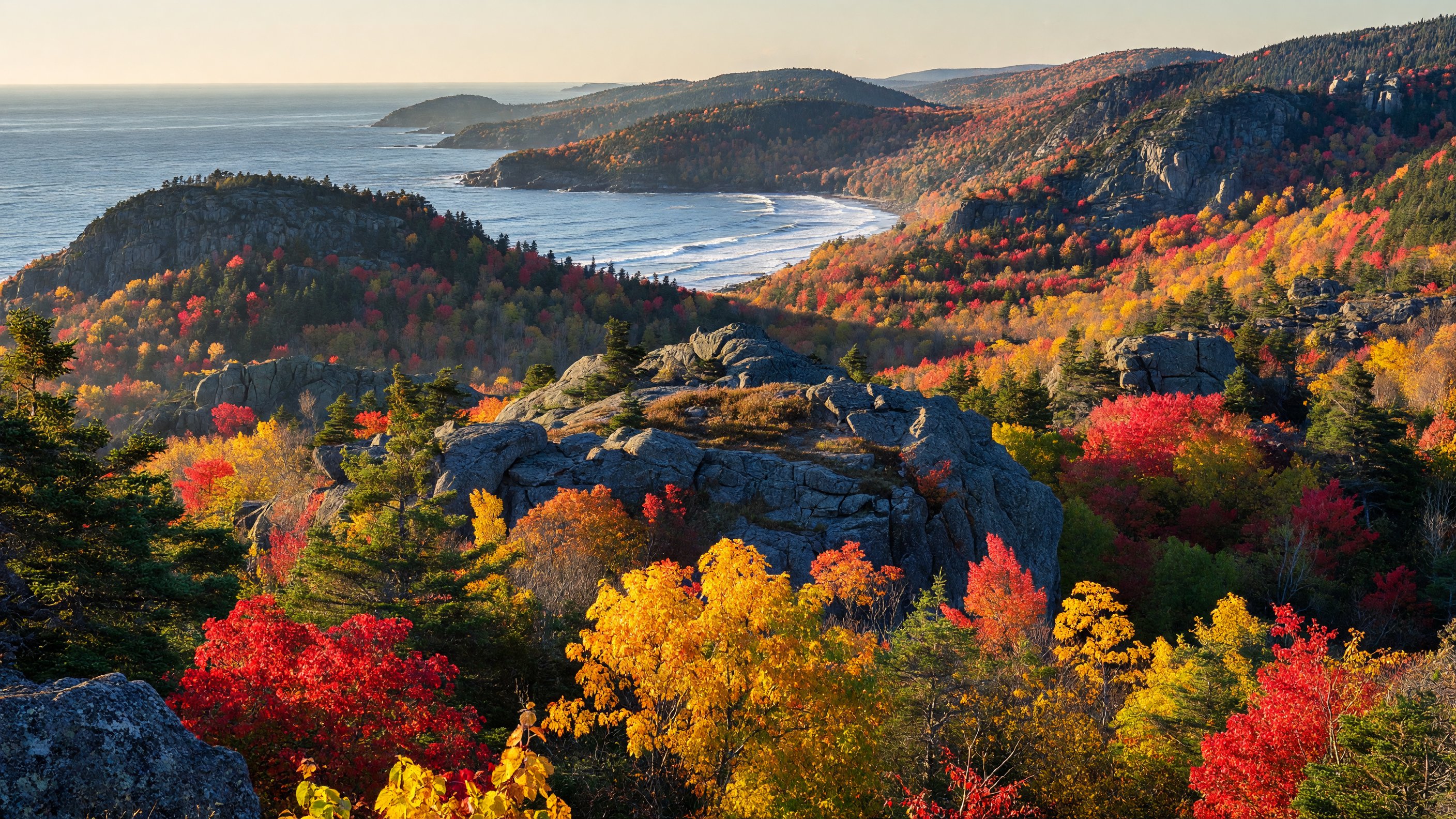
October is the month Acadia National Park earns its reputation. The combination of peak foliage, smaller crowds, crisp mornings, and the return of first-sunrise status on Cadillac Mountain makes early-to-mid October the sweet spot for a visit to this extraordinary stretch of Maine coastline. If you are planning a fall trip — especially with family — the decisions you make in the next few weeks will determine whether you spend your mornings on a granite summit watching the sky turn gold or sitting in a line of cars at a closed gate.
This guide is built around the practical planning decisions that matter most for a fall visit: when to go, how to secure the reservations that are actually required, where to hike with kids versus where to leave them behind, and how to navigate Bar Harbor without surrendering half your day to logistics.
What Is Acadia National Park?
Acadia encompasses approximately 50,000 acres spread across three distinct land units on the coast of Maine: the bulk of Mount Desert Island, the Schoodic Peninsula on the mainland (the only section accessible without a ferry or boat), and the remote southern end of Isle au Haut. Together they protect a landscape where granite mountains drop almost directly into the Atlantic — a geological collision that creates the dramatic visual contrasts the park is known for.
The park receives roughly 4 million visits annually, placing it consistently among the top ten most-visited national parks in the country. The difference from summer to fall is substantial: July and August bring heavy traffic, parking scarcity, and crowded trails, while October sees visitor numbers drop significantly even as conditions improve. Cooler temperatures make hiking more comfortable, the air is typically clearer, and the foliage transforms the forest from green to a mix of orange, red, and amber that you do not find in the Southwest parks.
The main visitor center — the Hulls Cove Visitor Center — sits just north of Bar Harbor and is the recommended first stop for orientation, maps, and up-to-date conditions.
Fall Foliage Timing: When Color Peaks at Acadia
Acadia’s foliage follows a predictable elevation gradient that gives visitors a useful planning framework. Color at the park’s highest elevations — Cadillac Mountain summit at 1,530 feet, Dorr Mountain, and the ridgeline above Gorham Mountain — typically peaks in the last week of September or first days of October. The birches and aspens at elevation turn earliest and most dramatically.
Mid-elevation forest on the slopes of Cadillac and in the carriage road network generally peaks in the first two weeks of October. This is the heart of the fall window for most visitors — the window when you get rich color across the hillsides without yet losing leaves to early storms.
Coastal lowlands and the shoreline sections of the Park Loop Road peak slightly later, often in the second or third week of October, as the moderating ocean temperature slows the cooling of air near sea level. The Ocean Path and the area around Sand Beach retain color longer than the interior ridges.
For families planning around school schedules: Columbus Day weekend (the second full weekend of October) consistently falls within the peak window for mid-elevation and coastal areas. It is also the busiest fall weekend in the park by a significant margin. If you can shift your visit one week earlier — arriving the first full week of October — you get comparable color with noticeably lighter crowds.
Foliage is largely gone by late October, though the bare granite ridges and open ocean views have their own appeal in November. The park is open year-round; the seasonal constraint is the Cadillac Summit Road reservation system, which closes for the season in late October.
The Cadillac Summit Road Reservation System
This is the single most important planning detail for an October visit, and missing it will cost you the centerpiece experience of the park.
The Cadillac Summit Road requires a vehicle reservation from May 20 through October 25 each year. Outside those dates, the road operates on a first-come, first-served basis (weather and road conditions permitting). During the reservation window, you cannot drive to the summit without a confirmed timed-entry reservation — no exceptions, no walk-up availability once slots fill.
How to book: Reservations are issued through Recreation.gov. Search for “Cadillac Summit Road” on the site. The reservation fee is $6 per vehicle, charged in addition to the standard park entrance fee. Reservations open in rolling windows — check the NPS Acadia site for the current release schedule, as the exact advance booking window changes slightly year to year. Sunrise slots — the hour before dawn through approximately 7:30 a.m. — fill within minutes of opening. If sunrise on Cadillac is on your itinerary, set a calendar reminder and book the moment reservations open.
Practical mechanics: Each reservation is tied to a specific date and time window. You must arrive within your window or your slot is forfeited. Once at the summit, there is no time limit on how long you stay — the window governs arrival, not departure. The paved summit road is well-maintained and accessible to standard passenger vehicles.
The sunrise experience: From early October through early March, the summit of Cadillac Mountain is the first point in the contiguous United States where sunlight reaches the earth each day. Arriving 45 minutes before your reservation window allows you to position yourself on the summit walk before the light appears. The summit path is paved and loops around the rocky top, with views in every direction — east over Frenchman Bay and the Porcupine Islands, south toward Isle au Haut, north toward the Canadian maritime provinces on clear days.
Bring layers. Summit temperatures in October typically run 15 to 20 degrees colder than Bar Harbor at sea level, and wind is a constant factor. Even a mild October morning at sea level can be genuinely cold on the summit at 5 a.m.
Fall Foliage Driving: The Park Loop Road
The 27-mile Park Loop Road is the primary vehicle route through the park and one of the best scenic drives in the northeastern United States. In fall, the drive through the interior forest sections — particularly the stretch from the Hulls Cove entrance past Eagle Lake toward the summit road junction — is lined with hardwood color.
The one-way southern section of the loop runs along the rocky ocean shoreline past Sand Beach, Thunder Hole, Otter Cliffs, and back north through the forest. This section is spectacular in October: the cobalt-blue Atlantic, orange and red foliage on the slopes above, and the gray granite cliffs in between. Otter Cliffs — a vertical granite headland rising 110 feet directly from the sea — is one of the most dramatic viewpoints on the loop and a reliable photography location at golden hour.
Plan 2 to 3 hours for the full loop if you stop at the main pullouts. Add more time if you plan to hike from any of the trailheads along the road.
Parking: Roadside pullouts along the ocean section fill by mid-morning on weekends even in October. Arriving before 9 a.m. gives you the best chance at popular stops without circling. The Island Explorer shuttle (see below) serves several loop road stops and is often faster than driving once lots are full.
The Carriage Roads: Best Trails for Families in Fall
John D. Rockefeller Jr. funded and oversaw the construction of 45 miles of broken-stone carriage roads through the park interior between 1913 and 1940, specifically to preserve a non-motorized alternative as automobiles began dominating travel. No motorized vehicles are permitted on the carriage roads today — they are open to hikers, cyclists, and equestrians only.
For families with younger children, the carriage roads are the most accessible and enjoyable trail system in the park. The surface is compacted gravel — smooth enough for bike trailers, strollers with larger wheels, and young hikers who are not yet comfortable on rocky terrain. Grades are gentle throughout; Rockefeller insisted on gradual curves and minimal steepness to keep the roads navigable by horse-drawn carriages.
In fall, the carriage roads are exceptional. The hardwood trees lining the interior loops turn brilliant orange and yellow while the stone bridges — 17 hand-built granite crossings over streams and gorges, each one architecturally distinct — frame the colored forest behind them. A 6 to 8 mile loop from Eagle Lake is among the best fall cycling routes in New England. Bikes can be rented in Bar Harbor from outfitters near the Village Green.
Family-recommended loops:
- Eagle Lake circuit (~6 miles, flat) — a full loop around Eagle Lake through dense hardwood forest. Accessible from the Eagle Lake parking lot off Route 233.
- Witch Hole Pond loop (~4 miles, gentle grades) — passes several of the stone bridges and a pond with good foliage reflections early in the morning.
- Around-the-Mountain connector sections — pieces of the longer network that can be combined into half-day rides.
The carriage roads connect to the summit road area and to several trailheads, making them useful as both destinations and connectors. The Friends of Acadia maintain excellent printed and digital maps of the carriage road network; pick one up at the visitor center.
Hiking: What Works for Families and What Doesn’t
Acadia has 158 miles of hiking trails ranging from flat waterfront paths to steep technical scrambles with iron rungs bolted into cliff faces. Choosing correctly matters — the consequences of taking the wrong trail with young children are real.
Jordan Pond Loop (3.3 miles, easy)
The Jordan Pond Loop is the best family hike in the park. The 3.3-mile circuit around the perimeter of Jordan Pond is mostly flat, with views of the glacially carved pond and the rounded granite humps of the Bubbles rising behind the north end. The south section of the loop runs on a well-maintained path through mixed forest; the north section crosses a rocky shoreline that requires some attention. Total elevation gain is minimal.
The Jordan Pond House restaurant sits at the south end of the pond and has served popovers — warm, hollow rolls served with butter and jam — since the late nineteenth century. Having lunch or afternoon tea on the lawn overlooking the pond is a genuine Acadia tradition. In October, the Bubbles and surrounding hillsides are draped in foliage, and the reflection in the still pond surface on calm mornings is a classic photography subject.
Beehive Trail (1.5 miles round trip, strenuous — NOT for young children)
The Beehive is a short but serious climb up the east face of a granite dome using iron rungs, iron rung ladders, and wooden bridges bolted directly into the cliff face. The trail gains approximately 450 feet in under a mile, much of it on exposed vertical sections. Adults who are comfortable with heights and who have done via ferrata-style scrambling elsewhere will find it exhilarating — the views over Sand Beach and the ocean from the top are outstanding.
Do not take young children on the Beehive. The iron rungs are spaced for adult reach and arm strength; the exposure on the upper sections is significant; and there is no graceful way to retreat once you are committed to the upper face. Children under approximately 10, or any child not specifically experienced with technical scrambling, should stay on the Jordan Pond Loop or the Ocean Path instead.
Precipice Trail (1.6 miles round trip, strenuous — seasonally closed)
The Precipice is Acadia’s most dramatic iron-rung trail and one of the most challenging hikes in New England. It ascends the near-vertical east face of Champlain Mountain via iron rungs, ladders, and exposed ledges.
Critical planning note: The Precipice Trail is closed each year from approximately late March through mid-August to protect nesting peregrine falcons. Peregrine falcons — once nearly extinct in the eastern United States before recovering under ESA protection — nest annually on the Champlain Mountain cliff face. The NPS closes the trail when birds are actively nesting and reopens it once fledglings have left the nest, typically in mid-August. By October, the trail is fully open. Check the NPS Acadia alerts page for current trail status before your visit.
Ocean Path (4 miles one way, easy)
The Ocean Path runs from Sand Beach south along the rocky Atlantic shoreline to Otter Cliffs, passing Thunder Hole along the way. It is flat, paved in sections, and one of the most scenic easy walks in the park. In October, the foliage on the slopes above the path frames the ocean views in color. The path is well-suited for families with younger children and for visitors who want ocean views without elevation gain.
Jordan Pond House: The Popover Tradition
The Jordan Pond House occupies a central place in Acadia’s social culture. The original structure burned in 1979 and was rebuilt; the tradition of afternoon tea and popovers on the lawn stretches back to the 1890s. Today it operates as a full-service restaurant with indoor and outdoor seating, open from mid-May through late October.
In October, advance reservations are strongly recommended for the popover service, particularly on weekends. The restaurant fills quickly despite the reduced overall crowds. The lawn seating with Bubble Mountain views is the preferred setting — bring a jacket, as October afternoons are cool even in sun. Popovers are served warm with butter and strawberry jam; the Jordan Pond House also serves full lunch and dinner.
The Jordan Pond parking lot is one of the most reliably full lots in the park during peak hours. Arriving before 10 a.m. or using the Island Explorer shuttle from Bar Harbor both improve your chances of finding space.
Bar Harbor: Gateway Logistics
Bar Harbor is the primary gateway town — a working Maine coastal community that has organized much of its economy around park visitors. The town sits on the northeast corner of Mount Desert Island, roughly 3 miles from the park boundary. In July and August it is genuinely crowded; by October, visitor volumes drop noticeably and the town becomes easier to navigate.
Getting there: The main approach is Route 3 across the Mount Desert Island bridge from Trenton on the mainland. Traffic on Route 3 into Bar Harbor can back up significantly in summer; in October it moves more freely. If you are flying, the nearest commercial airports are Bangor International (BIA, 1 hour) and Portland International Jetport (PWM, 2.5 hours).
Parking in Bar Harbor: The Village Green parking area near the town pier is the main lot. Arrive before 9 a.m. on fall weekends to secure a space. A park-and-ride option operates from the Hannaford supermarket lot on the edge of town, connecting to the Island Explorer shuttle network.
The Island Explorer shuttle: The Island Explorer is a free propane-powered bus system that connects Bar Harbor, the visitor center, and major park destinations including Jordan Pond, Sand Beach, Thunder Hole, and the Blackwoods Campground. It operates from late June through mid-October — meaning it runs through the fall foliage season, typically stopping service around Columbus Day or shortly after. The shuttle is funded through a partnership that includes L.L.Bean and the Friends of Acadia, making it free to all riders. No tickets required — simply board at any stop.
For fall visitors arriving without a car, or for those who want to park once and not drive the park loop: the Island Explorer is a legitimate and efficient option. Route maps are available at the visitor center and at exploreacadia.com. Visitors planning a broader East Coast fall parks itinerary can find complementary planning guidance in the Great Smoky Mountains National Park guide and the Shenandoah National Park guide.
Lodging: Bar Harbor has extensive inn and B&B options; many close after Columbus Day weekend. If you are visiting in the second or third week of October, verify your preferred property is still operating. Southwest Harbor and Northeast Harbor on the quieter western side of the island both have lodging and are closer to the less-visited sections of the park.
Accessibility Notes
The Park Loop Road is accessible to standard vehicles, and most of the major overlooks are reachable from parking pullouts without significant walking. The Jordan Pond Path has accessible sections near the Jordan Pond House. The carriage roads are compacted gravel — accessible for wheelchairs with larger wheels and strollers, though the surface is not paved. The Cadillac summit has a paved loop trail around the top that is accessible for most mobility levels, though the grade on sections of the summit road may be challenging for some.
The NPS Acadia accessibility page provides current detailed information on accessible facilities, trail surfaces, and accessible parking.
Photography: Where to Be and When
Fall adds a layer of photographic opportunity at every location in the park.
- Cadillac summit at sunrise: The classic shot. Arrive before first light and position yourself on the east-facing ledge below the summit loop for the moment the sun clears the horizon over Frenchman Bay. October color on the slopes below the summit adds foreground interest.
- Jordan Pond reflection: Best on still, clear mornings before 9 a.m. The north end of the loop, looking south toward the Bubbles, gives the classic reflection shot. Arrive at dawn for the best light and lowest foot traffic.
- Otter Cliffs at golden hour: The south end of the Park Loop Road, 90 minutes before sunset. The granite face catches warm light, and the ocean below takes on color. The access path from the parking area is short. Tripod strongly recommended.
- Carriage road bridges: The Hadlock Brook bridges (numbers 13 and 14) are among the most photographed in the system, surrounded by hardwoods that turn brilliant in October. Morning light is best in this area.
- Bar Harbor waterfront: The view from the pier looking toward the Porcupine Islands at golden hour is underrated. The town lights and the islands in the bay make a strong composition in the half-hour after sunset.
Frequently Asked Questions
Do I need a reservation to drive Cadillac Summit Road in October?
Yes. The Cadillac Summit Road vehicle reservation is required from May 20 through October 25. Reservations are issued through Recreation.gov at a cost of $6 per vehicle (in addition to the standard park entrance fee). Slots — especially for sunrise — fill very quickly after the booking window opens. Check the NPS Acadia website for the current release schedule and book as early as possible.
When does fall foliage peak at Acadia?
Higher elevations (Cadillac Mountain summit, Dorr Mountain) typically peak in late September to early October. Mid-elevation forest on the carriage road network peaks during the first two weeks of October. Coastal lowland areas near the Park Loop Road and Ocean Path often peak in the second or third week of October. Columbus Day weekend typically falls during peak mid-elevation color.
Is the Island Explorer shuttle free?
Yes. The Island Explorer operates at no charge to riders. It is funded by a partnership that includes L.L.Bean and the Friends of Acadia. It serves major park destinations from late June through mid-October. Route information is available at exploreacadia.com and at the Hulls Cove Visitor Center.
Are the carriage roads good for young children?
Yes — the carriage roads are among the most family-friendly trails in any national park. The compacted gravel surface is smooth, grades are gentle, and the 45-mile network can be broken into loops of any length. Bikes can be rented in Bar Harbor. The Eagle Lake loop (approximately 6 miles) and the Witch Hole Pond area are particularly well-suited for families.
Is the Precipice Trail open in October?
Yes. The Precipice Trail closes annually from approximately late March through mid-August to protect nesting peregrine falcons, and reopens once the birds have fledged — typically in mid-August. By October it is open, though it should only be attempted by adults comfortable with exposed scrambling and significant heights. The Beehive trail, also open in October, involves similar iron-rung climbing and carries the same caution for younger or less experienced hikers.
What park entrance fee should I expect?
Acadia charges an entrance fee year-round. Private vehicle fees and individual/annual pass options are listed at nps.gov/acad. The America the Beautiful annual pass (available at any national park entrance station or through Recreation.gov) covers entrance fees at all national parks and is worth considering if you plan more than two or three park visits per year.
Where should I stay for a fall visit?
Bar Harbor has the widest selection of lodging but many properties close after Columbus Day weekend. Southwest Harbor and Northeast Harbor on the quieter western side of the island have year-round options and are closer to the less-trafficked western sections of the park. Book several months in advance for Columbus Day weekend dates.
Plan your visit using the official NPS Acadia website for current conditions, reservation schedules, and trail closures. Cadillac Summit Road reservations are issued through Recreation.gov. Island Explorer shuttle information is available at exploreacadia.com. For park advocacy and conservation resources, visit NPCA.org.