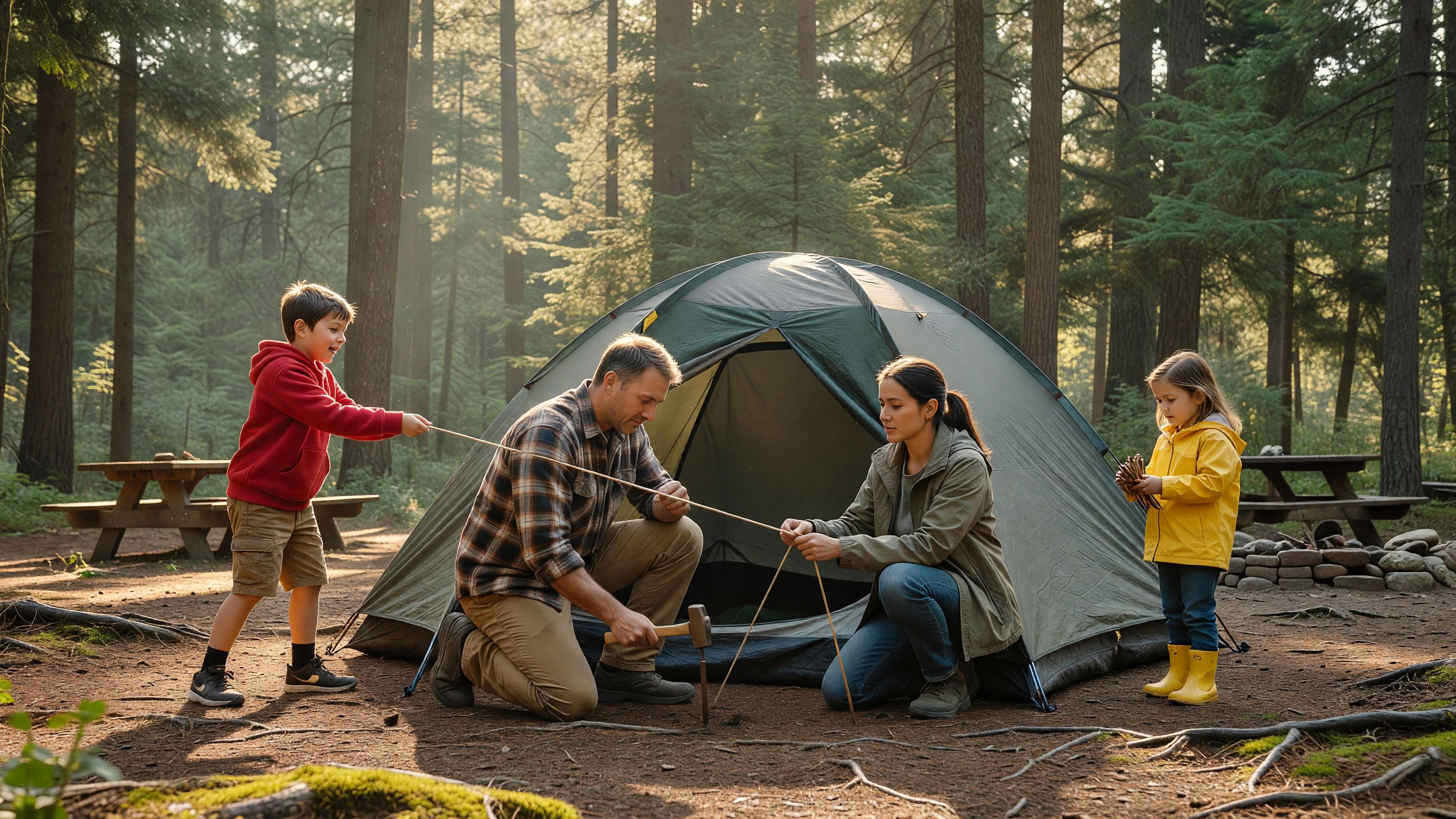
Summer camping with kids is one of those experiences that looks chaotic in photos and feels transformative in retrospect. The mosquitoes are real. The logistics are non-trivial. And the window to book a site at the parks that families actually want — the ones with safe swimming, short hikes that hold a seven-year-old’s interest, and Junior Ranger programs that give everyone a reason to talk to a ranger — opens earlier than most families realize.
This guide is built for parents who are planning now rather than scrambling in July. I’ve organized it around what actually matters for a successful family camping trip: campground amenities (flush toilets vs. vault toilets matters when you’re camping with a five-year-old), the quality of the park’s Junior Ranger program, whether there’s safe swimming within walking distance of the campground, manageable wildlife risks, and the drive or flight logistics from major metro areas.
Parks are ranked by their overall family-camping score — a blend of all five factors. The order is not purely about prestige. Some of the most famous parks are lower on this list precisely because their crowd levels, booking difficulty, or campground infrastructure make them harder to pull off with kids.
What Makes a National Park Great for Family Summer Camping
Before the ranked picks, it’s worth being explicit about the criteria. National parks span an enormous range of camping experiences — from beachside sites with flush toilets and an amphitheater 50 feet away to backcountry sites requiring a 12-mile hike in. Most families camping with young children are looking for something in the middle-front: a developed campground with modern restrooms, proximity to the park’s best accessible features, and a manageable distance from a trailhead or waterfront.
Campground infrastructure is the most underweighted factor among first-timers. Flush toilets, running water, and a dump station for RVs matter for trip comfort. Some campgrounds that look beautiful in photos still use vault toilets — fine for experienced campers, a genuine strain for families with toddlers at 3 a.m.
Hike accessibility for kids means trails in the two-to-five-mile range with manageable elevation gain and a payoff — a waterfall, a viewpoint, a lake — within the attention span of a child under ten. Parks with paved or hardened trails accessible to strollers get extra credit.
Junior Ranger programs vary more than most people expect. Some programs are desk-stamping exercises. Others involve genuine ranger interaction, age-differentiated activity booklets, and evening programs at the campground amphitheater that become the best memories of the trip. The NPS Junior Ranger program is available at virtually every national park; the quality on the ground depends on the park’s ranger staffing.
Swimming and water access is often the difference between a trip kids want to repeat and a trip they endure. Beach access, lake swimming, or a safe river stretch within camp-to-shore walking distance is a significant factor for July and August trips.
Wildlife risk is real and contextual. Grizzly bear country requires different preparation than deer-and-rabbit territory. All of the parks on this list have wildlife, but I’ll note where bear canisters are required and where the risk level warrants a pre-trip safety briefing.
1. Acadia National Park, Maine
Campgrounds: Blackwoods (open May–October, flush toilets, on Mount Desert Island’s eastern side) and Seawall (open late May–September, flush toilets, on the island’s quieter western side). Both require reservations through recreation.gov. The six-month booking window releases on the first of each month — for a July 1 arrival, that window opens January 1; for July 15, it opens January 15. Mark the specific date that corresponds to your target arrival date.
Best family hikes: The carriage road network — 45 miles of gravel lanes closed to motor vehicles — is the best family cycling and hiking infrastructure in any national park in the Northeast. With a rental bike from Acadia Bike in Bar Harbor, even young children can cover significant ground without the elevation challenge of the summit trails. For hiking, the Jessup Path and Ocean Path are flat, paved or hardened, and extraordinarily scenic. Jordan Pond is a 3.3-mile loop with almost no elevation gain and ends at the Jordan Pond House where you can get popovers — a family tradition for many repeat visitors.
Junior Ranger program: Acadia’s is one of the strongest in the system. Multiple age-differentiated booklets, ranger-led evening programs at the campground amphitheater, and a genuinely interactive presentation at the Hulls Cove visitor center. The swearing-in ceremony is the kind of moment kids remember.
Swimming: Sand Beach — a 290-meter-long sand beach on the open Atlantic — is the marquee summer swimming spot and one of the only true sand beaches in any national park north of Cape Hatteras. The water is cold even in August (typically 55–60°F) but the beach itself is extraordinary. Echo Lake, on the quieter western side of the island, is warmer and gentler — better for families with young kids who need calm water.
Drive from nearest major airport: 1 hour from Bangor International (BGR); 3.5 hours from Boston Logan (BOS). Bangor is the practical access airport.
Wildlife reality: Black bears are present but rarely encountered at campgrounds. Standard NPS food storage rules apply. No grizzlies.
Accessibility callout: Most carriage roads and several hiking trails are accessible for mobility devices. The Island Explorer bus system — free in summer — serves both campgrounds and major trailheads.
Summer crowd reality: July–August is peak season. Cadillac Mountain has a vehicle reservation requirement via recreation.gov for sunrise and morning entry during peak weeks — check current-year status on nps.gov/acad before your trip.
2. Yosemite Valley, California
Campgrounds: There are five campgrounds in Yosemite Valley — Upper Pines (236 sites, open year-round, flush toilets), Lower Pines (74 sites, seasonal, flush toilets), North Pines (81 sites, seasonal, flush toilets), Camp 4 (35 sites, walk-in, historically climber-focused), and Housekeeping Camp (266 units, semi-enclosed canvas structures). For families, Upper Pines is the default: large, central, flush toilets, and relatively easy to reach from the Valley Loop Road. Reservations through recreation.gov — peak summer dates at Yosemite Valley campgrounds are among the most competitive in the entire system. The booking window for Yosemite Valley campgrounds opens on the 15th of each month, five months in advance, at 7 a.m. Pacific Time. For a July 15 arrival, that means the window opens February 15. Set a phone alarm for 6:55 a.m. PT on the 15th.
Note on Yosemite’s reservation system: Yosemite Valley has operated a day-use vehicle reservation system for peak-hour entry during peak season — the mechanics have changed year to year. Check nps.gov/yose for current-year requirements before your trip; if you’re camping in the Valley you typically receive entry with your campsite reservation, but confirm this for your specific dates.
Best family hikes: Valley Floor Loop (13 miles fully, but any segment is walkable or bikeable via the valley bike path), Mirror Lake loop (5 miles round trip, flat, excellent for kids), Vernal Fall via the Mist Trail to the footbridge (1.6 miles round trip — the bridge gives an excellent waterfall view without the serious exposure of the upper trail).
Junior Ranger program: Excellent — multiple age tracks, ranger-led programs at multiple campground amphitheaters, and NPS Yosemite Education programs for school-age kids.
Swimming: The Merced River has multiple swimming holes in the Valley corridor — Cathedral Beach and Sentinel Beach are popular family spots with shallow entry areas. Always check current river conditions; early-season snowmelt can make the Merced fast and dangerous through June.
Drive from nearest major airport: 1.5 hours from Fresno Yosemite International (FAT), 3 hours from San Francisco (SFO).
Wildlife reality: Black bears are active throughout Yosemite and notorious for vehicle break-ins. The park provides bear boxes at every campsite — use them religiously. Do not leave any food, coolers, or scented items in your car at any time. Fines are real.
Accessibility callout: The Valley Floor Loop shuttle is fully accessible. Valley Visitor Center, Yosemite Valley Lodge, and several valley trailheads have accessible facilities.
Summer crowd reality: Very high. Weekdays are substantially less crowded than weekends. If you can shift your camping dates to Monday–Thursday, the valley experience improves significantly.
3. Grand Teton National Park, Wyoming
Campgrounds: Colter Bay (350 sites, flush toilets, some full hookups — one of the best-equipped campgrounds in the NPS system), Lizard Creek (60 sites, flush toilets, on Jackson Lake’s northern end), and Jenny Lake (49 sites, first-come-first-served, tents only, extremely scenic). Colter Bay is the clear family pick — large enough that you can usually find a site with reasonable notice, full amenities, and directly on Jackson Lake for swimming and paddling. Reservations through recreation.gov. Jenny Lake fills by 9 a.m. on summer mornings and is first-come only.
Best family hikes: Jenny Lake Loop (7.1 miles, flat, can shorten with the shuttle ferry), Hidden Falls and Inspiration Point via the shuttle ferry (2.4 miles round trip from the boat dock — one of the park’s best easy hikes), String Lake Loop (3.8 miles, flat, excellent for kids with swimming available from String Lake’s shores), Taggart Lake (3 miles round trip, one of the best shorter hikes in the park with direct mountain views).
Junior Ranger program: Strong. Colter Bay Visitor Center has excellent ranger staff and active programming. Evening campfire programs at Colter Bay amphitheater are family classics.
Swimming: Jackson Lake at Colter Bay is the swimming and paddling hub. The water is cold in early summer but warms through July; a sandy beach area near Colter Bay Village is safe for kids. String Lake is even calmer and slightly warmer, with a sandbar area popular for families.
Drive from nearest major airport: 45 minutes from Jackson Hole Airport (JAC), which is actually inside the park. 5 hours from Salt Lake City International (SLC).
Wildlife reality: Grand Teton is grizzly bear and moose country. Standard grizzly protocols apply: bear spray on hikes, no food in tents, strict food storage. Moose are more common and more dangerous to approach than they look — give them wide berth. The wildlife density is one of the park’s great family attractions; bison, pronghorn, and bald eagles are routinely visible from the road.
Accessibility callout: Colter Bay Visitor Center and most Colter Bay campground facilities are accessible. The Jenny Lake shuttle boats are not accessible — Jenny Lake Loop on foot is the alternative for mobility-limited visitors.
Summer crowd reality: Peak season is July–August. Grand Teton is less crowded than Yellowstone despite being adjacent. If you’re combining the two parks, base in Grand Teton for camping and day-trip north to Yellowstone.
4. Glacier National Park, Montana
Campgrounds: Apgar (194 sites, flush toilets, first-come-first-served, on Lake McDonald’s south shore — best family pick for amenities), Fish Creek (180 sites, flush toilets, requires reservations via recreation.gov, on Lake McDonald’s western side), and Many Glacier (109 sites, flush toilets, reservations required, in the park’s remote northeast corner near Swiftcurrent Lake). Apgar is the most accessible family campground; Many Glacier is more remote but has extraordinary scenery and a family-friendly hike to Grinnell Lake.
Note on vehicle reservations: Glacier has operated a vehicle reservation system for the Going-to-the-Sun Road corridor during peak season in recent years. The system has changed year to year — verify current-year requirements at nps.gov/glac before your trip. Campers with reservations inside the park typically have a different entry process than day visitors.
Best family hikes: Trail of the Cedars (1.1-mile loop, paved, accessible, old-growth cedar forest near Avalanche Creek), Avalanche Lake (4.5 miles round trip from the Trail of the Cedars, moderate elevation, ends at a turquoise lake with waterfall backdrop — one of the best family day hikes in the park), Hidden Lake Overlook (2.7 miles round trip from Logan Pass, easy to moderate, boardwalk, mountain goats likely visible), Swiftcurrent Lake Loop (2.6 miles, flat, near Many Glacier campground).
Junior Ranger program: Active and well-run. Both the Apgar and Many Glacier visitor centers have strong ranger staff.
Swimming: Lake McDonald is large, cold, and swimmable from Apgar beach — one of the most scenically situated lake beaches in any national park, looking directly up at the Garden Wall. Water temperature in July is cold but manageable for active kids. Swiftcurrent Lake near Many Glacier is similar.
Drive from nearest major airport: 2.5 hours from Glacier Park International (FCA) in Kalispell.
Wildlife reality: Grizzly bear country — bear spray is not optional. Carry it on every hike. Bear canisters are required for overnight backcountry trips and recommended for campsite food storage. Mountain goats, bighorn sheep, and moose are commonly sighted.
Accessibility callout: Trail of the Cedars is fully paved and accessible. The park’s red “jammer” buses (historic open-top vehicles on Going-to-the-Sun Road) have limited accessibility; check current accessibility status on nps.gov/glac.
Summer crowd reality: Peak season is late June through mid-August. Going-to-the-Sun Road is one of the most photographed drives in North America; Logan Pass parking fills by 9 a.m. on summer days. Going early or taking the shuttle from Apgar is the practical move.
5. Yellowstone National Park, Wyoming/Montana/Idaho
Campgrounds: Madison (276 sites, flush toilets, central location on the Madison River, reservations required), Bridge Bay (431 sites, flush toilets, on Yellowstone Lake, reservations required), Grant Village (430 sites, flush toilets, Yellowstone Lake’s south shore, reservations required). For families, Madison is the geographic sweet spot — roughly equidistant from Old Faithful to the south and Norris Geyser Basin to the north, on a river where bison commonly graze and sometimes block the road.
Yellowstone booking note: Madison, Bridge Bay, and Grant Village are operated by Yellowstone National Park Lodges (not a separate concessioner) and are bookable through recreation.gov using a standard six-month advance window — the same as most NPS campgrounds. All campsites at Yellowstone must be reserved in advance (only Mammoth operates first-come-first-served, and only in the off-season). Book as soon as the six-month window opens for July–August dates.
Best family hikes: Old Faithful and the Upper Geyser Basin boardwalk loop (2.5 miles, flat, the core Yellowstone experience), Grand Prismatic Overlook Trail (1.6 miles round trip, one of the best short walks in the park — looks down on the famous hot spring from above), Mystic Falls Loop (2.6 miles, easy elevation, a genuine backcountry feel within easy reach), Artist Point and South Rim Trail (2 miles, Canyon section, spectacular viewpoints above the Grand Canyon of the Yellowstone).
Junior Ranger program: Excellent — multiple age tracks and one of the few parks where Junior Ranger programs run year-round at multiple visitor centers.
Swimming: Yellowstone has strict no-swimming policies in thermal waters. Swimming in the Firehole River at designated areas (Firehole Swimming Area, typically open July–August when crowds allow) is the main family swimming option — warm water heated by geothermal runoff. Check current status at the park; the area can close during high water or thermal anomalies.
Drive from nearest major airport: 1.5 hours from Bozeman Yellowstone International (BZN). West Yellowstone, MT has a small regional airport (WYS) with seasonal service.
Wildlife reality: Grizzly bears, black bears, wolves, bison, elk. Bear canisters required for backcountry. The most critical family safety briefing in this guide: do not approach bison under any circumstances. They are not tame. They account for more injuries in Yellowstone than any other animal, and they move at 35 mph. The rule is 25 yards minimum distance from bison and elk, 100 yards from bears and wolves. More deaths have resulted from disregarding this than from any other cause in the park.
Accessibility callout: Old Faithful Geyser viewing area and the boardwalk loop around the Upper Geyser Basin are accessible. Grand Prismatic Overlook trail is paved and accessible. Major visitor centers all have accessible facilities.
Summer crowd reality: Extremely high. Yellowstone draws over four million visitors per year. Interior roads can be gridlocked around geyser basins at midday. Strategy: geysers and hot spring basins before 8 a.m. and after 6 p.m.; wildlife corridors (Lamar Valley, Hayden Valley) at dawn and dusk. This is actually easier with children who wake early.
6. Olympic National Park, Washington
Campgrounds: Kalaloch (170 sites, flush toilets, on the Pacific coast directly above the beach, reservations required via recreation.gov), Fairholme (88 sites, flush toilets, on Lake Crescent’s western end), Sol Duc Hot Springs (82 sites, flush toilets, access to the Sol Duc Hot Springs Resort). Kalaloch is the standout family campground in the system — literally camped on the edge of a Pacific bluff, with a short path down to one of the wildest and most accessible beach camping experiences in the US.
Best family hikes: Ruby Beach (0.25-mile beach access trail, sea stacks, tide pools — extraordinary for kids), Hoh Rain Forest Hall of Mosses (0.8-mile loop, flat, moss-draped maples and Sitka spruce, otherworldly atmosphere for children), Marymere Falls (1.8 miles round trip, easy, ends at a 90-foot waterfall near Lake Crescent), Sol Duc Falls (1.6 miles round trip, easy, one of the most dramatic short hikes in the Pacific Northwest).
Junior Ranger program: Active at multiple visitor centers — Hoh Rain Forest, Kalaloch, and Hurricane Ridge all have ranger staff during summer. Evening programs at the campground amphitheater at Sol Duc.
Swimming: Lake Crescent is one of the most beautiful lakes in any national park — clear, cold, and swimmable from Fairholme Beach and Log Cabin Resort. Crescent Lake is glacier-carved, extremely deep (624 feet), and cold even in August; suitable for older kids and adults rather than toddlers. The Pacific beaches at Kalaloch are not safe for swimming due to currents and surf — they’re spectacular for tidepooling and beachcombing but not for wading beyond ankle depth.
Drive from nearest major airport: 2 hours from Seattle-Tacoma International (SEA) to Port Angeles (northern entry), or 3 hours to Kalaloch (coastal section).
Wildlife reality: Black bears are present throughout the park. Standard food storage required. No grizzlies. Olympic has an isolated gray wolf population; sightings are rare and non-threatening.
Accessibility callout: Hall of Mosses loop is accessible. Kalaloch Lodge and campground have accessible sites. The Hoh Rain Forest Visitor Center is accessible.
Summer crowd reality: Olympic has historically been one of the less-crowded major parks because of its location on the Olympic Peninsula. No timed-entry system as of recent seasons — verify current status on nps.gov/olym before your visit. Summer temperatures are mild (60s and 70s), making it one of the most comfortable summer camping parks on this list.
7. Great Smoky Mountains National Park, Tennessee/North Carolina
Campgrounds: Elkmont (220 sites, flush toilets, on the Little River, reservations required via recreation.gov), Cades Cove (159 sites, flush toilets, near the Cades Cove loop road and wildlife viewing area), Smokemont (142 sites, flush toilets, in the North Carolina section near the Oconaluftee Visitor Center). Elkmont is the premier family campground — central location, excellent hiking access, and situated on a river where kids can wade.
Great Smokies access note: Great Smoky Mountains is the only major park on this list that charges no entrance fee — a significant factor for families doing a week-long camping trip. The free entry is federally mandated by the park’s original charter.
Best family hikes: Laurel Falls (2.6 miles round trip, paved, one of the most popular hikes in the park — arrive very early in summer), Alum Cave Trail to Alum Cave Bluffs (4.4 miles round trip, moderate, fascinating geology for older kids), Cades Cove Loop (11-mile one-way drive with pull-offs and short walking trails, wildlife-rich, deer and black bears routinely sighted), Little River Trail from Elkmont (flat, riverside, as long as you want — perfect for young children).
Junior Ranger program: Strong. Sugarlands and Oconaluftee Visitor Centers both have active programs. Evening ranger talks at Elkmont and Cades Cove campground amphitheaters are a summer staple.
Swimming: Wading in the Little River near Elkmont is extremely popular with kids and is a defining Smokies experience — clear mountain water, flat rocks, and managed crowds. No designated swimming beaches in the traditional sense, but river wading is permitted and practiced throughout the park. Check current river conditions; flash flooding is possible.
Drive from nearest major airport: Knoxville (TYS) is 1 hour from the Sugarlands entrance; Asheville (AVL) is 1 hour from the Oconaluftee entrance. The park is within a day’s drive of roughly a third of the US population.
Wildlife reality: Black bears are common and the Smokies has the highest bear density of any park on this list. Food storage is strictly enforced. Do not feed bears or leave unsecured food; violations result in the park having to euthanize animals that associate humans with food. Elk were reintroduced to the Cataloochee area of the North Carolina section and are reliably seen at dawn and dusk.
Accessibility callout: Clingmans Dome parking area and observation tower access is challenging (steep 0.5-mile paved path). Oconaluftee Island Park near Cherokee, NC has accessible facilities. Laurel Falls trail is paved but can be crowded. The National Parks Conservation Association’s park page for Great Smoky Mountains covers current conservation and access issues.
Summer crowd reality: Very high — the Smokies is consistently the most-visited national park in the system. Parking at popular trailheads (Alum Cave, Laurel Falls) fills before 8 a.m. on summer weekends. Weekdays are noticeably less crowded.
8. Sequoia and Kings Canyon National Parks, California
Campgrounds: Lodgepole (214 sites, flush toilets, near the General Sherman Tree and shuttle stops, reservations through recreation.gov), Dorst Creek (218 sites, flush toilets, northern Sequoia section, reservations required), Sheep Creek (111 sites, Kings Canyon section, flush toilets, near Cedar Grove). Lodgepole is the family hub — it’s where the shuttle to General Sherman departs, and the trees are within a 20-minute walk of most sites.
Note on combined entry: One entrance fee covers both Sequoia and Kings Canyon National Parks. The America the Beautiful Annual Pass covers entry to both parks and pays for itself quickly if your family is visiting multiple parks.
Best family hikes: Congress Trail loop (2 miles, flat, passes General Sherman and dozens of other massive sequoias — the essential family walk), Big Trees Trail (1.3-mile loop, paved, flat, accessible, near Round Meadow), Tokopah Valley Trail (3.4 miles round trip, follows the Marble Fork Kaweah River through a canyon to a dramatic waterfall), Zumwalt Meadow Loop in Kings Canyon (1.8 miles, flat, one of the most beautiful short hikes in any national park — meadow surrounded by granite walls).
Junior Ranger program: Active at Lodgepole Visitor Center and Cedar Grove Visitor Center. Ranger-led walks through the giant forest are one of the better ranger-led programs in the system for school-age children.
Swimming: The Marble Fork and Middle Fork Kaweah River near Lodgepole have swimming holes popular in summer. Kings Canyon’s South Fork Kings River near Cedar Grove has swimmable stretches. Both are cold and swift in June; safer by mid-July when snowmelt subsides.
Drive from nearest major airport: 1.5 hours from Fresno Yosemite International (FAT). No rail or significant bus service to the parks.
Wildlife reality: Black bears are very active in Sequoia and Kings Canyon. Bear canisters are required for all overnight backcountry. In frontcountry campgrounds, bear boxes are provided at every site — using them is mandatory and enforced. Mountain lions are present but extremely rarely seen.
Accessibility callout: Big Trees Trail and Congress Trail are both paved and accessible. The free Sequoia Shuttle during summer runs from the town of Visalia to Lodgepole.
Summer crowd reality: High but more manageable than Yosemite. Timed-entry requirements have been discussed but as of recent seasons were not in place for frontcountry access — confirm current policy at nps.gov/seki.
9. Cuyahoga Valley National Park, Ohio
Camping note: Cuyahoga Valley National Park does not have in-park campgrounds in the traditional sense. The Stanford House Hostel inside the park offers dormitory and private room accommodations but is not tent camping. The standard approach for families tent-camping is to base at one of the Ohio state parks adjacent to the park — Punderson State Park (35 miles), Wingfoot Lake State Park (22 miles), or Findley State Park (35 miles) — and day-trip into the national park.
Why it’s on this list anyway: Cuyahoga Valley is one of the most accessible national parks in the country, sitting between Cleveland and Akron with no entrance fee and no timed-entry system. For Eastern families doing a camping trip with a national park component, combining a state park campground with days in Cuyahoga Valley is a genuinely excellent strategy. The Ohio State Park system’s campgrounds are well-maintained and significantly easier to book than most national park campgrounds.
Best family activities: Brandywine Falls boardwalk (1.5 miles round trip, easy, leads to the park’s signature 65-foot waterfall), Towpath Trail (20 miles, flat, follows the historic Ohio & Erie Canal — bikeable by the whole family), Beaver Marsh (a short accessible boardwalk with excellent wildlife viewing), the Cuyahoga Valley Scenic Railroad (operates excursion trains through the valley on weekends).
Junior Ranger program: Active at the Canal Exploration Center in Valley View, OH.
Drive from nearest major airport: 30 minutes from Cleveland Hopkins International (CLE), 40 minutes from Akron-Canton Airport (CAK).
For a fuller picture of the park: see Cuyahoga Valley National Park: Ohio’s Quiet Treasure.
10. Mount Rainier National Park, Washington
Campgrounds: Cougar Rock (179 sites, flush toilets, in the Paradise corridor, reservations required via recreation.gov), White River (88 sites, flush toilets, first-come-first-served on the mountain’s northeast side, closer to Sunrise area). Cougar Rock is the family anchor campground — central access to Paradise, proximity to the wildflower meadows, and flush toilets in summer. Note: Ohanapecosh Campground (southeast section) is closed for rehabilitation as of 2026 — verify status at nps.gov/mora before trip planning.
Best family hikes: Skyline Trail from Paradise (5.5 miles round trip, moderate, the iconic wildflower meadow loop best done late July–August when blooms peak), Nisqually Vista Loop (1.2 miles round trip, easy, panoramic views from Paradise), Silver Falls Loop near Ohanapecosh (3 miles round trip, flat, old-growth forest, a 40-foot waterfall), Emmons Moraine Trail from White River (3 miles round trip, excellent glacier view, families can walk to within 200 meters of the Emmons Glacier toe).
Junior Ranger program: Active at Paradise and White River contact stations. Paradise Visitor Center has strong summer programming.
Swimming: Rivers in Mount Rainier National Park are glacially cold and swift — not suitable for swimming in the traditional sense. The family swimming alternative is to treat the hikes and meadow experiences as the primary activity and plan swimming at a lake outside the park if needed.
Drive from nearest major airport: 1.5 hours from Seattle-Tacoma International (SEA) to Paradise via US-706. White River (northeast entrance) is approximately 2 hours from SEA.
Wildlife reality: Black bears and mountain goats. Bear canisters required for backcountry. No grizzlies. Marmots are abundant and entertaining for children at the Paradise and Sunrise meadows.
Wildflower timing: The subalpine meadows at Paradise and Sunrise typically peak in late July through mid-August. Arriving before peak bloom — even in early July — means snow may still be on the meadow trails. Check current conditions at nps.gov/mora before your trip.
Accessibility callout: Paradise Visitor Center, the Skyline Trail lower section, and Nisqually Vista Loop have accessible sections. The park operates a free shuttle system between Paradise and Ashford during summer.
Summer crowd reality: High but manageable on weekdays. The Paradise parking lot fills on summer weekends by late morning — arriving by 8 a.m. or taking the park shuttle from Ashford is the practical approach.
Booking Strategy: The Six-Month Window (and the Exceptions)
The standard Recreation.gov booking window for NPS campgrounds is six months to the day before your arrival date, released at 7 a.m. Mountain Time. For a July 15 arrival, that’s January 15 — set your alarm for 6:55 a.m. MT. The most popular campgrounds (Upper Pines at Yosemite, Elkmont at Great Smokies, Cougar Rock at Rainier, Many Glacier at Glacier) sell out within minutes of that window opening.
Key exceptions to the six-month rule:
- Yosemite Valley campgrounds: Five months in advance, on the 15th of each month (not six months, unlike most NPS campgrounds). 7 a.m. Pacific Time.
- Acadia’s Blackwoods and Seawall: Six months on the first of each month. For a July 15 arrival, the window opens January 15.
- First-come, first-served options: Jenny Lake at Grand Teton, White River at Rainier, Apgar at Glacier (some sites) — arriving before 7 a.m. on a weekday is generally reliable in May–June and September; the July–August peak is less predictable.
Booking strategy for multiple-park trips: Lock in the hardest sites first (Yosemite Valley, Madison at Yellowstone), then fill in the others around them. Do not book a non-refundable transportation package until your campsite reservations are confirmed.
Cancellations surface regularly. Recreation.gov allows cancellations up to 48 hours before arrival (with a cancellation fee). The site releases cancelled inventory in real time — checking at 7 a.m. daily in the weeks before a popular trip can yield previously booked sites at top campgrounds.
What to Pack for Family Summer Camping
The essentials list that matters most for national park camping with kids:
Bear safety (required or strongly recommended at most parks on this list):
- Bear canister (required for backcountry at Glacier, Yellowstone, Sequoia/Kings Canyon, Grand Teton) — Frontcountry campgrounds provide bear boxes, so a canister is backcountry-only
- Bear spray (required at Glacier, Yellowstone, Grand Teton — carry it on every hike, not in the car)
- REI’s bear safety gear guide covers canister selection and spray usage
Water and food:
- Water filtration: SteriPen or Sawyer filter — most backcountry water sources require treatment
- Cooler with locks or straps (bear proof, or use the campsite bear box)
- Mess kit, biodegradable soap
Sun and weather:
- SPF 50+ sunscreen — elevation increases UV intensity at all Western parks
- Wide-brim hats for kids
- Rain jacket for each family member (Pacific Northwest parks especially — Olympic and Rainier can see rain any day in summer)
- Layers — high-altitude campgrounds (Paradise at Rainier, Logan Pass area at Glacier, High Country at Sequoia) can drop to freezing at night even in July
Kids specifically:
- Headlamps with fresh batteries — one per person, including kids
- Trekking poles for school-age kids on moderate hikes
- Binoculars — the single piece of gear that converts wildlife distance to engagement for children under ten
- Junior Ranger activity books (downloadable in advance at nps.gov for many parks)
Safety Essentials: What Parents Need to Know Before Camping with Kids
Bear country: Five of the ten parks on this list are in grizzly bear territory (Glacier, Yellowstone, Grand Teton) or high-density black bear territory (Great Smoky Mountains, Sequoia). The rules are the same across all of them: food stored out of reach or in a bear box at all times, no food in tents, never approach a bear. For parks with grizzlies, carry and know how to use bear spray. The NPS has current bear activity reports at each park’s website.
Altitude: The Western parks on this list range from 5,000 to 8,000+ feet elevation at common day-hiking areas. Altitude affects children more quickly than adults in some cases. Symptoms of altitude sickness — headache, nausea, unusual fatigue — should prompt a descent to lower elevation and rest. Adequate hydration before and during the trip helps.
Sun: At the elevation of most Western park campgrounds and trailheads, UV intensity is meaningfully higher than at sea level. SPF 50+ sunscreen applied every 90 minutes and wide-brim hats are not optional precautions for kids.
Water: Do not drink from streams, even clear ones, without filtration. Giardia is present in backcountry water sources in most parks. Use a filter or treatment for any water not from a campground spigot.
Flash flooding: Relevant at Olympic (rivers), Great Smokies (rivers), and Zion if you add it to your itinerary. Check weather forecasts and river conditions before river-adjacent activities.
Wildlife distance rules: Standard NPS rules — 25 yards from large herbivores (bison, elk, deer), 100 yards from bears and wolves — apply across all parks. The most common violations are with bison at Yellowstone. Make these rules part of your pre-trip briefing with kids using clear, simple language.
Frequently Asked Questions
What national parks are best for camping with toddlers?
Acadia, Great Smoky Mountains, and Cuyahoga Valley (camping nearby) are the most toddler-friendly on this list. All three have paved or hardened trails, flush toilets and running water at main campgrounds, accessible visitor centers with ranger programs, and no grizzly bears. Olympic’s Kalaloch is another strong option — Kalaloch beach is extraordinary for young kids.
How far in advance do I need to book a campsite at Yosemite?
Yosemite Valley campgrounds book via Recreation.gov with a five-month advance window that opens on the 15th of each month at 7 a.m. Pacific Time. For a July 15 arrival, set your alarm for February 15. For July and August dates, expect valley campgrounds like Upper Pines and Lower Pines to sell out within minutes of the window opening.
Are bear canisters required at national parks?
Bear canisters are required for overnight backcountry camping in several parks, including Glacier, Grand Teton, Yellowstone, and Sequoia/Kings Canyon. For frontcountry campground use, most parks provide in-ground or on-site bear boxes at each site, so a personal canister is not required. Check individual park requirements on nps.gov for your specific destinations.
Can I bring my dog camping in a national park?
Dogs are permitted in developed campgrounds at most national parks but are generally restricted from trails, backcountry areas, and many park buildings. Leash rules (6-foot maximum) apply in all areas where dogs are allowed. If you’re camping with a dog, Great Smoky Mountains and Cuyahoga Valley are more dog-tolerant than the Western parks on this list. Check individual park pet policies before you go — they vary significantly.
What is the Junior Ranger program and how does it work?
The NPS Junior Ranger program is a free activity booklet available at any park visitor center. Kids complete a set of activities — ranger-led walks, wildlife observations, history questions — and then present their completed booklet to a ranger for review. After the review, they take a pledge and receive an official Junior Ranger badge and patch. Most parks offer multiple age-group booklets. The quality varies by park; Acadia, Great Smoky Mountains, and Yellowstone are among the strongest programs in the system.
What’s the best national park for family summer camping on the East Coast?
Acadia in Maine is the strongest all-around option for Eastern families. Great Smoky Mountains in Tennessee/North Carolina is the most accessible — it’s within a day’s drive of roughly a third of the US population, charges no entrance fee, and has well-developed campgrounds. Shenandoah in Virginia is a strong third option for families based in the Mid-Atlantic, with Skyline Drive and multiple developed campgrounds on Shenandoah National Park’s visitor page.
How do I handle meals with kids when bears are active at camp?
The rule is simple and non-negotiable: nothing with a scent leaves the bear box or your car when you’re not actively using it. That means sunscreen, chapstick, baby wipes, diapers, and food all go in the bear box when unattended. Eat meals at the picnic table, clean up immediately, and pack waste into sealed bags in the bear box. Do not take snacks into your tent. This applies at every park on this list with bear activity — which is all of them.
If you’re still deciding which park to target first, the First-Time Visitor Guide: Which National Park Should You Pick? works through the full decision framework — time, season, ability, and starting city — before you commit to logistics. For campsite reservations at most parks on this list, use Recreation.gov — it’s the official booking platform for NPS-operated campgrounds. Note that Yellowstone’s major campgrounds (Madison, Canyon, Bridge Bay, Grant Village, Fishing Bridge) are operated by Yellowstone National Park Lodges — a separate concessioner system with a different booking window than Recreation.gov. See How to Reserve Yellowstone Campsites for a detailed breakdown of the two systems. The National Parks Conservation Association tracks funding and access issues that affect campground availability year to year — worth bookmarking if you’re planning a multi-year family parks trip. Planning a trip to a specific park on this list? Park directory profiles for Acadia National Park, Great Smoky Mountains, Yellowstone, Grand Teton, Glacier, Olympic, Sequoia, and Cuyahoga Valley have deeper coverage of each park’s trails, permits, and seasonal conditions. For trail-level planning, see Best National Park Hikes Under Five Miles — 18 short trail picks with elevation gain, terrain notes, and family-friendly flags across the same parks.