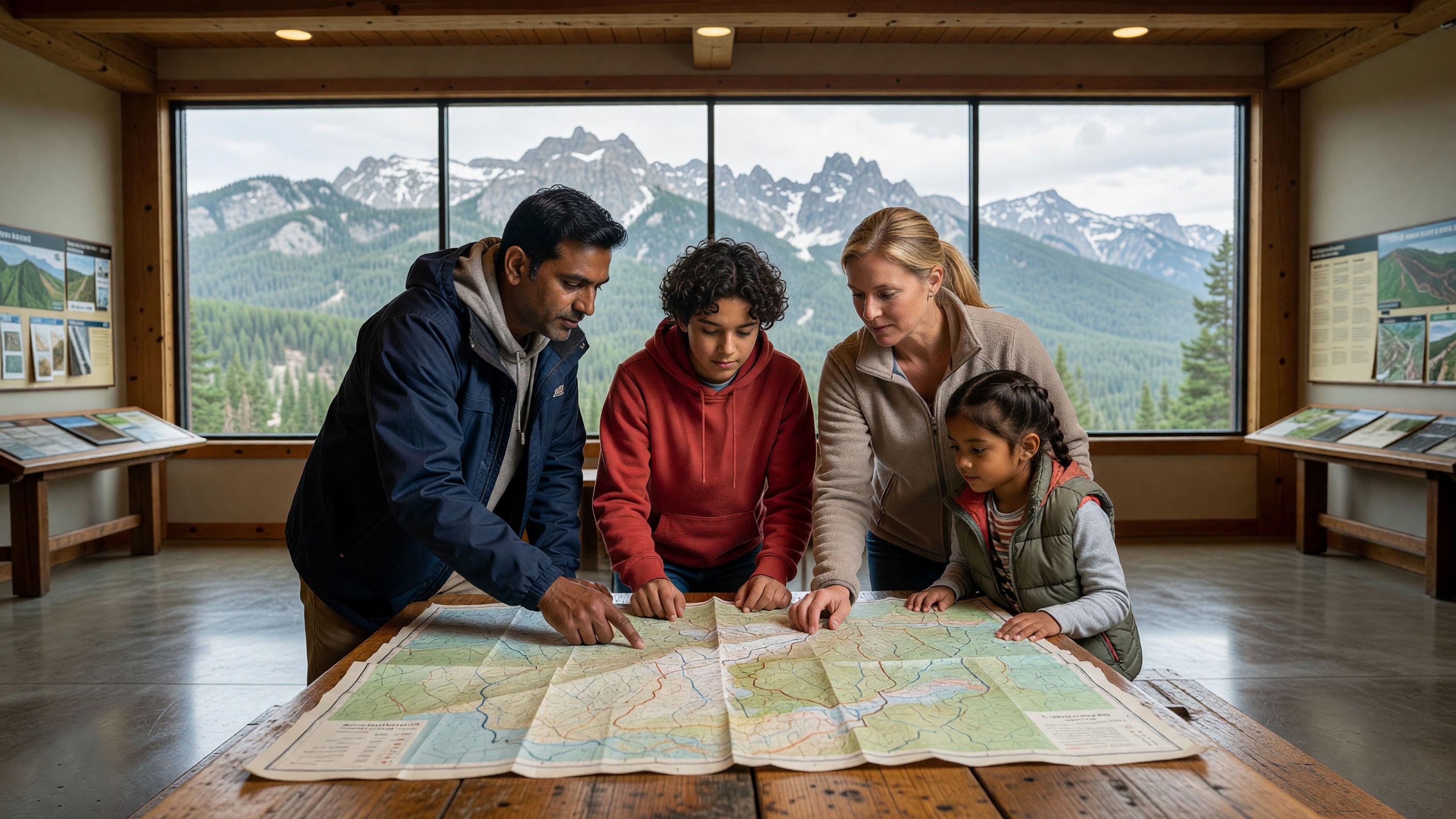
International visitors make up roughly 14 percent of total US national park visitation in a typical year — tens of millions of travelers from Europe, Asia, Latin America, Australia, and elsewhere who come specifically to see Yellowstone’s geysers, the Grand Canyon’s scale, or Yosemite’s granite walls. The parks are genuinely world-class, but the logistics of reaching and navigating them are not intuitive for someone arriving from outside the United States. The distances are longer than most international visitors expect. The car is more central than in most tourist destinations. The pass system was reorganized in 2026 with new fees for non-residents. And entry requirements — ESTA, visas, passport validity — have changed recently.
This guide covers every practical layer: entry and immigration, driving and rental cars, the pass purchase decision, how to move between parks without a car, how far things actually are, insurance, language, and the best starting routes for a first international visit.
Entry Requirements — ESTA, Visas, and Passports
Visa Waiver Program and ESTA
Citizens of 42 countries — including most of Western Europe, Japan, South Korea, Australia, New Zealand, Chile, Singapore, and Brunei — can enter the United States for up to 90 days under the Visa Waiver Program (VWP) without a traditional tourist visa. Instead, VWP travelers must apply for an Electronic System for Travel Authorization (ESTA) before departure.
ESTA is not a visa — it is an electronic pre-travel authorization. You apply online at esta.cbp.dhs.gov, receive a decision within 72 hours in most cases (often within minutes), and the authorization is valid for two years or until your passport expires, whichever comes first. During those two years, you can make multiple trips to the United States, each for up to 90 days.
The ESTA fee changed significantly in 2025. As of September 30, 2025, the ESTA fee increased from $21 to $40 — nearly doubling. The fee structure: a $4 processing fee (non-refundable, charged on application) plus a $36 authorization fee (charged only if approved). Apply through the official CBP portal only; numerous third-party sites charge substantially more. Budget $40 per traveler in your party.
Passport validity. Your passport must be valid for the duration of your US stay. Some countries’ passports also have additional validity requirements beyond the travel dates — check current US entry requirements for your specific nationality via travel.state.gov.
Countries NOT currently eligible for the VWP include India, China, Brazil, Russia, Mexico, the Philippines, Nigeria, Indonesia, Egypt, Turkey, most of South Asia and Southeast Asia (with the exceptions noted above), and most of Africa and Central America. Citizens of these countries require a B-1/B-2 tourist visa, which involves an interview at a US Embassy or Consulate and significant lead time. Processing times vary by country and season — for popular destinations like London, Toronto, or Seoul, plan at least three months ahead; for high-demand consulates, six months or more is not unusual.
Border crossing. Whether you arrive by air, sea, or land border, you will clear US Customs and Border Protection (CBP) at your first port of entry. Air travelers typically process through immigration at their first US airport, even if connecting onward. Be prepared to provide a CBP officer with: your passport, ESTA confirmation or visa, proof of onward travel (return ticket or itinerary), and address of where you are staying in the US.
Driving and Rental Cars
The hard truth about US national parks: the vast majority require a car. Unlike national parks in places like Switzerland or the UK, where train and bus networks can carry you to a trailhead, most American parks sit at the end of long access roads in regions with limited public transit. You can reach a handful of major parks without driving — this is covered in the Transportation section — but for any multi-park trip, a rental car is close to mandatory.
Do You Need an International Driving Permit?
The short answer is: probably not, but it depends on your license language and the rental company.
Most US states accept a valid foreign driver’s license for driving. California, Florida, New York, Nevada, and Texas — states where many international visitors rent cars — all accept valid foreign licenses without additional documentation, provided the license is current and in good condition.
An International Driving Permit (IDP) is strongly recommended if your license is not in the Latin alphabet (Arabic, Cyrillic, Chinese, Japanese, Korean, Thai, etc.). Rental car companies including Alamo, Hertz, and Enterprise typically require an IDP or certified translation when the home-country license uses a non-Latin script. Even where not strictly required, an IDP provides a standardized English-language format that speeds up interactions with rental staff and, more importantly, with US law enforcement if you are stopped.
How to get an IDP: In most countries, the IDP is issued by the national automobile association — AAA equivalents — for a modest fee ($20–40). It is not issued by US authorities; you must obtain it before leaving your home country. The IDP is valid for one year from the date of issue and must be carried alongside your home-country license (it is not a standalone document).
Some states — Georgia, Massachusetts, and Tennessee, notably — have stricter requirements around translated licenses and may require an IDP for visitors regardless of script. If your trip takes you through any of these states, carry an IDP regardless of your license language.
Driving on the Right
Americans drive on the right side of the road. For visitors from the United Kingdom, Ireland, Australia, New Zealand, India, Japan, South Africa, and other left-hand-traffic countries, this requires active adjustment, particularly at intersections, roundabouts, and when turning. The adjustment typically takes a day or two of conscious practice. Rental car companies and road signs will not remind you of this.
Toll Roads
Many US highways and bridges charge tolls. In most regions, cash toll lanes are being phased out in favor of transponder-based electronic tolling (E-ZPass in the Northeast, FasTrak in California, TxTag in Texas, and many others). Rental car companies offer transponder rentals for a daily fee; if you decline, the car’s license plate is photographed and you are billed by mail — typically with an administrative fee on top of the toll. Clarify the rental company’s policy before declining the transponder, particularly if your trip includes the Northeast, Florida, Texas, or California.
Rental Car Insurance
International visitors should understand their coverage before leaving the rental lot.
- Your home-country car insurance almost certainly does not cover rental cars in the United States.
- Many credit cards (Visa, Mastercard, and Amex premium products especially) offer rental car collision damage waiver (CDW) as a cardmember benefit when you pay for the rental in full with that card. Check your specific card’s policy — coverage limits, excluded vehicle types (large SUVs and luxury cars are often excluded), and whether US rentals are covered. Some non-US-issued cards do not extend this benefit for US rentals.
- If your credit card does not provide CDW coverage, the rental company’s CDW is worth purchasing. Without it, you are responsible for the full cost of damage to the vehicle.
- Third-party travel insurance policies often include rental car coverage; check your policy documents before the trip.
Gas station etiquette: US gas stations are generally self-service. Most require a credit card inserted at the pump (a US-issued card with a zip code may be required at some pump terminals — if it declines, pay inside). Fuel is sold in gallons, not liters. The price displayed per gallon includes all taxes. National park areas and remote Western towns often have only one gas station within a significant radius — fill up before entering remote areas.
Pass Pricing — What Non-Residents Actually Pay in 2026
The pass system for international visitors changed on January 1, 2026. Understanding the new structure before you visit is worth your time; it directly affects your entry budget.
The Nonresident Surcharge at 11 Parks
Non-US residents age 16 and older now pay a $100 per-person surcharge at 11 of the most-visited national parks, in addition to each park’s standard entrance fee. The 11 parks where this surcharge applies are:
- Acadia (Maine)
- Bryce Canyon (Utah)
- Everglades (Florida)
- Glacier (Montana)
- Grand Canyon (Arizona)
- Grand Teton (Wyoming)
- Rocky Mountain (Colorado)
- Sequoia and Kings Canyon (California)
- Yellowstone (Wyoming/Montana/Idaho)
- Yosemite (California)
- Zion (Utah)
For a couple visiting three of these parks, that is $600 in nonresident surcharges alone — before entrance fees. For a family of four adults, the surcharges at three parks total $1,200. This math changes the pass purchase calculation significantly.
The Non-Resident Annual Pass — $250
Non-US residents can purchase the America the Beautiful Non-Resident Annual Pass for $250. This pass functions identically to the standard $80 Annual Pass — covering entrance fees and nonresident surcharges at all federal recreation areas — but is priced for non-residents. For the pass holder plus occupants of a private vehicle at per-vehicle fee sites, or the pass holder plus three additional adults at per-person sites, the pass waives both the entrance fee and the nonresident surcharge at all 11 high-demand parks.
The math is straightforward: A single visit to Yellowstone would otherwise cost a family of four adults $35 (standard entrance) plus $400 in nonresident surcharges = $435. The $250 Non-Resident Annual Pass covers all of it for 12 months. If your trip visits two or more of the 11 parks, the pass pays for itself on the first visit.
The Non-Resident Annual Pass is available at any federal fee site entrance station and online at store.usgs.gov. Valid for 12 months from first use.
Standard Annual Pass — $80 (US Citizens and Permanent Residents Only)
The standard $80 America the Beautiful Annual Pass is available to anyone regardless of citizenship, but it does not waive the nonresident surcharge. If you purchase the $80 pass as a non-US resident and visit one of the 11 nonresident-fee parks, you will still pay the $100 per-person surcharge at the gate. For international visitors planning to visit any of the 11 high-demand parks, the $250 Non-Resident Annual Pass is the correct choice.
For a full breakdown of pass variants, Senior Pass and Access Pass eligibility (US citizens and permanent residents only), and what all passes do and do not cover, see the America the Beautiful Pass guide.
Parks Without Nonresident Surcharges
Many excellent national parks are not on the nonresident-fee list and charge only their standard entrance fees — including Great Smoky Mountains (no entrance fee at all), Shenandoah, Olympic, Crater Lake, Mesa Verde, Badlands, and many others. International visitors planning trips anchored at these parks pay standard entrance fees only.
Getting There Without a Car — Transportation Options
For travelers who prefer not to drive, or who are arriving in the US without an international driver’s license, the options are limited but real.
Amtrak Trains
Glacier National Park is the most train-accessible major park in the system. Amtrak’s Empire Builder route (Chicago → Seattle/Portland) stops at West Glacier (year-round), East Glacier Park (seasonal, roughly mid-April through mid-October), and Whitefish (year-round, 25 miles west of the park boundary). The East Glacier stop sits within walking distance of Glacier Park Lodge. This is a legitimate no-car option for Glacier, though once inside the park, transport depends on seasonal shuttle service or lodging-arranged transfers between the major lodge clusters.
The California Zephyr (Chicago → San Francisco via Denver) passes through the Rockies and approaches Grand Junction, Colorado — from which driving is still required to reach Arches, Canyonlands, and other Utah parks. The Zephyr’s stop at Granby, Colorado, places you about 20 minutes from Rocky Mountain National Park’s west entrance, but taxi and rideshare options in these areas are minimal. The scenic journey is exceptional; the logistics from train to park require pre-planning.
No Amtrak route drops travelers directly at Yellowstone, Grand Canyon’s South Rim, Yosemite, or most other major parks. The Grand Canyon Railway (a heritage rail line) connects Williams, Arizona — itself accessible via Greyhound or a rental car from Flagstaff — to the South Rim. This is a popular option for travelers who want to arrive by rail but should not be confused with a national passenger rail connection.
Regional Airport Access
Flying into smaller regional airports can significantly reduce driving distances:
- Bozeman Yellowstone International (BZN): Gateway to Yellowstone (90 minutes to the north entrance at Gardiner). Several airlines serve Bozeman from major hubs.
- Jackson Hole Airport (JAC): Located inside Grand Teton National Park — the only commercial airport inside a national park boundary. Access to both Grand Teton and Yellowstone.
- Las Vegas (LAS): Convenient hub for the Mighty 5 Utah parks (Zion is about 2.5 hours east) and Grand Canyon South Rim (about 4 hours east).
- Anchorage (ANC): Gateway to Kenai Fjords and Denali; Fairbanks (FAI) serves Denali from the north entrance.
- Fresno Yosemite International (FAT): The closest commercial airport to Yosemite Valley, with YARTS bus service running from Fresno to the valley.
Bus and Shuttle
Intercity bus options serving national parks are limited. YARTS (Yosemite Area Regional Transportation System) runs scheduled service from Fresno, Merced, and Sonora into Yosemite Valley — this is one of the few genuine bus options into a major park. The Zion Canyon Shuttle operates within the park but requires arriving in Springdale, Utah by other means. Yellowstone, Glacier, Grand Canyon, and most other parks have no intercity bus service.
Rideshare (Uber, Lyft) coverage in rural Western areas near parks is inconsistent to nonexistent. Do not plan a park trip based on rideshare availability outside of major gateway cities.
Distance and Scale — Setting Realistic Expectations
This is the section that surprises most international visitors, particularly those from Europe or Southeast Asia where countries are compact and train networks are dense.
The American West is large in a way that is difficult to convey in advance. Distances between parks that appear adjacent on a map are often full driving days. A few reference points:
| Route | Approximate Drive Time |
|---|---|
| Yellowstone → Grand Canyon (South Rim) | 11–12 hours |
| Yosemite → Death Valley | 6–7 hours |
| Yellowstone → Glacier (Going-to-the-Sun Road entrance) | 6–7 hours |
| Grand Canyon → Zion | 2.5–3 hours |
| Zion → Bryce Canyon | 1.5 hours |
| Bryce Canyon → Arches | 3 hours |
| Arches → Capitol Reef | 2 hours |
| Capitol Reef → Grand Staircase–Escalante | 1 hour |
| Las Vegas → Death Valley | 2.5 hours |
| Denver → Rocky Mountain (Estes Park entrance) | 1.5 hours |
The Grand Canyon and Yellowstone are roughly 900 miles apart — comparable to London to Moscow. Driving from Yellowstone to Glacier and then continuing to the Pacific Coast takes three to four days at a comfortable pace. Planning a two-week itinerary that includes Yellowstone, the Grand Canyon, and Yosemite requires understanding that you are covering roughly the same ground as driving from Portugal to Poland.
Budget driving days into your itinerary explicitly. Many international visitors underestimate this and spend a larger fraction of their trip in the car than intended. The standard planning advice: do not try to visit more than two or three major parks on a 10-day trip. The parks reward time; attempting five parks in seven days means seeing all of them poorly.
Speed limits and road character. Interstate highways run at 70–80 mph (113–129 kph) in most Western states. Two-lane park roads run at 35–45 mph (56–72 kph) and cannot be rushed. Park road conditions vary: Going-to-the-Sun Road in Glacier, for example, is a narrow mountain road with limited passing and sheer drop-offs; the park advises against driving vehicles over 21 feet on the full route.
Insurance for International Visitors
Travel Insurance
Travel insurance is not required for US entry, but it is strongly recommended. US healthcare is among the most expensive in the world — an emergency room visit can run $2,000–5,000 for minor injuries, and a serious wilderness medical emergency (helicopter evacuation, surgery, multi-day hospitalization) can reach $50,000–100,000 or more. Your home-country national health insurance almost certainly does not cover care in the United States.
A comprehensive travel insurance policy for the US should include: emergency medical coverage with a high limit (at minimum $500,000 is prudent; $1 million is better for backcountry activities), emergency medical evacuation (this is separate from medical care and covers the cost of air transport, which is itself thousands of dollars), trip cancellation and interruption, and baggage and personal effects.
Emergency Medical Evacuation Insurance
For backcountry hiking, whitewater, or mountaineering in national parks, medical evacuation insurance is specifically worth verifying. Helicopter rescues in places like the Grand Canyon, Glacier’s backcountry, or the Sierra Nevada are expensive and charged to the rescued party in some circumstances. Policies from providers such as Global Rescue or Medjet, or comprehensive travel policies that include evacuation coverage, address this specifically.
Rental Car Insurance
As covered in the Driving section: verify your credit card’s rental car coverage before the trip, and consider whether to purchase the rental company’s CDW. US rental car base rates are often low; the insurance and add-on fees frequently exceed the base rate. Understanding what you already have before you reach the rental counter will save both money and confusion.
Language and Information
English is the working language of US national parks. Visitor center staff, rangers, and park signage are in English; most major park maps and brochures are available in English only, though NPS has produced materials in Spanish for many major parks and limited materials in Chinese, Korean, Japanese, German, and French for some flagship sites. Visitor centers typically have at least basic multilingual capability for the most common visitor languages.
The NPS mobile app (National Park Service app, available on iOS and Android) includes offline maps, trail information, and self-guided audio tours for many major parks. Downloading park maps before arrival — particularly for areas with no cell service — is practical regardless of language.
Google Translate’s camera mode works well for in-the-moment trail signage and visitor center displays. Cell service is available at most developed park areas; backcountry areas typically have no service regardless of carrier.
Emergency call: 911 is the US emergency number for police, fire, and medical. In areas without cell service, satellite communicators (Garmin InReach and similar) can send SOS messages directly to rescue coordination centers.
Cultural Norms
Tipping: The US service culture involves tipping at restaurants (15–20% of the bill is standard; 20%+ for good service), for hotel housekeeping ($2–5 per night), and for guided tours and activities. Tipping is not expected for park rangers or at national park visitor centers.
Leave No Trace: US national parks are managed under strict leave-no-trace principles — pack out all trash, stay on designated trails, do not remove rocks, plants, or artifacts, and camp only in designated areas. These are not suggestions; violations can result in fines.
Bear safety: Most Western parks have active bear populations. Store all food, scented items, and garbage in provided bear-proof boxes at campgrounds — not in your car’s passenger cabin, not at your tent. Black bears are common; grizzly bears are present in Yellowstone, Grand Teton, and Glacier. Carry bear spray (not the same as pepper spray — sold at park outfitters and outdoor retailers near the parks) in grizzly country and know how to use it. Rangers at visitor centers can provide a brief orientation.
Photography near tribal and Native lands: Many national parks are situated adjacent to or within lands sacred to Indigenous nations. Some areas — particularly in the Southwest, including parts of Monument Valley, Canyon de Chelly, and sites within Navajo Nation — have specific photography restrictions. Look for and respect posted signage; when in doubt, ask a ranger.
Wildlife distance: NPS guidelines require staying at least 100 yards (91 meters) from bears and wolves, and 25 yards (23 meters) from other wildlife including bison, elk, and moose. Bison at Yellowstone injure more visitors than any other animal — they look calm and slow but can run at 35 mph. The rule is enforced.
Best Parks for a First International Visit
If you have one to two weeks in the US and are visiting national parks for the first time, these are the most accessible and rewarding starting points:
Grand Canyon South Rim (Arizona) — Accessible from Las Vegas, served by a free year-round shuttle, with a walkable rim trail, lodging within the park, and a guest experience that functions well without hiking into the canyon. The scale of the canyon on first view is genuinely unlike anything photographed. Easy to combine with Zion and Bryce Canyon in a week.
Yosemite Valley (California) — Accessible from Fresno and San Francisco, with internal shuttle service and an established infrastructure for international visitors. Half Dome and El Capitan are genuinely recognizable worldwide. Accessible by the YARTS bus from Fresno for car-free visitors.
Yellowstone and Grand Teton (Wyoming) — These two parks share a pass zone and are a natural pair. Yellowstone’s thermal features are unlike anything in Europe or Asia; Grand Teton’s peaks above the Snake River valley are scenically spectacular. Fly into Jackson Hole for the most direct access.
Best Multi-Park Routes for International Visitors
The Mighty 5 (Utah — 7–10 days)
Zion → Bryce Canyon → Capitol Reef → Canyonlands → Arches. All five parks are in southern Utah within roughly 300 miles of each other — the most geographically concentrated set of major parks in the system. A clockwise loop from Las Vegas covers the full circuit. Driving distances are manageable; most nights are 2–3 hours apart. Moab (for Arches and Canyonlands) and Springdale (for Zion) are the best base towns.
California Big Three (8–12 days)
Yosemite → Sequoia/Kings Canyon → Death Valley. San Francisco or Los Angeles as bookends. The contrast between the granite walls of Yosemite, the massive sequoia groves, and the stark desert of Death Valley (the hottest place on earth) is a compelling sequence. Death Valley is best April–May or October–November; July temperatures can exceed 50°C (122°F).
Pacific Northwest Triple (8–11 days)
Olympic → Mount Rainier → North Cascades. Seattle is the logical hub — all three parks are within a three-hour drive. Olympic’s three ecosystems (alpine, rainforest, wilderness coast), Rainier’s glaciated volcanic peak, and North Cascades’ remote mountain landscape cover a remarkable range of terrain. Summer is the only reliable season for Rainier and North Cascades; Olympic is accessible year-round.
Frequently Asked Questions
Do international visitors pay more to enter US national parks?
Yes, at 11 high-demand parks since January 1, 2026. Non-US residents age 16 and older pay a $100 per-person surcharge at Acadia, Bryce Canyon, Everglades, Glacier, Grand Canyon, Grand Teton, Rocky Mountain, Sequoia and Kings Canyon, Yellowstone, Yosemite, and Zion — on top of each park’s standard entrance fee. The $250 Non-Resident Annual Pass waives these surcharges for 12 months. Parks not on this list charge only their standard entrance fees.
Can I visit national parks on a tourist visa or ESTA?
Yes. There are no restrictions on national park visits for holders of valid US tourist visas (B-1/B-2) or ESTA authorizations. Entry to the parks is separate from immigration authorization — if you are legally in the United States, you may visit any national park.
Do I need an International Driving Permit to rent a car at a US national park?
Most major rental car companies require an IDP or certified translation if your home-country license is in a non-Latin script (Arabic, Chinese, Japanese, Cyrillic, etc.). If your license is in a Latin-alphabet language (English, French, German, Spanish, Italian, and most European languages), an IDP is generally not required but is a useful precaution. Obtain the IDP from your national automobile association before leaving home — it cannot be issued in the United States.
What is ESTA and how much does it cost?
ESTA (Electronic System for Travel Authorization) is a pre-travel authorization required for visitors from the 42 countries in the US Visa Waiver Program. As of September 30, 2025, the ESTA fee is $40 (up from $21). Apply through the official CBP portal at esta.cbp.dhs.gov only. ESTA is valid for two years from approval or until your passport expires, and allows multiple visits of up to 90 days each. Citizens of countries not in the VWP must apply for a B-1/B-2 tourist visa through a US Embassy or Consulate.
Can I visit multiple national parks without a car?
A limited number of parks are accessible by public transport: Yosemite Valley (YARTS bus from Fresno/Merced), Glacier (Amtrak Empire Builder to West Glacier or East Glacier), and the Grand Canyon South Rim (shuttle from Flagstaff, with the Grand Canyon Railway from Williams). For most multi-park itineraries, particularly in the Western US, a rental car is the practical requirement.
How far in advance should I book park reservations?
For the high-demand parks (Yellowstone, Yosemite, Glacier, Grand Canyon, Zion), timed-entry reservations during peak season (June–August) should be secured as early as possible — the Recreation.gov reservation system typically opens months in advance. International visitors who have booked flights early often discover that park entry reservations fill up; check Recreation.gov as soon as your travel dates are confirmed. The $2/vehicle timed-entry fee is not covered by any America the Beautiful Pass.
Is travel insurance required to enter the US?
Travel insurance is not required for US entry. However, given the cost of US healthcare, comprehensive travel insurance including emergency medical and evacuation coverage is strongly recommended for any national park trip, particularly if backcountry hiking is planned.
Official US visa and ESTA information: travel.state.gov and esta.cbp.dhs.gov. National park passes for non-residents: nps.gov/planyourvisit/passes.htm and store.usgs.gov. Nonresident fee details: nps.gov/aboutus/nonresident-fees.htm. Timed-entry reservations: Recreation.gov. YARTS Yosemite bus: yarts.com. For independent advocacy and park conservation information, visit the National Parks Conservation Association.