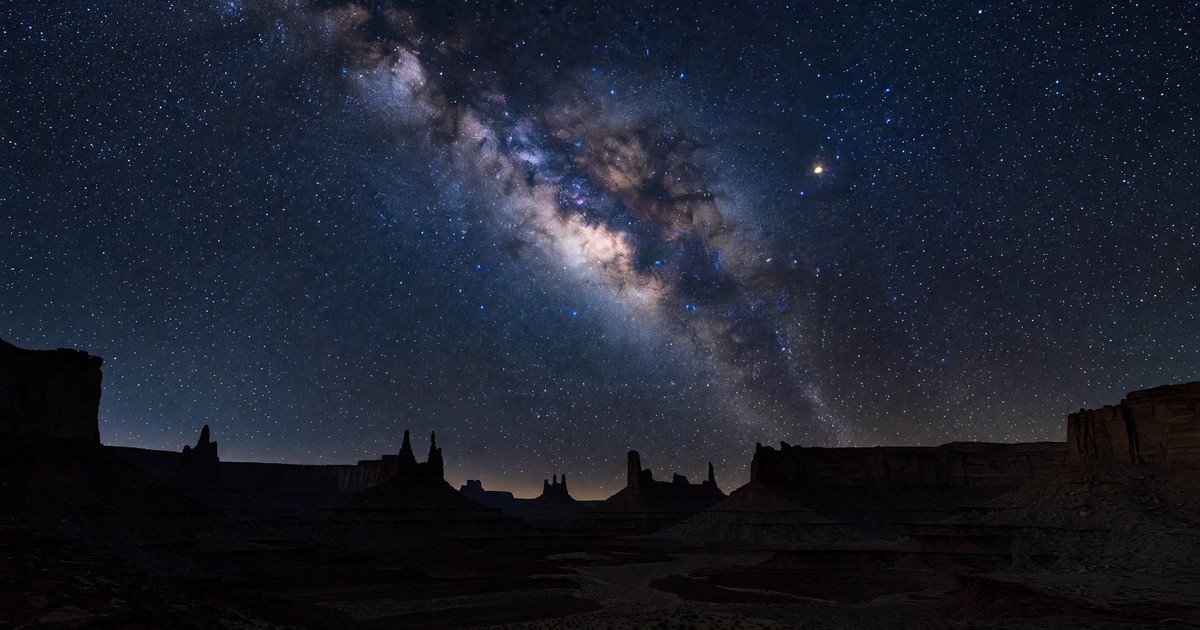
The first time I drove into Big Bend National Park at night and killed the headlights at the trailhead, the sky dropped on me like a curtain being pulled from the top. I had seen the Milky Way before — in photographs mostly, and once at a campground in Wyoming that I’d thought was impressively dark. This was different. The galactic core arched from horizon to horizon like a structural element of the sky, not a smear but a three-dimensional object, thick and bright at the center and fading through a gradation of stars I could not have named if I tried. I stood there for twenty minutes before I thought to set up a tripod.
That experience is repeatable throughout the American West, but not at every park — and the differences between parks are significant enough to matter for planning. A park like Joshua Tree is technically designated and genuinely dark in its core, but light domes from Palm Springs and Indio cut the western horizon. Big Bend has essentially no light pollution in any direction for a hundred miles. Bryce Canyon delivers one of the most unusual combinations in landscape photography — hoodoo fields in the foreground under a Milky Way overhead — but its elevation means the season is compressed. If you’re planning a trip specifically around the night sky, the choice of park matters as much as the choice of month.
This guide covers twelve Western parks with meaningful dark sky credentials, ranked roughly by overall sky quality. For each, I’ve noted the Bortle class, DarkSky International designation status, best viewing spots, ranger programs, and the moon-phase and weather factors that actually govern whether any given night delivers what the Bortle maps promise.
Understanding DarkSky International Designations and the Bortle Scale
Before getting into specific parks, two frameworks are worth understanding: the Bortle scale and DarkSky International’s designation program.
The Bortle scale — developed by amateur astronomer John Bortle in 2001 and published in Sky & Telescope — measures naked-eye sky darkness on a nine-point scale. Class 1 is the darkest possible sky: the Milky Way is bright enough to cast faint shadows, the zodiacal band is visible all year, and the sky has a distinctly three-dimensional quality. Class 2 is nearly as dark, with minor airglow possible at the horizon. Class 4 is a typical rural sky — the Milky Way is obvious but lacks the structural detail visible at Class 1–2. Class 6–7 is a suburban sky where only the brightest stars are accessible to naked-eye observation. Most of the parks on this list rate Class 1 or 2 in their darkest sections — a meaningful statement when compared with Class 5–6 conditions found within 100 miles of nearly every major Western city.
DarkSky International (the organization formerly known as the International Dark-Sky Association, or IDA) maintains a formal designation program for parks, communities, and reserves that actively protect night sky quality. Designation as an International Dark Sky Park requires demonstrated commitment to minimizing light pollution — shielded fixtures, amber-spectrum outdoor lighting, and often a staff ranger program. Some parks hold a Gold Tier classification indicating the highest measurable sky quality (essentially Bortle 1–2 with no significant artificial light dome in any direction); others hold standard or provisional designations. The full designation list and current tiers are maintained at darksky.org.
NPS’s Night Sky Team, a dedicated unit within the National Park Service, conducts sky quality measurements and advocates for dark sky preservation across the park system. Their data underpins many of the Bortle estimates you’ll find in park planning materials.
The 12 Best Western Parks for Stargazing
1. Big Bend National Park, Texas
Big Bend holds the Gold Tier classification from DarkSky International — earned at the time of its 2012 designation and reflective of what remains one of the most light-pollution-free environments in the contiguous United States. The nearest significant artificial light source in most directions is more than 100 miles away. In the darkest sections of the park, Bortle Class 1 conditions are achievable on moonless nights. The Milky Way is bright enough to read by — not metaphorically.
Best viewing spots are the Chisos Basin campground area, the Persimmon Gap area on the north side, and the unpaved River Road along the Rio Grande — increasingly dark the farther east you travel from the west entrance. Ranger star talks run seasonally at the Basin campground, typically Thursday through Sunday from spring through early fall. Check nps.gov/bibe for current schedules.
Moon-phase planning: In a Class 1 environment, even a quarter moon is enough to wash out faint nebulae and reduce the Milky Way’s structural detail. Plan around the new moon window — the three to four nights on either side of new moon are the most productive. For the galactic core (visible May through August in the early-morning sky, shifting to evening visibility by July), you want new moon on a clear, dew-free night, ideally with low wind.
Big Bend’s drawback is logistical: it is genuinely remote. The nearest large city, El Paso, is five hours away. Plan fuel stops carefully; Panther Junction inside the park is the only in-park option.
2. Death Valley National Park, California
Death Valley is the largest national park in the contiguous United States at 3.4 million acres — and its scale translates directly to sky quality. Its 2013 Gold Tier IDA designation covers a park where light domes simply cannot reach the core from any direction without having to traverse more than 100 miles of desert first. The northwestern reaches of the park, around Ubehebe Crater, are generally rated Bortle Class 1. The southern areas near Badwater Basin run closer to Bortle Class 2 as scattered light from Las Vegas begins to affect the southern horizon.
Best viewing spots: Ubehebe Crater for raw sky darkness (no artificial light in any direction), Mesquite Flat Sand Dunes for foreground interest, Badwater Basin at 282 feet below sea level for a completely flat horizon. The basin’s salt flats reflect starlight subtly and create a disorienting ground-and-sky symmetry if you’re photographing at long exposure.
Season note: Death Valley’s stargazing season is winter — November through March. Summer heat renders the park dangerous for any outdoor activity after dark (ground temperatures can remain above 100°F well into the night). The trade-off is that winter skies are crisp, dry, and excellent; the Milky Way galactic core is below the horizon in winter, but winter Milky Way above the ecliptic and the winter Hexagon asterism are spectacular.
3. Great Basin National Park, Nevada
Great Basin is one of the least-visited national parks in the country — fewer than 150,000 annual visitors compared with millions at the major Utah parks — and that isolation translates to extraordinary skies. The park sits in central Nevada, roughly 65 miles from the nearest town of any size, with no major city within 200 miles. Bortle Class 1 conditions are consistently recorded at the Wheeler Peak campground area (9,886 feet elevation) and throughout the park’s high terrain.
The Great Basin Astronomy Festival, held annually in September, is one of the most concentrated amateur astronomy events in the western United States — three days of public telescope viewing, astrophotography workshops, presentations from professional astronomers, and ranger-led night sky walks. For current dates, see nps.gov/grba.
The park earned Gold Tier DarkSky International designation in 2016, and its sky quality measurements from the NPS Night Sky Team consistently rank among the darkest in the system. For moon-phase planning: the Astronomy Festival is scheduled around new moon when possible, but verifying the specific year’s lunar calendar is essential.
4. Capitol Reef National Park, Utah
Capitol Reef received its Gold Tier IDA designation in April 2015, recognizing sky quality throughout the park that is consistently measured at Bortle Class 2. The park’s remote position in south-central Utah — with no major urban center within 80 miles — means the horizon stays clean in nearly every direction. The town of Torrey (just outside the west entrance) maintains dark-sky-compliant lighting as part of the broader designation commitment.
The park’s distinctive geography — a 100-mile monocline called the Waterpocket Fold — creates elevated plateau terrain ideal for night sky observation. The Fruita campground area and the Cathedral Valley in the park’s northern reaches are the most popular stargazing locations. Capitol Reef does not have a regular ranger astronomy program on the scale of Bryce Canyon, but ranger evening programs covering geology and sky are offered seasonally — check nps.gov/care for current scheduling.
5. Bryce Canyon National Park, Utah
Bryce Canyon earned Gold Tier IDA Dark Sky Park status in 2019, and the combination of its sky quality and its hoodoo landscape makes it one of the most visually arresting stargazing locations in the national park system. The park sits above 8,000 feet, with rim elevations reaching 9,100 feet — clean high-elevation air, low humidity, and minimal nearby development translate to reliable Bortle Class 2 conditions in the amphitheater area.
The annual Astronomy Festival, typically held over four days in late June, is the park’s signature dark sky event: telescope viewing at the rim, constellation talks, and ranger programs that run every clear night. The park also conducts roughly 100 ranger-led astronomy programs per year, scheduled to avoid full moon periods. Evening programs run from spring through fall; summer is the most reliably scheduled. The Bryce Canyon NPS page posts exact festival dates each year.
For photography, the Bryce Amphitheater overlooks — especially Bryce Point and Inspiration Point — frame the Milky Way core above the hoodoo fields from May through August on moonless nights. A 16–24mm wide-angle lens, f/2.8 aperture, 20-second exposure at ISO 3200 is a workable baseline. Bring a low-power red-mode headlamp to paint the hoodoo foregrounds during a long second exposure; this is the most effective technique for the composite look you’ve seen in landscape photography from this location.
6. Canyonlands National Park, Utah
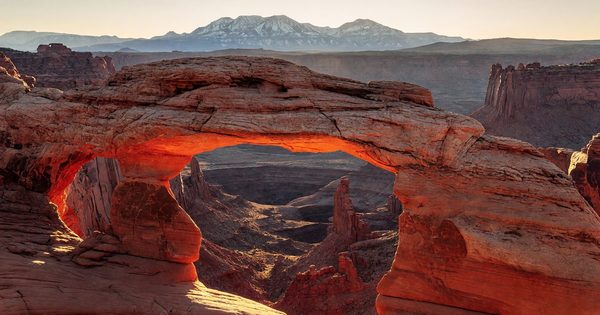
Canyonlands is one of the darkest parks in the country — remote, massive (527 square miles), and hemmed on all sides by public land that buffers it from development. The Island in the Sky district, reached via US-313 north of Moab, offers the most accessible viewpoints: Grand View Point, Mesa Arch, and the Green River Overlook all provide open sky with minimal tree obstruction and dramatic canyon foregrounds. Bortle Class 2 conditions are typical in the Island in the Sky area; more remote zones of the Needles and Maze districts may run Class 1.
The park earned Gold Tier IDA dark sky park designation in 2015. Island in the Sky’s accessibility from Moab (32 miles) makes it the practical choice for most visitors — but note that Moab itself, while small, contributes a faint glow on the northeastern horizon from some viewpoints. Face southwest or west for the cleanest sky.
Seasonal consideration: Late summer (July–August) combined with the galactic core timing makes Canyonlands one of the premier Milky Way locations in Utah. Afternoon thunderstorms are common in July–August; sky conditions often clear dramatically after a storm by 9–10 PM, giving clear, washed air and exceptional transparency.
7. Arches National Park, Utah
Arches National Park, adjacent to Canyonlands and also IDA designated at the Silver Tier in 2019, offers one of the most iconic foreground subjects in landscape photography: Delicate Arch — a 52-foot freestanding sandstone arch — under the Milky Way. The photographic demand for this image is high; on clear, moonless summer nights, the Delicate Arch trailhead parking fills well before midnight.
Bortle conditions in the park core are around Class 2, though the eastern horizon shows increasing light contamination from Moab and, at low elevation, distant Grand Junction. The practical sky for serious astrophotography is overhead and to the southwest.
Access note: The park implemented a timed-entry reservation system from 2022 through 2025 for spring and summer access. As of 2026, timed-entry reservations are no longer required. During the pilot years, nighttime entry (typically after 6 PM) was generally unrestricted. Verify current entry requirements at nps.gov/arch before planning a visit — entry policies may change.
8. Glacier National Park, Montana
In April 2017, Glacier National Park — jointly with Waterton Lakes National Park in Alberta — received a Gold Tier designation as the world’s first transboundary International Dark Sky Park: the Waterton-Glacier International Peace Park. The joint designation recognizes sky quality across both parks, with the highest-quality conditions in the more remote eastern sections of Glacier, away from the Going-to-the-Sun Road corridor.
Logan Pass at 6,646 feet (the high point of Going-to-the-Sun Road) is a popular night sky location when the road is open — typically late June through mid-October. The high-elevation position above the valley floor reduces atmospheric interference and extends the visible horizon. The Many Glacier area on the park’s east side is considered darker, with fewer lodging-related light sources nearby and a flat eastern skyline facing away from any significant settlement.
Ranger astronomy programs at Glacier are less structured than at Bryce Canyon or Grand Canyon but do occur seasonally, often tied to interpretive evening talks at the major campground amphitheaters. Check nps.gov/glac for current programming.
Milky Way timing at Glacier: The galactic core is visible from approximately May through September at useful hours — but Glacier’s latitude (48–49°N) means the core rises lower in the southern sky than at the Utah or Texas parks, reducing its visual drama somewhat compared with Big Bend or Bryce. Northern lights are a compensating possibility in the Glacier season; solar activity permitting, auroral displays are not uncommon on clear nights.
9. Joshua Tree National Park, California
Joshua Tree is IDA designated at the Silver Tier (2017) and genuinely dark in its core — but its proximity to Southern California’s population corridor means stargazers need to be aware of directional sky quality. Light domes from Palm Springs, Indio, and the greater Coachella Valley affect the western and southern horizons. The best sky is found looking north, overhead, and east; the north sky above the park’s higher terrain (Skull Rock area at 4,000 feet) is consistently rated Bortle Class 3–4, with darker conditions possible on nights with exceptional atmospheric transparency.
Joshua Tree’s primary advantage is accessibility — it’s within two to three hours of Los Angeles, making it the most practical dark sky option for Southern California residents. The park runs ranger-led night sky programs, typically from fall through spring when daytime temperatures drop to a manageable range. The desert in summer (June–August) reaches 110°F; late September through November and February through April are the practical dark sky seasons for most visitors.
The best foreground subjects are Joshua trees themselves — the silhouetted profiles of the branching trees against the Milky Way are the park’s signature night photography look. The Cholla Cactus Garden, Keys View, and the Hidden Valley area are popular composition locations.
10. Grand Canyon National Park, Arizona
Grand Canyon earned IDA dark sky park designation in 2019, following a long-term program to replace park lighting with shielded, dark-sky-compliant fixtures. The park’s scale — 1.2 million acres — means sky quality varies significantly by location. The Desert View section on the eastern South Rim, roughly 25 miles from Grand Canyon Village, has the darkest conditions on the accessible South Rim because it sits farther from the concentrated development and lighting around the main visitor area.
Grand Canyon Village itself, with its lodges and services, contributes meaningful light pollution for observers on the nearby rim viewpoints. Desert View, Lipan Point, and Navajo Point are the recommended dark sky viewing locations on the South Rim. The North Rim, while closed in winter and accessible only seasonally (mid-May through mid-October), delivers noticeably darker conditions than the South Rim village area.
Ranger astronomy programs at Grand Canyon have historically been among the most structured in the NPS system — the park maintains dedicated star party equipment and schedules programs from the spring through fall seasons. Check nps.gov/grca for current scheduling.
11. Mesa Verde National Park, Colorado
Mesa Verde received IDA dark sky park designation in 2021, recognizing the park’s commitment to dark-sky-compliant lighting across its facilities and the genuine sky quality of its remote southwest Colorado location. At elevations between 7,000 and 8,500 feet, the park delivers Bortle Class 3–4 conditions across most of the accessible mesa terrain — not the Class 1–2 of the most isolated Utah parks, but significantly better than any of the surrounding towns.
The park’s Morefield Campground, four miles inside the entrance, is the best accessible stargazing location; the far end of the campground away from the entrance road reduces light from the park facilities. The mesa top viewpoints — Park Point at 8,572 feet is the highest accessible point — deliver open sky in most directions. Ranger evening programs are offered seasonally and occasionally include night sky components, but Mesa Verde’s primary interpretive focus is on its Ancestral Puebloan architecture rather than astronomy. Check nps.gov/meve for current programs.
12. Black Canyon of the Gunnison National Park, Colorado
Black Canyon holds IDA dark sky park designation, recognizing sky quality above a remote canyon in western Colorado. Bortle conditions on the South Rim accessible road area run approximately Class 3, with darker conditions possible on the North Rim (accessible in summer only, via a dirt road from Crawford) where fewer facilities mean less ambient light.
The park’s dramatic topography — walls descending 2,000+ feet to the Gunnison River below — limits sky access somewhat; the most open viewing is from the rim overlooks, particularly Gunnison Point near the visitor center and Dragon Point on the eastern end of the rim road. The narrow gorge itself blocks the horizon in two directions, which reduces the total sky area but also creates an unusual sense of depth when looking straight overhead.
Black Canyon doesn’t have a formal ranger astronomy program on the scale of Bryce or Grand Canyon, but the lack of crowds makes it one of the more relaxed dark sky experiences in the Colorado parks system. No reservation systems, no timed entry, and a campground that typically has open sites on weekday nights.
Milky Way Season and Galactic Core Timing
The galactic core — the dense central region of the Milky Way that creates the most spectacular visual display — is only visible during specific months in the Northern Hemisphere. The core rises above the southern horizon in early spring and is best placed for evening observation from approximately May through August. The peak window is generally late June through early August, when the core is highest in the southern sky during the late evening hours (10 PM to 2 AM local time).
Before May, the core rises after midnight and is best seen in the hours before dawn. After August, the core sets earlier and earlier in the evening sky, becoming inaccessible at useful hours by October.
Moon phase is the single most important planning variable. A full moon outshines the Milky Way in most conditions; even a gibbous moon (50–75% illuminated) reduces the galactic core’s visual impact significantly. The practical observing window for serious dark sky work is the three to four nights on either side of new moon — roughly seven to eight nights per month where conditions are meaningfully dark. Plan your park visit around this window first, then optimize for location.
Meteor Shower Calendar
Two annual meteor showers are consistently the most productive for Western park stargazing:
Perseids — peak August 11–12: The Perseids are the most-watched meteor shower of the year, producing up to 100 meteors per hour under ideal conditions. The radiant is in the Perseus constellation, which rises in the northeast and is well-placed from midnight to dawn. The 2024 Perseid peak on August 11–12 coincided with a last-quarter moon (rising around midnight), leaving the early evening hours dark but washing out the pre-dawn window.
Geminids — peak December 13–14: The Geminids are, in most years, actually the more prolific shower — up to 150 meteors per hour at peak — and unlike most showers (which peak in the pre-dawn hours), the Geminid radiant is well-placed by 9–10 PM. The December timing limits accessible parks: most high-elevation Western parks are cold, and some roads are snow-closed. Joshua Tree, Big Bend, and Death Valley are the practical warm-weather options for Geminid viewing. The 2024 Geminid peak fell on December 13–14 with the Full Moon arriving December 15 — a nearly full moon that washed out most faint meteors, reducing visible rates to roughly 15–20 per hour even under dark skies.
Gear Basics for Park Stargazing
You do not need a telescope to have a meaningful dark sky experience at any of these parks. Here’s the short list:
Red-filter headlamp: Mandatory. White light destroys dark adaptation (the eye’s adjustment to low light), which takes 20–30 minutes to develop and seconds to lose. A red-mode headlamp preserves your night vision and is the single most important piece of kit you can bring. Nearly every headlamp sold in the last five years has a red mode; make sure yours does before you leave.
Binoculars — 10×50 is the ideal starter spec: A 10×50 binocular (10× magnification, 50mm objective lens) provides enough light-gathering to resolve the Orion Nebula, the Andromeda Galaxy, open clusters in Perseus, and dozens of other objects invisible to the naked eye — without the complexity of polar-aligning a telescope. 10×50s are hand-holdable, pack easily, and work for daytime wildlife viewing as well. Image-stabilized binoculars (Canon, Nikon) are significantly better for extended sky scanning.
Planisphere or stargazing app: A planisphere (rotating star chart matched to your latitude) works without a battery and doesn’t emit white light. For apps: Sky Map, SkySafari, and Stellarium are consistently recommended by amateur astronomy communities. Use your phone in red-filter mode if the app doesn’t have it built in — there are full-screen red overlay apps for both iOS and Android. The American Astronomical Society maintains resources for beginner observers including software recommendations.
Layered clothing: Temperature drops dramatically at elevation after dark. Bryce Canyon in August can be 75°F at sunset and 45°F at midnight. Big Bend in October reverses the pattern (warm nights) but desert temperatures can still plunge. A down jacket is not optional at high-elevation parks.
For astrophotography: A wide-angle prime lens (16–24mm, f/2.8 or faster), a full-frame mirrorless or DSLR body with good high-ISO performance, a sturdy tripod, and a remote shutter release are the baseline kit. Target 15–25 second exposures at ISO 3200 to start; adjust from there based on your sensor’s noise floor. Bring a spare battery — cold temperatures drain batteries quickly.
Tracking Sky Conditions Before You Go
Clear Outside and Clear Dark Sky (cleardarksky.com) are the two most widely used tools for forecasting night sky quality at specific parks. Clear Dark Sky plots astronomical seeing, atmospheric transparency, wind, humidity, and moon altitude for hundreds of named observation sites — including most major national park campground areas. The forecast horizon is 48 hours; planning a trip around a specific night requires checking three to four days out and refreshing the forecast as you get closer.
The NPS Night Sky Team also publishes park-by-park sky quality data and photometry measurements, accessible through the NPS Night Sky program pages.
Light-Pollution Etiquette at Dark Sky Parks
The parks that made this list earn their designations partly through the cooperation of visitors. A few practices that matter:
No white headlamps on overlooks or in camping areas. Switch to red mode before leaving your car. If your headlamp only has white, cover it with red cellophane or point it directly at the ground.
No flash photography near telescopes or ranger programs. Flash photography destroys the dark adaptation of every observer nearby and is generally prohibited at ranger astronomy events. Long-exposure photography without flash is always appropriate.
No campfire light visible from observation areas. Campfires are fine in designated rings; be aware of where the light travels. A campfire behind a ridgeline casts no sky glow; one directly adjacent to an observation area does.
Keep car headlights off as long as possible. When parking at a dark sky viewpoint, turn headlights off before you reach the viewing area if possible, and avoid using backup lights that flash on nearby observers.
Frequently Asked Questions
Which Western national park has the darkest skies?
Big Bend National Park in Texas has the darkest skies of any park on this list — Bortle Class 1 conditions in most of the park, a Gold Tier DarkSky International designation, and no significant light source within roughly 100 miles in any direction. Great Basin National Park in Nevada is a close competitor, with Class 1 readings in the Wheeler Peak area and extraordinary sky quality driven by its extreme isolation in central Nevada.
What is the best time of year to see the Milky Way at Western parks?
The galactic core — the densest, brightest part of the Milky Way — is visible in the evening sky from approximately May through August in the Northern Hemisphere. Peak months are June through early August, when the core is highest in the southern sky during prime nighttime hours. Combine this window with the new moon phase (three to four nights on either side of new moon) for the best conditions.
Do I need special equipment to stargaze at a national park?
No. The naked eye under a Class 1–2 sky reveals thousands of stars, satellite galaxies (the Andromeda Galaxy is visible naked-eye under good conditions), star clusters, and the full structural detail of the Milky Way. Binoculars — particularly a 10×50 model — significantly extend what you can see without requiring any specialized knowledge. A planisphere or stargazing app helps with identification. A red-mode headlamp is essential for preserving your night vision.
When is the Perseid meteor shower in 2024?
The 2024 Perseid meteor shower peaked on the night of August 11–12. Rates can reach 50–100 meteors per hour under dark skies. The 2024 peak occurred with a last-quarter moon that rose around midnight, so the pre-midnight hours offered good dark conditions before moonrise interfered.
Are all DarkSky International-designated parks equally dark?
No. Designation confirms that a park actively manages its lighting and has measurably low artificial sky brightness — but sky quality still varies significantly between parks. Gold Tier classification (held by Big Bend, Capitol Reef, Glacier, and a handful of others) indicates the highest measurable sky quality. Parks like Joshua Tree and Grand Canyon are genuinely dark in their cores but have light pollution on some horizons from nearby urban areas. Check the Bortle class for the specific park section you plan to observe from.
Can I see the Milky Way without a camera?
Yes — and at a Class 1–2 dark sky site, the naked-eye experience is arguably more impressive than any photograph. Cameras compress the Milky Way’s three-dimensional appearance into a flat image; standing under a truly dark sky, the galactic core has depth and texture that photographs only partially capture. The central bulge of the galaxy, several emission nebulae, and the dark rifts within the band are all visible to the naked eye under Class 1–2 conditions.
For current park entry requirements, ranger program schedules, and road conditions, consult each park’s page at nps.gov. Dark sky designation data is maintained by DarkSky International. Sky quality forecasts for specific park observation sites are available via Clear Dark Sky. The NPS Night Sky Team publishes park-by-park sky quality measurements for all major national parks. The American Astronomical Society provides resources for beginner observers and coordinates citizen science sky quality programs. For the Bryce Canyon National Park page and Glacier National Park page see the detailed park guides on this site.