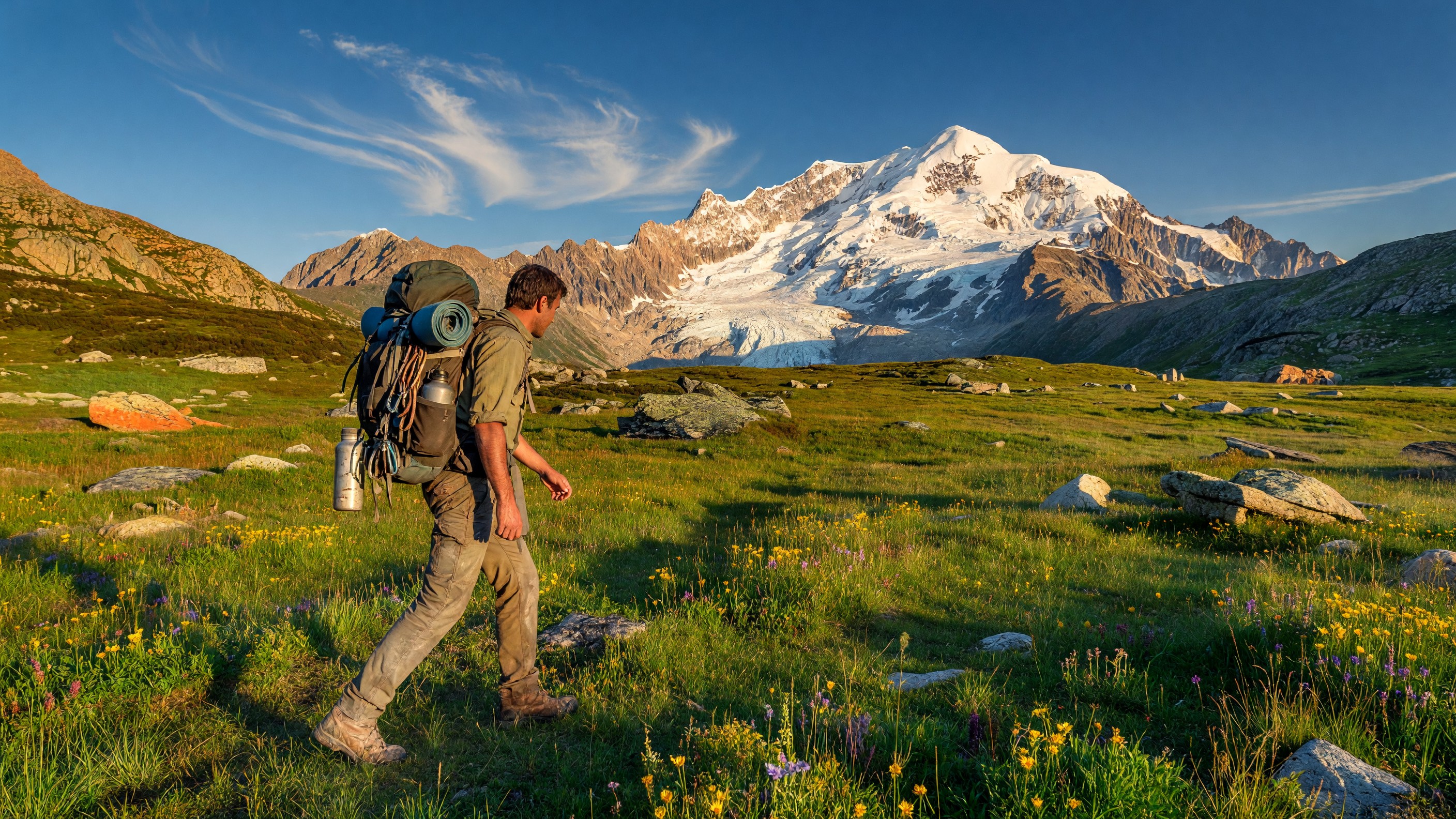
Multi-day backpacking in US national parks operates on a different set of rules than a day hike. The permit system is the gatekeeper, not your fitness level. Routes like the John Muir Trail and the Wonderland Trail at Mount Rainier are attainable for intermediate-to-advanced backpackers — but only if you understand the lottery systems, know when to apply, and have a backup plan for when the lottery doesn’t go your way.
This guide covers twelve of the most rewarding multi-day backcountry routes in the national park system, ranked roughly by complexity and logistics depth. Each entry gives you the numbers that matter: total distance, elevation gain, days required, permit application timeline, bear canister requirements, water sources, and gear essentials. A strategy section at the end covers how permit lotteries actually work, how to use alternates and walk-up windows, and how to structure your application calendar for a summer that has multiple permit targets.
How National Park Backcountry Permits Work
Most heavily-trafficked backcountry routes in national parks now operate on a lottery or advance reservation system managed through Recreation.gov. The lottery system works roughly as follows: the NPS sets a quota on nightly backcountry campers per zone or trailhead to protect resources and distribute visitor impact. Applications open during a specified window (most major lotteries run January through March for that calendar year’s summer season). When applications exceed available permits, a random draw assigns permits to applicants. Unsuccessful applicants receive a refund or no charge.
The critical detail most first-timers miss: the lottery window for the coming summer typically opens in January or February — which means you need to be planning in winter for a July or August trip. Routes like the Teton Crest Trail run their lottery in January. The Yosemite Wilderness Permit lottery for popular entry trailheads accepts applications in February. If you miss the advance lottery, walk-up permits are typically made available the day before each entry date, but availability is limited and not guaranteed.
Separate from Recreation.gov-managed lotteries, a few long-distance permits operate through different channels. The Pacific Crest Trail Long-Distance Permit is issued by the Pacific Crest Trail Association (PCTA) rather than Recreation.gov. The Continental Divide Trail has no unified permit system — it crosses multiple jurisdictions, each with different requirements.
Bear Canister Requirements
A hard-sided bear canister is required in a growing number of backcountry zones across the national parks. Regardless of whether a canister is mandated, it is strongly recommended wherever black bears or grizzlies are present — which is most of the parks on this list. Where canisters are not required, parks typically provide bear boxes at designated camp sites. The specifications below note whether a canister is required or whether food storage boxes are provided.
Common canister dimensions for bear-box approval at most parks: the container must be hard-sided, odor-resistant, and open without a coin, screwdriver, or paw. Garcia Wilderness Bear Canister and BearVault models are most widely approved. Check the specific park’s current canister approval list before departure — some parks (Yosemite, for example) have a formal approved-canister list.
Leave No Trace in Backcountry
The Leave No Trace Center for Outdoor Ethics publishes the seven principles that govern ethical backcountry travel. In regulated national park zones, the practical applications are:
- Camp only in designated sites or in impacted sites 200 feet from water, trails, and other campers (zone-dependent)
- Pack out all waste including food scraps; bury human waste in a cathole 6–8 inches deep and 200 feet from water
- No campfires above timberline and follow all fire restrictions (many backcountry zones prohibit fires entirely)
- Cairn neutrality — do not build new cairns or add to existing ones
- Wildlife distance — 100 yards from bears and wolves; 25 yards from all other wildlife
The Routes
1. Wonderland Trail — Mount Rainier National Park
Total distance: 93 miles (loop) Elevation gain: Approximately 22,000 feet cumulative Days required: 10–14 days (most parties plan 12) Permit: Wilderness camping permit — advance lottery opens early March via Recreation.gov; walk-up permits available at trailhead stations day-of or day-before Bear canister: Required in Mount Rainier backcountry Water sources: Abundant — glacier-fed streams throughout; treat all water Best window: Late July through mid-September (snow clears high camps by mid-July in most years)
The Wonderland Trail circumnavigates the entire base of Mount Rainier — a 14,411-foot active volcano — through old-growth forest, subalpine meadows, and glacier-carved river valleys. The full 93-mile loop gains and loses roughly 22,000 feet, crossing eight major drainages and dozens of named creek crossings that can be knee-deep during peak snowmelt in early July.
The permit system divides the trail into camp zones. The advance lottery (typically opening in early March on Recreation.gov for that summer) is the primary access route; it assigns specific camp zones for each night. Walk-up permits are available daily at Longmire, Carbon River, and White River ranger stations starting at 7 a.m. the day before the start date. Walk-up availability in July is genuine but not reliable for weekend starts on the most popular sections (Carbon River to Mowich, Sunrise to White River).
Gear essentials: Bear canister (required), microspikes for early-season snow crossings, trekking poles, a filter rated for silty glacial water (a squeeze filter like Sawyer can clog faster than usual — carry a backup bandana prefilter), wool or synthetic base layers for the cold-night elevations even in August.
NPS resource: nps.gov/mora/planyourvisit/backcountry-permits.htm
2. Half Dome Overnight via Little Yosemite Valley — Yosemite National Park
Total distance: 16–17 miles (out-and-back via Happy Isles to summit via cables) Elevation gain: 4,800 feet Days required: 2 (overnight at Little Yosemite Valley) Permit: Wilderness permit (Little Yosemite Valley zone) + Half Dome day-use cable permit — both via Recreation.gov lottery; Yosemite Wilderness Permit lottery opens in late February Bear canister: Required in Yosemite backcountry Water sources: Merced River and tributary streams; treat all water Best window: Late May (when cables are installed) through mid-October
The Half Dome cable route is one of the most iconic summit experiences in the national park system — and one of the most permit-constrained. Two permits are required for an overnight approach to the summit: a Yosemite Wilderness Permit for the Little Yosemite Valley camp zone, and a separate Half Dome day-use permit for the cables section on summit day.
The Yosemite Wilderness Permit lottery for popular trailheads (Happy Isles / Mist Trail to Little Yosemite Valley being among the most sought) opens in late February on Recreation.gov. The Half Dome cable permit is managed separately on a daily lottery basis during the cable season (roughly late May through mid-October when cables are installed). Daily Half Dome permits are also distributed in a same-day lottery and through a preseason lottery.
Camping at Little Yosemite Valley puts you approximately 4 miles from the summit — a manageable approach before the cable section. The cables themselves are steep (approximately 45 degrees on the upper section) and require upper body strength and a clear head for heights. Gloves or grippy gardening gloves improve grip on the steel cables significantly.
NPS resource: nps.gov/yose/planyourvisit/halfdome.htm
3. John Muir Trail — Yosemite to Mount Whitney
Total distance: 211 miles (Yosemite Valley to Whitney Portal) Elevation gain: Approximately 47,000 feet cumulative Days required: 17–21 days (most parties plan 3–4 weeks) Permit: Yosemite Wilderness Permit (northbound entry from Happy Isles) or Whitney Zone Permit (southbound) — Yosemite lottery via Recreation.gov opens in late February; Whitney Zone permit via Recreation.gov lottery opens in February Bear canister: Required throughout (mandatory in all zones along the JMT) Water sources: Abundant — Sierra Nevada lakes and streams; treat all water Best window: Late July through mid-September (passes are snow-free; Whitney Portal accessible)
The John Muir Trail is the flagship long-distance route of the Sierra Nevada — 211 miles linking Yosemite Valley to the summit of Mount Whitney (14,505 feet), the highest point in the contiguous United States. The route crosses eleven passes above 11,000 feet, traverses sections of the Kings Canyon and Sequoia backcountry, and passes through some of the most remote wilderness in the lower 48 states.
The permit bottleneck is the Yosemite Wilderness Permit for southbound hikers starting from Happy Isles. This is among the most competitive backcountry permits in the national park system. The advance lottery on Recreation.gov opens in late February for the entire summer season; success rates for the highest-demand dates (Friday and Saturday starts in July) are estimated at 10–20% in recent years. Northbound hikers starting from Whitney Portal face the Whitney Zone permit, which has its own lottery structure.
Key permit strategy: Apply for both southbound (Yosemite) and northbound (Whitney) lotteries, with flexible start dates. Mid-week starts (Tuesday–Thursday) have significantly higher lottery success rates than weekend dates. Permit holders can modify their itinerary once in the backcountry as long as they stay within the quota zone structure.
NPS resource: nps.gov/yose/planyourvisit/jmt.htm
4. Pacific Crest Trail — Yosemite or Washington Sections
Total distance: Section-dependent (Yosemite section ~70 miles; Washington’s South Cascades section varies) Elevation gain: Section-dependent Days required: 5–10 days (section-dependent) Permit: PCT Long-Distance Permit issued by PCTA for hikes of 500+ miles; section hikes through regulated zones (Yosemite, Glacier, etc.) require the relevant park’s wilderness permit in addition — via Recreation.gov. PCT Long-Distance Permit application: pcta.org Bear canister: Required in Yosemite sections; required in most high-use Sierra sections Water sources: Reliable in Sierra and North Cascades; carry 2–3L capacity in drier southern sections Best window: July through September (North Cascades); late June through September (Sierra sections)
The Pacific Crest Trail runs 2,650 miles from the US-Mexico border at Campo, California, to the US-Canada border at Manning Provincial Park, British Columbia. For section hikers in the national park system, the two most rewarding segments are the Yosemite traverse (entering via Yosemite’s northern boundary near Sonora Pass and exiting via Tuolumne Meadows) and the North Cascades section through Washington State.
The permit structure for PCT section hikes through national parks has two layers: if you are hiking 500 or more continuous miles of the PCT, the PCTA issues a Long-Distance Permit that covers the trail corridor; for sections under 500 miles, or for camping in regulated park zones, the relevant national park wilderness permit applies. Yosemite’s PCT-through-hiker quota manages entry at Lyell Canyon and Tuolumne via the Yosemite Wilderness Permit system.
PCTA resource: pcta.org/discover-the-trail/permits/
5. Continental Divide Trail — Glacier, Rocky Mountain, and Yellowstone Sections
Total distance: Section-dependent (Glacier CDT section ~100 miles; full park-to-park varies) Elevation gain: Highly variable Days required: Section-dependent (5–15 days per major section) Permit: No unified CDT permit — each traversed jurisdiction has its own system; Glacier backcountry permit required for in-park camping; Yellowstone backcountry permit required; Rocky Mountain backcountry permit required — all via Recreation.gov or park-specific permit systems Bear canister: Required in Glacier (grizzly country — treat seriously); recommended or required in Yellowstone and Rocky Mountain backcountry Water sources: Reliable in most sections; treat all water Best window: Late July through mid-September (snow clears CDT passes late in the season)
The Continental Divide Trail runs 3,100 miles along the spine of the Rocky Mountains from the US-Mexico border at Antelope Wells, New Mexico, to the US-Canada border at Waterton-Glacier International Peace Park. Unlike the PCT and AT, the CDT has no unified federal permit. Section hikers need to research the permit requirements for each jurisdiction they traverse.
In Glacier National Park, the CDT follows the Highline Trail and the North Fork corridor — wilderness camping permits for these zones are required and issued through Recreation.gov. In Yellowstone, the CDT overlaps with backcountry zones that require a Yellowstone backcountry use permit. In Rocky Mountain National Park, the CDT section requires a Rocky Mountain backcountry permit. Plan an additional two to three weeks of lead time for multi-park CDT sections because the permit applications are not coordinated — each must be pursued separately.
NPS resources: nps.gov/glac | nps.gov/yell | nps.gov/romo
6. Hayduke Trail — Arches to Zion
Total distance: Approximately 800 miles Elevation gain: Approximately 100,000 feet cumulative Days required: 60–90 days (expedition-level commitment) Permit: No unified permit; dozens of jurisdictions including Arches, Canyonlands, Capitol Reef, Bryce Canyon, Grand Staircase-Escalante, Grand Canyon, and Zion — each with its own permit system; Grand Canyon Phantom Ranch requires separate lottery Bear canister: Not universally required on the Hayduke, but strongly recommended for food protection; check individual jurisdiction requirements Water sources: The most serious planning variable on this route — water sources in canyon country are scarce, unreliable, and require advance research; carry 6L capacity minimum in desert sections Best window: March through May or September through November (summer heat in canyon country is dangerous and frequently trip-ending)
The Hayduke Trail is not a national park permit route — it is an unofficial 800-mile route linking the canyon country of southern Utah and northern Arizona, created by route-finders Mike Coronel and Joe Mitchell as a tribute to Edward Abbey’s fictional character George Washington Hayduke. It traverses the redrock canyon systems connecting Arches National Park in the northeast to Zion National Park in the southwest, crossing slot canyons, obscure water pockets, and terrain that requires route-finding, rope skills, and comfortable navigation in canyon country.
The Hayduke is expedition-level backpacking. Water logistics alone require a dedicated planning spreadsheet: the route crosses sections with 20–30 miles between reliable water sources, and “reliable” in canyon country means confirmed-by-recent-trip-reports, not mapped. Most serious Hayduke attempts involve leaving water caches in advance (legal in some sections, prohibited in others — research each jurisdiction), carrying filtration capable of handling silty pothole water, and having an exit strategy for every major section.
This is not a route for first or second multi-day trips. It rewards deep canyon-country experience, comfort with off-trail travel, and significant self-sufficiency skills.
Reference: hayduke trail.org for current route notes and water research
7. Teton Crest Trail — Grand Teton National Park
Total distance: 35–40 miles (point-to-point, Teton Village to String Lake or Granite Canyon to String Lake depending on variant) Elevation gain: Approximately 8,500 feet Days required: 4–6 days Permit: Grand Teton backcountry camping permit — advance lottery via Recreation.gov opens in January for that summer’s season; walk-up permits available at Colter Bay and Jenny Lake visitor centers Bear canister: Required in Grand Teton backcountry Water sources: Abundant — mountain lakes and streams throughout; treat all water Best window: Late July through mid-September (passes clear of snow; tram at Teton Village operational)
The Teton Crest Trail traces the spine of the Teton Range above 10,000 feet for most of its length, delivering sustained views of the Cathedral Group — Grand Teton, Mount Owen, Teewinot — that are among the most dramatic alpine panoramas in the lower 48. The classic routing runs from the Granite Canyon trailhead (or via the Teton Village aerial tram to gain elevation on day one) through Alaska Basin, Death Canyon Shelf, and South Fork Cascade Canyon before descending to String Lake or Jenny Lake.
The January lottery opening on Recreation.gov is the key planning date. Applications open in mid-January and the lottery draws are completed before February. The zone permit system assigns specific campsites for each night — the Death Canyon Shelf zone and the Alaska Basin campsites (in the adjacent Jedediah Smith Wilderness in Idaho, which has a separate permit) are the most competitive. Walk-up permits are available day-before at Colter Bay Visitor Center, with limited but genuine availability on weekdays.
NPS resource: nps.gov/grte/planyourvisit/backcountry-camping.htm
8. Bright Angel — South Kaibab Loop, Grand Canyon
Total distance: Approximately 24 miles (Bright Angel descent + South Kaibab ascent, or vice versa, with Phantom Ranch at the bottom) Elevation gain: 4,380 feet (South Rim to Colorado River and back) Days required: 2–3 days (one to two nights at Phantom Ranch or Bright Angel Campground) Permit: Phantom Ranch lottery via Recreation.gov for lodging (opens 15 months in advance, released on the 1st of each month); Bright Angel Campground backcountry permit via NPS Backcountry Information Center lottery — applications accepted beginning October 1 for the following year Bear canister: Not required (food storage boxes provided at Phantom Ranch and Bright Angel Campground); strongly recommended for rodent-proof storage Water sources: Water available at Indian Garden / Havasupai Gardens, Bright Angel Campground, and Phantom Ranch; seasonal at South Kaibab (none on the descent — carry 3–4L from the rim) Best window: October through April (inner canyon temperatures exceed 110°F in summer; the NPS issues heat advisories and discourages below-the-rim hiking from May through September)
The corridor-route loop through the Grand Canyon inner canyon is one of the most dramatic overnight backpacking experiences accessible to intermediate hikers — the transition from rim forest through the Redwall limestone to the Tonto Platform to the Colorado River covers more than 2 billion years of geological exposure in a single descent. But the inner canyon is a heat environment that has proven fatal to underprepared visitors in summer months.
The permit system has two components: lodging at Phantom Ranch (dormitory bunks and private cabins) is managed by Xanterra via a Recreation.gov lottery that opens 15 months in advance, with unsold inventory released on the 1st of each month; camping at Bright Angel Campground (backcountry permit) is managed through the NPS Backcountry Information Center, with advance applications accepted beginning October 1 for the following calendar year and walk-up permits available at the rim visitor center.
The South Kaibab Trail has no water until Phantom Ranch; descend with a minimum of 3 liters per person per day in cool months, more in spring. Electrolyte supplements (not just water) are essential for multi-day inner canyon travel.
NPS resource: nps.gov/grca/planyourvisit/backcountry.htm
9. Highline Trail Multi-Day Extension — Glacier National Park
Total distance: 36–50 miles (Highline Trail extension to Fifty Mountain, Goat Haunt, and Waterton) Elevation gain: Approximately 8,000–12,000 feet (section-dependent) Days required: 3–5 days Permit: Glacier backcountry camping permit via Recreation.gov; advance lottery typically opens in mid-March; walk-up permits available at Apgar and St. Mary visitor centers Bear canister: Required in Glacier backcountry (grizzly bear country — this is a hard requirement, not a recommendation) Water sources: Reliable throughout — mountain streams and lakes; treat all water Best window: Late July through mid-September (Logan Pass access via Going-to-the-Sun Road; snow clears high camp zones late)
Glacier’s standard Highline Trail day hike (7.6 miles one-way from Logan Pass to Granite Park Chalet) is well-documented and heavily trafficked. What is less discussed is the multi-day extension north toward Fifty Mountain Camp and down to Goat Haunt at the US-Canada border — a 36–50 mile route that includes some of the most remote terrain accessible to backpackers without cross-country navigation.
Grizzly bear density in Glacier is among the highest in the lower 48 states. Bear canisters are required in all backcountry camp zones, and bear spray should be carried accessible (not packed away) throughout the route. The NPS Glacier backcountry permit system via Recreation.gov opens in mid-March; the advance lottery assigns camp zones, and Fifty Mountain is one of the highest-demand zones in the park. If the advance lottery misses, walk-up permits at Apgar Visitor Center often yield midweek availability in August.
The international border at Goat Haunt requires crossing documentation — US citizens need a passport or passport card to enter and return from Canada.
NPS resource: nps.gov/glac/planyourvisit/backcountry.htm
10. Skyline Trail to Camp Muir — Mount Rainier National Park
Total distance: 9 miles round-trip (Skyline Trail to Camp Muir at 10,080 feet) Elevation gain: 4,600 feet Days required: 1–2 (overnight at Camp Muir for summit attempts) Permit: Backcountry camping permit required for Camp Muir — via Recreation.gov (advance reservations typically open in March); summit climbing permit required separately for summit attempts above Camp Muir Bear canister: Required in Mount Rainier backcountry Water sources: Snow melt at Camp Muir (carry treatment capacity); no liquid water at the camp reliably Best window: Late June through early September (route involves permanent snowfield travel; poles and microspikes minimum, crampons recommended for icy conditions)
Camp Muir at 10,080 feet is the standard base camp for summit attempts on Mount Rainier and the overnight destination for backpackers on the Skyline Trail who want a sub-alpine wilderness experience without the full Wonderland Trail commitment. The 9-mile round trip gains 4,600 feet on a route that transitions from paved Paradise visitor center paths to the permanent Muir Snowfield by mile 2.
The overnight permit for Camp Muir is issued through Recreation.gov and is separate from the Wonderland Trail permit system. Summit attempts above Camp Muir require a separate climbing permit, issued by the NPS. For backpackers not intending to summit — using Camp Muir as a destination for high-camp solitude and a sunrise panorama of the Cascades — the backcountry permit is the only requirement.
Weather at Camp Muir changes fast and dramatically. A clear afternoon at Paradise can produce near-whiteout conditions at 10,000 feet within an hour. Navigation to Camp Muir in fog requires compass skills or a GPS track — the snowfield is featureless in poor visibility.
NPS resource: nps.gov/mora/planyourvisit/climbing.htm
11. Rae Lakes Loop — Sequoia and Kings Canyon National Parks
Total distance: 41 miles (loop from Roads End, Kings Canyon) Elevation gain: Approximately 6,700 feet Days required: 4–6 days Permit: Kings Canyon Wilderness Permit — advance lottery via Recreation.gov; lottery opens in February for the following summer season; walk-up permits available at Roads End Permit Station Bear canister: Required in the Kings Canyon wilderness (black bear activity is high — canisters are strictly enforced) Water sources: Abundant — lakes and streams throughout; treat all water Best window: Late June through mid-September (Kearsarge and Glen passes clear of snow by late June in most years)
The Rae Lakes Loop is widely regarded as the most accessible introduction to multi-day Sierra Nevada backpacking — the combination of granite lake basins, high passes, and forested drainage valleys that defines the range is all present in a 41-mile circuit achievable in four days at a moderate pace. The loop departs from Roads End in Kings Canyon and crosses Kearsarge Pass, Pinchot Pass, and Glen Pass in a counterclockwise direction (the standard routing).
The permit system at Kings Canyon is managed through Recreation.gov with an advance lottery opening in February. The Roads End entry point is one of the most popular in the Sierra; weekend July permits are competitive. Mid-week starts with flexible dates have a meaningfully higher lottery success rate. Walk-up permits are released 24 hours before each start date at the Roads End Permit Station — genuine availability on weekdays, limited on summer weekends.
Bear canister compliance is strictly enforced on the Rae Lakes Loop; rangers have issued citations for hanging food (which does not meet the bear-safe standard at Kings Canyon). Use an NPS-approved hard-sided canister.
NPS resource: nps.gov/seki/planyourvisit/permits.htm
12. Olympic Coast Trail — Shi Shi Beach to Ozette
Total distance: Approximately 13 miles (point-to-point, Shi Shi Beach to Ozette Lake trailhead) Elevation gain: Minimal — largely flat coastal travel with headland scrambles Days required: 2–3 days Permit: Olympic National Park Wilderness Permit — via Recreation.gov for overnight camping in designated coastal zones; walk-up permits available at Wilderness Information Center in Port Angeles Bear canister: Not typically required on the Olympic Coast; food must be hung or stored in park-provided food storage boxes at designated camp sites Water sources: Freshwater streams available at regular intervals along the coast; saltwater is abundant but unusable without distillation equipment; treat all freshwater sources Best window: May through September (coastal fog common year-round; summer brings the most stable weather window)
Olympic’s coastal strip — accessible via a series of trailheads along Highway 101 on the park’s western edge — offers a fundamentally different multi-day experience than any of the other routes on this list. Instead of alpine passes and granite basins, the Olympic Coast route travels between tidal headlands, past sea stacks and tide pools, through Sitka spruce rainforest, and along some of the most remote coastline in the lower 48 states.
The Shi Shi Beach to Ozette section (approximately 13 miles) is the most commonly run two-to-three-day coastal segment. It includes the Point of the Arches sea stack formation at Shi Shi, the beach travel south through Rialto-adjacent zones, and the final section to Lake Ozette with its signature 3-mile boardwalk return trail through old-growth forest. Tidal timing is a required planning element — several headlands can only be crossed at low tide, and the tidal schedule must be cross-referenced against your daily itinerary. NPS provides tide tables and identifies the specific headlands that require low-tide passage.
NPS resource: nps.gov/olym/planyourvisit/coastal-backpacking.htm
Permit Application Strategy
How Lotteries Actually Work
Recreation.gov lotteries for backcountry permits are conducted in a random draw. Applications within the lottery window are not first-come-first-served — submitting on the first minute the window opens does not improve your odds. The draw runs after the application window closes, and all applications within the window have equal probability.
What does improve your odds:
Apply for flexible dates. Most lottery systems allow you to list alternate start dates. Applying for a three-day window (for example, July 10, 11, and 12) triples your effective applications. Applying for mid-week dates (Tuesday, Wednesday, Thursday) rather than weekends dramatically increases success probability on competitive routes like Yosemite’s JMT entry and the Teton Crest.
Apply in the first available lottery window, not the last. Some parks (Yosemite Wilderness) release a percentage of permits in pre-season lotteries (February) and hold a percentage for daily lotteries or walk-up availability. The pre-season lottery is not the only option, but it is the highest-volume opportunity.
Use alternate entry points. The JMT lottery is most competitive for Happy Isles (Yosemite Valley) entry. Alternate JMT entries — Tuolumne Meadows, Lyell Canyon, Glacier Point — have lower competition and can be combined with a bus ride or car shuttle from the valley. Check alternate trailhead quotas on Recreation.gov before applying only for the most obvious option.
Walk-Up Permits
Walk-up permits (also called “day-of” or “first-come” permits) are available at most backcountry permit stations for trips starting the following day. The NPS typically holds a percentage of each day’s quota for walk-up distribution, often 40–50% of daily capacity. For popular permits in peak season, walk-up queues at Yosemite’s wilderness permit counters can form before dawn on summer weekends. For mid-week attempts on secondary routes, walk-up availability is often genuine and accessible without an early queue.
The Olympic Coast, the Highline Trail extension in Glacier, and the Bright Angel / South Kaibab loop all have meaningfully better walk-up odds than the JMT or the Wonderland Trail. If your schedule is flexible, a drive-up-and-try approach on a Tuesday in August is a realistic strategy for these routes.
Permit Application Calendar
| Route | Lottery Opens | System |
|---|---|---|
| Teton Crest Trail | January (mid-month) | Recreation.gov |
| John Muir Trail (Happy Isles) | Late February | Recreation.gov |
| Half Dome Cable Permit | February (preseason) | Recreation.gov |
| Yosemite Wilderness (general) | Late February | Recreation.gov |
| Rae Lakes Loop / Kings Canyon | February | Recreation.gov |
| Wonderland Trail | Early March | Recreation.gov |
| Glacier Backcountry | Mid-March | Recreation.gov |
| Grand Canyon (Bright Angel Camp) | October 1 (prior year) | NPS Backcountry Office |
| PCT Long-Distance Permit | Year-round, rolling | PCTA |
Leave No Trace: Backcountry Deep-Dive
The most impactful LNT behaviors in regulated national park backcountry are not the obvious ones — most people carrying a bear canister understand not to feed wildlife. The behaviors that create measurable resource damage are subtler:
Campsite selection. In dispersed-camping zones (where designated sites are not required), camp on durable surfaces — rock, gravel, dry grass, snow. Never camp on soil within 200 feet of any water source, trail, or other camp. In regulated zones with designated sites, camp only in the designated footprint.
Waste management. Pack out all food waste including cooking scraps, citrus peels, and coffee grounds — these attract rodents and bears even when not obviously food-like. Human waste requires a cathole 6–8 inches deep in organic soil, 200 feet from water. In the Grand Canyon inner canyon, catholes are problematic in canyon-bottom desert soil — use a WAG bag (carry-out system), which is required in some Grand Canyon backcountry zones.
Water source stewardship. Do not use soap — even biodegradable — within 200 feet of any water source. Carry water 200 feet away to wash dishes; strain food solids out and pack them out.
Campfire ethics. The LNT framework discourages fires above timberline. In practice, most backcountry zones on the routes in this guide either prohibit fires entirely or restrict them to fire rings at designated sites. Never build a fire in an unpermitted zone regardless of how established-looking a fire ring may appear — legacy fire rings spread camping impact and are not authorization for fire use.
For the full LNT framework and current guidance: lnt.org/why/7-principles
Regulated Camping Zones
Several routes on this list operate under zone-based camping permits rather than site-based permits. The distinction matters:
- Zone permit (Glacier, Wonderland Trail): Your permit assigns you to a named zone for each night; you choose your specific campsite within that zone on arrival, as long as it meets LNT standards or uses a designated site within the zone.
- Site permit (Grand Canyon, Half Dome / Little Yosemite Valley): Your permit names a specific campground. You must camp there.
- Quota permit (JMT, Kings Canyon): Your permit controls entry point and daily entry quota; campsite selection within the backcountry is more flexible, subject to zone restrictions.
Check the specific permit confirmation for your route to understand whether you are assigned a site or a zone — the on-the-ground experience differs significantly.
Frequently Asked Questions
When is the best time to apply for a national park backcountry permit?
The most competitive permits — JMT, Wonderland Trail, Teton Crest — should be applied for in the January–February lottery window for the same summer season. For the Grand Canyon’s Bright Angel Campground, the NPS accepts advance applications beginning October 1 for the following calendar year. The Pacific Crest Trail Long-Distance Permit through PCTA is available on a rolling basis. Most other permits listed here run March–April lotteries via Recreation.gov.
What happens if I don’t win the lottery?
Most parks retain a percentage of daily permit quota for walk-up distribution at trailhead ranger stations or visitor centers. Check the specific park’s walk-up permit policy. Additionally, Recreation.gov often makes cancellations visible in real time — setting up notifications for your target route and checking regularly in the weeks before your planned trip date frequently surfaces last-minute availability.
Are bear canisters required everywhere on these routes?
Not uniformly — but most of the routes in this guide either require them or strongly recommend them. In Yosemite, Kings Canyon, Mount Rainier, and Grand Teton, hard-sided canisters are mandatory. In Glacier, they are required due to grizzly bear presence. The Grand Canyon provides food storage boxes at designated sites. Olympic Coast permits hanging food from park-provided poles at designated camps. Verify requirements at the specific park’s backcountry page before departure.
How much water should I carry?
Water strategy is route-specific, but the practical minimum: carry 2–3 liters in the Sierra Nevada and Pacific Northwest where water is abundant, 3–4 liters in transition zones, and 4–6 liters in canyon country (Grand Canyon, Hayduke) where sources can be separated by 15–25 miles. Always treat backcountry water regardless of how remote or clear the source appears. Carry a filter rated for the conditions — squeeze filters (Sawyer, Platypus) work well in most mountain environments; UV treatment (SteriPen) is faster but vulnerable to battery failure.
What is the hardest route on this list?
By logistics complexity and commitment level, the Hayduke Trail is in a different category from everything else on this list — 800 miles of largely unmaintained, cross-country canyon-country navigation with water logistics that require expedition-level planning. Among the maintained permit routes, the full John Muir Trail is the most demanding: 211 miles, 47,000 feet of cumulative elevation gain, multiple high passes, and the most competitive permit in the national park system.
Permit dates and lottery procedures cited throughout this guide reflect historical patterns through 2025. Recreation.gov procedures and NPS permit systems are subject to change annually. Always verify current-year permit requirements and application windows at nps.gov and recreation.gov before applying.
For national park policy and advocacy context: National Parks Conservation Association (npca.org)
If your national park trip combines technical climbing with overnight wilderness camping, see best national parks for rock climbing for permit rules, guide services, and climbing ethics across ten parks.