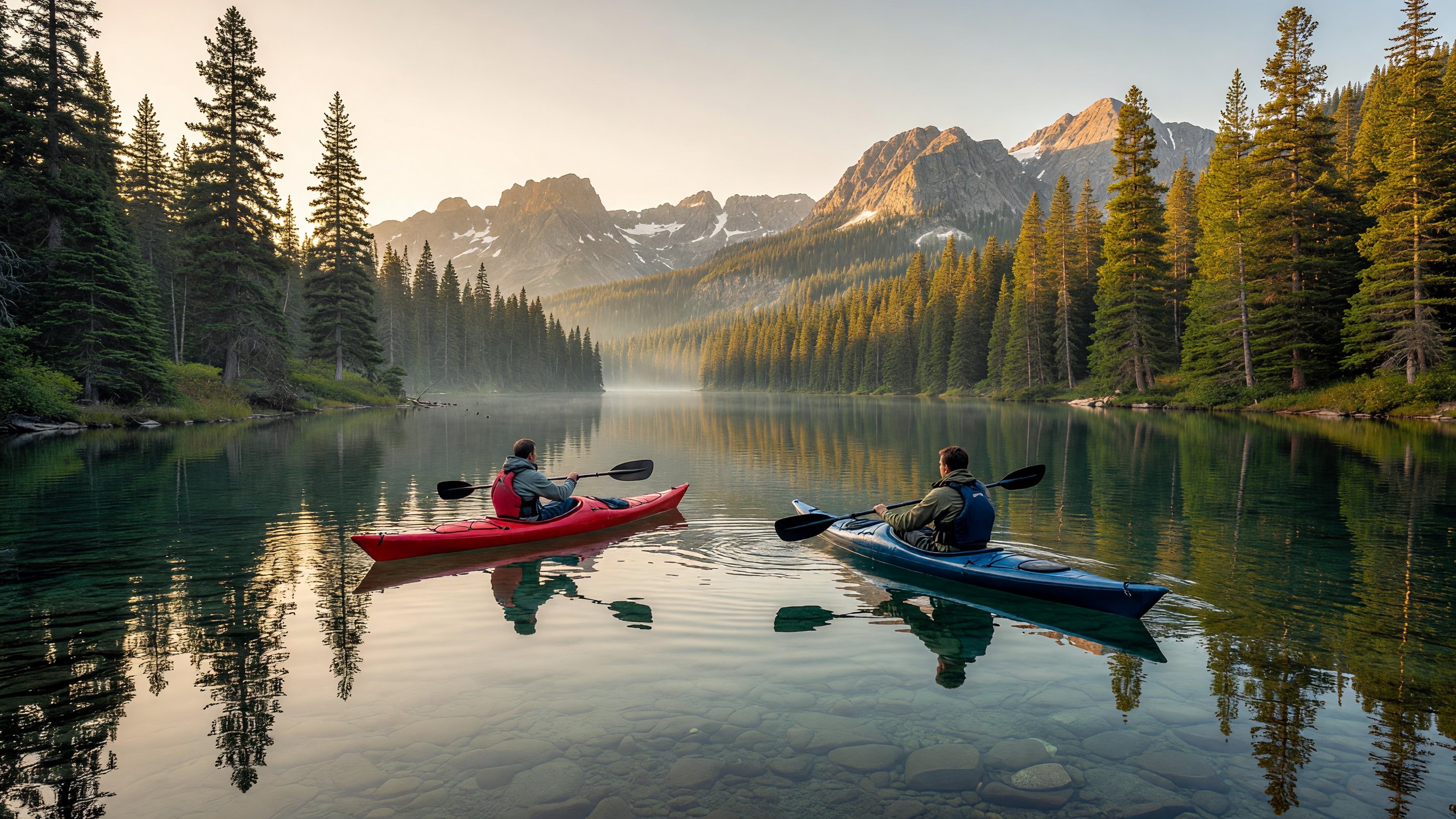
Not every national park is best seen from a trail. Some parks are designed — by geology, hydrology, or sheer scale — to be experienced from the water. Voyageurs National Park in northern Minnesota is 40 percent water by area: if you don’t have a boat, you are locked out of most of the park. The Everglades Wilderness Waterway is a 99-mile canoe and kayak route through one of the most ecologically complex systems on the continent. Glacier Bay is accessible from shore only at its gateway cove — the glaciers, the fjords, and the wildlife are on the water.
For paddlers, these parks are not alternatives to the hiking parks. They are the main event.
This guide covers 12 parks where kayaking and canoeing are a primary or major activity — ranked by paddling depth, ranging from beginner day-trip flatwater to multi-week sea kayak expeditions. Each entry covers trip type, where to rent gear, permit and reservation logistics, safety considerations, family-suitability, and what distinguishes the experience from anywhere else in the park system.
1. Voyageurs National Park, Minnesota
Trip type: Multi-day canoe routes (flatwater lakes), family-friendly day paddles | Skill level: Beginner to intermediate | Terrain: Four large border lakes, 500+ smaller interior lakes
Voyageurs is the only national park in the contiguous United States where the primary transportation network is water. Approximately 40 percent of the park’s 218,000 acres is water — the four main lakes (Kabetogama, Rainy, Namakan, and Sand Point) span the US-Canada border, and the interior of the Kabetogama Peninsula is reachable exclusively by boat. Trails exist, but they are boat-access trails: you paddle in, tie up, and hike from there.
Day trips: Both Kabetogama and Rainy Lake offer calm, island-sheltered paddling that is appropriate for families with children or anyone new to open-water canoeing. The coves and bays near Kabetogama Lake Visitor Center and Rainy Lake Visitor Center are the best starting points for first-time visitors — well-protected from wind, with clear sight lines to developed docks and pull-outs.
Multi-day canoe routes: The Kabetogama Peninsula interior contains 110+ miles of interconnected water trails linking island campsites. These are not primitive campsites — they are designated backcountry sites with fire grates, bear boxes, and privies, bookable through Recreation.gov. The most popular multi-day loop is the Blind Indian Portage route, a 2–4 day circuit through the interior lakes of the peninsula. Portages are generally short (under 0.5 miles), and the routes are well-mapped by the NPS.
Rentals and outfitters: Canoe and motorboat rentals are available from private operators near both Kabetogama and Rainy Lake. The NPS does not operate rental concessions at Voyageurs; check the park’s authorized outfitter list at nps.gov/voya before booking. Houseboats (available from park-permitted operators) are popular for multi-night trips and provide a floating base camp.
Permits and reservations: Backcountry campsite reservations through Recreation.gov are required for all designated sites. Day paddling does not require a permit. There is no permit for motorized watercraft on the main lakes; watercraft inspections for invasive species are required at park entry points — follow current protocols at nps.gov/voya.
Safety: Rainy Lake can produce whitecap-level chop quickly in afternoon thunderstorms, which are common July through August. Cross open water in the morning when wind is typically calmer; hug island shores rather than taking direct open-water routes. Bring a VHF radio or satellite communicator for multi-day trips — cell coverage is absent on most of the peninsula interior.
Family pick: Kabetogama Lake day paddles, especially the sheltered bays near Ash River Visitor Center. Flat water, minimal boat traffic, and short distances to island beaches.
2. Everglades National Park, Florida
Trip type: Multi-day expedition (wilderness waterway), day kayak | Skill level: Day paddlers: beginner to intermediate; Wilderness Waterway: experienced paddlers only | Terrain: Mangrove estuary, open Florida Bay, freshwater slough
The Everglades Wilderness Waterway is a 99-mile marked canoe and kayak route stretching from Everglades City in the northwest to Flamingo in the southeast. An 8-to-10-day itinerary is typical for the full route; most paddlers average 12–15 miles per day in the backcountry. Campsites along the route are a mix of wooden chickee platforms (elevated over water — the only option in open Florida Bay sections) and beach or ground sites; all require advance reservation through Recreation.gov.
Day trips: Two routes are consistently recommended for day visitors:
- Nine Mile Pond (Flamingo area): A 5-mile loop through mangrove tunnels, sawgrass prairie, and open ponds. Blazed by tree markers. Best for sit-on-top kayaks; partially shaded.
- West Lake: An 8.1-mile one-way route through mangrove forest to Alligator Creek, with high probability of manatee sightings in cooler months.
Rentals: Flamingo Marina (operated by the park’s concessioner, Forever Florida) rents canoes, kayaks, and stand-up paddleboards. Check current rental availability at the Flamingo Visitor Center page on nps.gov/ever; post-Hurricane Ian recovery has affected infrastructure at various points.
Permits: All backcountry overnight paddling requires a backcountry permit, available through Recreation.gov. The permit system limits use per campsite; apply well in advance for winter season (November–March), which is peak paddling season. Summer paddling is possible but not recommended for most visitors — heat, humidity, mosquito density, and afternoon thunderstorm frequency make the winter dry season the correct window.
Safety: Alligators are present throughout the freshwater zones of the park; this is their habitat and encounters are common. The NPS guidelines are clear: maintain a respectful distance (minimum 15 feet), never feed wildlife, and do not paddle toward or block animals. Saltwater crocodiles inhabit the Flamingo area and Florida Bay (rarer, but present). Tidal awareness is essential for the coastal sections of the Wilderness Waterway — timing crossings to avoid being stranded on mudflats is a real logistics consideration. All paddlers should carry a marine-grade compass and waterproof topo; the mangrove maze is genuinely disorienting.
Family pick: Nine Mile Pond loop in dry season (December–March). Short, shaded, manageable for school-age children with basic paddling experience.
3. Glacier Bay National Park & Preserve, Alaska
Trip type: Sea kayaking (guided day trips, independent multi-day expedition) | Skill level: Guided day trips: beginner welcome; independent expeditions: advanced sea kayakers only | Terrain: Tidewater fjords, active calving glaciers, marine mammal habitat
Glacier Bay is one of the most dramatic sea kayaking destinations in the world. The park protects 16 active tidewater glaciers — including Margerie Glacier and Grand Pacific Glacier at the head of the bay — and the wildlife density in these waters is extraordinary: humpback whales, orcas, Steller sea lions, harbor seals, and brown bears are all routinely seen by paddlers.
Guided trips from Bartlett Cove: Glacier Bay Lodge (the park’s only in-park lodging, operated by the park’s authorized concessioner) offers guided day kayak tours departing from Bartlett Cove. These are the right entry point for visitors without sea kayaking experience — stable touring kayaks, life jackets, wetsuit gear, and a certified guide. Advance reservations are strongly recommended; check the current tour schedule through the concessioner contact on nps.gov/glba.
Backcountry expeditions: Independent multi-day kayak expeditions into the upper bay require a free backcountry permit (available at the Visitor Center at Bartlett Cove) and typically involve chartering a boat to drop gear and paddlers at the head of the bay or into one of the fjord arms. The most common itinerary is 5–10 days paddling from a charter drop-off point back to Bartlett Cove. The National Park Conservation Association maintains visitor resources for Glacier Bay trip planning; consult the NPS backcountry guide for required equipment lists and bear canister rules.
Permits: Free backcountry permits are required for overnight stays. No permit required for day paddling from Bartlett Cove. There are strict vessel traffic management zones in certain areas of the bay — particularly around tidewater glacier faces — that are enforced to protect wildlife. Review the current vessel regulations at nps.gov/glba before your expedition.
Safety: Tidewater glaciers calve without warning. The NPS enforces a 0.25-mile exclusion zone from glacier faces — this is a safety rule, not a suggestion. Calving ice creates waves and can capsize a kayak at significant distance. Cold water immersion is fatal in minutes in Glacier Bay; full immersion gear (drysuit, not wetsuit) is strongly recommended for independent expeditions. Marine fog is common; navigation by compass and GPS is essential for any open-water crossing.
Family pick: Guided day tours from Bartlett Cove. Appropriate for families with children 8 and older; confirm minimum age requirements with the concessioner. The guided route is managed for safety and delivers reliable wildlife sightings without the logistical complexity of an independent expedition.
4. Channel Islands National Park, California
Trip type: Sea kayaking (day trips and multi-day island camping) | Skill level: Intermediate to advanced | Terrain: Pacific ocean sea caves, kelp beds, rocky coastline
Channel Islands is a sea cave and marine wildlife destination — and Santa Cruz Island’s Painted Cave is the destination. At roughly 1,227 feet long with an entrance ceiling reaching 160 feet above water level, Painted Cave is the longest sea cave in North America — a cathedral-scale opening in the Santa Cruz Island sea cliffs accessible only by kayak. The cave’s interior contains a waterfall during wet season and supports a colony of Brandt’s cormorants visible from the kayak.
Getting there: There is no vehicle ferry. All visitors reach the islands by boat charter from Ventura Harbor (primarily through Island Packers, the park’s authorized concessioner), and sea kayaks are typically transported as deck cargo or are available as rentals on Santa Cruz Island through permitted operators. Check current rental and charter availability at nps.gov/chis.
Day paddling: From the Scorpion Anchorage landing area on Santa Cruz Island, guided sea kayak tours to the sea caves (including Painted Cave) run 3–5 hours. These require intermediate paddling ability — you are in Pacific swells, not flatwater.
Camping: Backcountry camping is available at Scorpion Canyon Campground (Santa Cruz Island) for multi-day island trips; reservations through Recreation.gov. Water is not available at the campground — carry all you need, or treat from the creek (treat if using natural sources).
Safety: Pacific swell and surge can render the sea caves inaccessible or dangerous on any given day. Channel Islands sea kayaking is managed with a strict “cave entry decision is made on-water, not in advance” protocol — outfitters reserve the right to turn away from caves based on conditions. Fog is common, particularly in June (locals call it “June Gloom”), and reduces visibility to near-zero. Do not paddle the open channel from the mainland to the islands on your own; use the charter system.
Family pick: Guided tours on Santa Cruz Island. Children 8 and older are generally acceptable for guided cave tours; confirm with the outfitter.
5. Acadia National Park, Maine
Trip type: Sea kayaking (coastal), flatwater lake paddling | Skill level: Beginner (inland lakes) to intermediate (coastal) | Terrain: Frenchman Bay coastline, inland lakes
Acadia offers two distinct paddling environments: the open-water sea kayaking of Frenchman Bay and the Mount Desert Island coastline, and the calm flatwater of Long Pond, Eagle Lake, and Jordan Pond.
Sea kayaking: Multiple outfitters in Bar Harbor (a 5-minute drive from the park entrance) offer guided half-day and full-day sea kayak tours of Frenchman Bay, including circumnavigation of the Porcupine Islands. This is a beginner-friendly coastal tour — Frenchman Bay is well-protected from the open Atlantic by Schoodic Peninsula — but tidal current and small-craft advisories apply. The NPS Acadia site at nps.gov/acad lists authorized outfitters.
Long Pond flatwater: Long Pond, on the western (Quietside) side of Mount Desert Island, is the largest lake entirely within the park boundary and is a calm, family-appropriate paddling destination. Canoe and kayak rentals are available from a private outfitter at the Pond’s End launch area on the south end. No permit required for day paddling.
Permits: No permit required for sea kayaking or flatwater paddling. Camping on shore requires backcountry permits for specific sites; consult nps.gov/acad for current backcountry camping rules.
Safety: Tidal currents in the narrows between the Porcupine Islands and Bar Harbor are strong at peak flow. Guided tours are timed for slack water; independent paddlers should consult tide tables (available at Bar Harbor outfitters). Water temperature in Frenchman Bay is cold even in August — immersion gear and a float plan are standard practice.
Family pick: Long Pond canoe or sit-on-top kayak rental. Flat water, no tidal current, excellent mountain views.
6. Olympic National Park, Washington
Trip type: Flatwater lake paddling, river floats | Skill level: Beginner to intermediate | Terrain: Glacially-carved alpine lakes, Pacific coast rivers
Olympic contains three distinct paddling environments: the deep alpine lakes of the interior (Lake Crescent, Lake Quinault, Lake Ozette), the river floats of the Hoh and Queets, and the coastal strip (limited paddling access due to surf).
Lake Crescent: One of the deepest and most scenically striking lakes in the Pacific Northwest — 624 feet at maximum depth, ringed by 4,000-foot forested ridges. The lake is too cold for swimming but excellent for kayaking: calm on most mornings, with afternoon wind picking up from the west. Canoe and rowboat rentals are available from the Log Cabin Resort and Lake Crescent Lodge (park concessioners). No motorized watercraft on most of the lake.
Lake Quinault: On the southwest side of the park, Lake Quinault is warmer and smaller than Crescent, with paddle access near the Quinault Rain Forest Ranger Station. Canoe rentals from Lake Quinault Lodge.
River floats: The Hoh River (lower section, outside the park boundary near Forks) and the Bogachiel River offer class I–II float trips in summer and fall. These are not permit-regulated; outfitters in Forks provide raft and kayak rentals.
Permits: No permit for lake day paddling. Backcountry camping near Lake Ozette requires a permit through nps.gov/olym.
Family pick: Lake Crescent morning canoe rental from Lake Crescent Lodge. Calm water, stunning mountain backdrop, rentals available on-site.
7. Grand Teton National Park, Wyoming
Trip type: Lake kayaking and canoeing, flatwater | Skill level: Beginner to intermediate | Terrain: High-elevation glacial lakes, Snake River
Grand Teton’s paddling is glacier-lake flatwater — Jenny Lake, Jackson Lake, String Lake, and Leigh Lake — each framed by the full Teton Range wall rising directly above the western shore. The scenery is immediate and total in a way that few flatwater paddling destinations can match.
Colter Bay Village: Jackson Lake is the park’s primary large-water paddling destination, and canoe and kayak rentals are available from the Colter Bay Marina (operated by the park’s authorized concessioner, Grand Teton Lodge Company). Jackson Lake is 25,730 acres — conditions can deteriorate rapidly with afternoon thunderstorms. Afternoon whitecaps are common; morning paddling is strongly preferred.
Jenny Lake: No motorized watercraft are permitted on Jenny Lake. Canoe and kayak access is via the String Lake Trailhead (just north of Jenny Lake), with a short portage into the lake. The views across Jenny Lake to the Cathedral Group peaks are among the most iconic in any national park. Note: the Grand Teton visitor guide covers the full park planning context, including Jenny Lake Shuttle timing if you’re combining a kayak with a hike to Hidden Falls.
String Lake and Leigh Lake: String Lake is a shallow, canoe-appropriate flat-water connection between Jenny and Leigh Lake; the portage from String to Leigh adds a multi-lake circuit option. Leigh Lake is the quieter destination of the two — less boat traffic, longer shoreline to explore.
Snake River float trips: Float trips on the Snake River (class I–II within the park) are operated by multiple park-concessioner outfitters departing from Moose. These are scenic raft or drift-boat floats, not whitewater — appropriate for families and non-paddlers.
Permits: No permit required for day paddling on Jackson Lake, Jenny Lake, String Lake, or Leigh Lake. Overnight paddling to backcountry campsite areas requires a backcountry camping permit through Recreation.gov; these sites are limited and competitive. Check nps.gov/grte for current permit windows.
Safety: Jackson Lake afternoon winds are the primary hazard. Lightning over exposed lake water is a serious risk in afternoon storm season (July–August). Hug the shoreline, and be back at the launch before noon on any day with afternoon storm potential.
Family pick: String Lake canoe launch, with the short portage to Leigh Lake. Flat water, short distances, mountain views, and no motorized boat traffic.
8. Congaree National Park, South Carolina
Trip type: Paddling trail (flatwater), multi-hour canoe/kayak loop | Skill level: Beginner to intermediate | Terrain: Bottomland hardwood floodplain, blackwater creek
Cedar Creek Canoe Trail is the signature water route in Congaree — a paddling trail of approximately 15–17 miles (full route from Bannister Bridge to the Congaree River) through the park’s old-growth bottomland forest that is genuinely unlike any other paddling trail in the national park system. The creek is blackwater (tannin-stained, tea-colored, not polluted — the color comes from organic acids leaching from cypress and tupelo leaves), and on calm mornings the reflections of ancient bald cypress knees and massive trunk bases in that dark water create something close to a mirrored hall of ancient trees. Wildlife is constant: river otters, swamp rabbits, wood ducks, prothonotary warblers in breeding season, and deer on the banks.
The route: The full Cedar Creek trail runs from the Bannister Bridge boat launch (off Bluff Road, outside the park boundary to the west) to the take-out near the Harry Hampton Visitor Center inside the park. Most paddlers allow 4–6 hours for the full trail; shuttle logistics require a vehicle drop at the take-out end. Some portions run fast after heavy rain; the creek can flood and become impassable after significant precipitation. Check current water levels and access at nps.gov/cong before putting in.
Rentals: Congaree does not operate in-park canoe rentals. Kayak and canoe rentals are available from outfitters in Columbia, SC (approximately 20 miles north). The Congaree National Park visitor guide covers the full park experience, including the Boardwalk Loop and synchronous firefly events, for visitors planning a full day or overnight trip.
Permits: No permit required for day paddling on Cedar Creek. Backcountry camping requires a free permit from the visitor center; campfire permits are separate.
Safety: Water moccasins (cottonmouth snakes) are present in the floodplain and may be seen on low branches above water. Keep hands and arms inside the boat in vegetated sections. Alligators occasionally enter the park from downstream — visually unlikely on Cedar Creek but not impossible.
Family pick: A shorter out-and-back from Bannister Bridge — turning around at the 3–4 mile mark keeps the route manageable for families while still delivering the full old-growth paddling experience.
9. Yellowstone National Park, Wyoming
Trip type: Lake kayaking (flatwater), quiet lake paddling | Skill level: Beginner to intermediate | Terrain: Large high-elevation alpine lake, small motor-free backcountry lake
Yellowstone is not primarily a paddling park — it’s a thermal and wildlife park, and most visitors come for the geysers, hot springs, and megafauna. But it has two paddling experiences worth planning around.
Yellowstone Lake from Bridge Bay Marina: Yellowstone Lake is the largest high-elevation lake in North America — 136 square miles at 7,733 feet elevation. Kayak rentals are available from Bridge Bay Marina (operated by the park’s concessioner, Xanterra). The marina is the center of in-park boating activity; conditions on the open lake can deteriorate to dangerous chop quickly in afternoon storms, so morning paddling is strongly preferred. Motorized boats share the lake; kayakers should stay in designated areas.
Lewis Lake and the Lewis River Channel: Lewis Lake (in the park’s southern section near the South Entrance) allows both motorized and non-motorized watercraft, but it is significantly smaller and calmer than Yellowstone Lake and sees far less motorboat traffic. The more interesting paddling destination is the Lewis River Channel — a 3.5-mile non-motorized-only waterway connecting Lewis Lake to Shoshone Lake, which is itself closed to all motorized craft. Paddling Lewis Lake then up the channel to Shoshone Lake is a multi-day backcountry route requiring a camping permit through Recreation.gov. The channel can be shallow in late summer and may require wading in spots.
Permits: Day paddling on Yellowstone Lake from Bridge Bay and on Lewis Lake requires a park-issued boating permit, available at Bridge Bay Marina or the South Entrance. Non-motorized boating permits are separate from motorized permits; fees differ. Check current fee and permit requirements at nps.gov/yell.
Family pick: Lewis Lake morning paddle. Low motorboat traffic on the southern lake section, calm on most mornings, and the thermal features around the southern shoreline make for an unusual backdrop. Ambitious paddling families can continue up the non-motorized Lewis River Channel toward Shoshone Lake.
10. Apostle Islands National Lakeshore, Wisconsin
Trip type: Sea kayaking (open Lake Superior, sea caves, island-to-island crossings) | Skill level: Intermediate to advanced | Terrain: Lake Superior sea cliffs, sandstone sea caves, island shorelines
The Apostle Islands are 21 islands in western Lake Superior, connected by the surrounding water and managed as a National Lakeshore. The sea cave formations on Mainland Unit (accessible by kayak from Meyers Beach in Cornucopia, WI) and on Sand Island are among the most visually striking sea cave systems in the Midwest — sandstone arches and caverns carved by lake ice and wave action, accessible only by kayak or small boat.
Seasonal access — ice caves: In winters when Lake Superior freezes sufficiently, the same sea caves become ice caves — walls of ice and icicle formations inside the sandstone chambers — accessible by foot across the ice. Ice cave access is weather and ice-thickness dependent and varies significantly by year; the National Park Service announces access windows when conditions are safe. Check nps.gov/apis for current-year winter access status.
Island-to-island paddling: With 21 islands spread across a navigable (in calm conditions) area of Lake Superior, multi-day island-hopping trips are the marquee Apostle Islands experience. Designated campsites on 18 of the islands are bookable through Recreation.gov. The crossings between islands are short (most under 2 miles) but Lake Superior conditions can be unforgiving — paddlers have been capsized in cold Lake Superior water in the past; hypothermia risk is real even in summer.
Permits: Backcountry camping permits required through Recreation.gov. Day paddling does not require a permit. The Apostle Islands National Lakeshore is fully NPS-administered; the NPS visitor center in Bayfield, WI (nps.gov/apis) handles all permits and trip-planning resources.
Safety: Lake Superior is an inland sea. Water temperature rarely exceeds 55°F even in August. A capsize in open water without a drysuit and swift self-rescue skills is a survival situation, not a swimming incident. The National Weather Service marine forecast for western Lake Superior is mandatory reading before any crossing. Wear your PFD on every crossing — no exceptions.
Family pick: Guided sea cave tours from Meyers Beach, offered by the park’s authorized concessioner in calm summer conditions. Appropriate for families with older children (10+) with basic paddling ability.
11. North Cascades National Park / Ross Lake National Recreation Area, Washington
Trip type: Multi-day lake paddling, canoe portage route | Skill level: Intermediate (lake paddling); the portage route adds logistics complexity | Terrain: Deep mountain reservoir, conifer-flanked fjord-like lake
Ross Lake, within the Ross Lake National Recreation Area that forms the core of the North Cascades complex, is a 24-mile reservoir stretching north into British Columbia. The lake is surrounded by 8,000-foot peaks on both sides, and the combination of the dark green water, steep forested walls, and total road inaccessibility (except at the south end near the Ross Lake Resort) makes it one of the most remote paddling destinations in the contiguous US.
The water taxi + portage system: Reaching Ross Lake for a multi-day paddle trip typically involves either: (a) launching from Diablo Lake below and portaging gear around Ross Dam (approximately 1 mile), or (b) using the Ross Lake Resort water taxi (floatplane or boat) to reach the resort and launch from there. The resort rents canoes and kayaks to overnight guests and day visitors. Check current availability and access logistics at nps.gov/noca.
Campsites: Designated campsites along Ross Lake are bookable through the park; some are accessible only from the water. The full 24-mile lake takes 3–5 days to paddle round-trip with camping; most visitors do a 2–3 day out-and-back from the south end.
Permits: Backcountry permits required for overnight camping; available through nps.gov/noca.
Safety: The wind tunnel effect in the steep-walled lake corridor can create sudden strong headwinds and chop. Morning paddling is preferable; the typical pattern is calm mornings, increasing wind after noon. Cold water, remote location — immersion gear and a reliable communication device (satellite communicator) are strongly recommended.
Family pick: Day paddles near the south end of Ross Lake for experienced paddling families. The portage logistics make this a poor choice for families with young children or first-time paddlers; consider Olympic National Park’s Lake Crescent as an accessible Pacific Northwest alternative.
12. Boundary Waters Context — Voyageurs National Park Adjacency
A note for trip planners: the Boundary Waters Canoe Area Wilderness (BWCAW) lies directly east of Voyageurs National Park in the Superior National Forest. The BWCAW is administered by the USDA Forest Service — not the National Park Service — but it is geographically and culturally continuous with the Voyageurs paddling ecosystem. The two areas together constitute the largest canoe wilderness in the world accessible by road.
BWCAW entry permits are required for all overnight trips and quota-controlled for day entry in some zones; they are managed through a separate permit system on recreation.gov under the USDA Forest Service. Combining a Voyageurs NPS trip with a BWCAW trip in the same week is a common and logical itinerary for serious paddlers — the NPS Voyageurs site has information on cross-border trip planning context.
Planning Your National Park Paddle Trip: Five Variables That Matter
Trip type — flatwater vs. sea kayak vs. river
These are fundamentally different skill sets and gear requirements. Flatwater canoe or sit-on-top kayak (Voyageurs, Congaree, Grand Teton, Olympic lakes) requires basic paddling mechanics and swimming ability. Sea kayaking (Glacier Bay, Channel Islands, Acadia coastal, Apostle Islands) requires at least an intermediate skill level, cold-water immersion awareness, and navigation ability. River floating (Olympic’s Hoh, Grand Teton’s Snake River) requires either a guide or whitewater certification depending on class.
Sit-on-top adaptive kayaks with outrigger floats are available from many in-park and gateway outfitters for paddlers with mobility limitations. Voyageurs and Grand Teton’s Colter Bay are the best parks for adaptive paddling access — contact the parks directly at their visitor contact pages on nps.gov for current adaptive equipment availability.
Rental vs. self-supply
In-park concessioner rentals are available at: Voyageurs (private operators near lake entries), Everglades (Flamingo Marina), Glacier Bay (guided tours only — no self-serve kayak rental), Grand Teton (Colter Bay Marina), Olympic (Lake Crescent Lodge, Quinault Lodge), and Yellowstone (Bridge Bay Marina). At Congaree, Apostle Islands, and North Cascades, plan to bring your own or rent from a gateway town outfitter.
Permit timing
Backcountry campsites at Voyageurs, Everglades, Glacier Bay, and Apostle Islands fill quickly for peak season. For Voyageurs interior sites and Everglades chickee platforms, book Recreation.gov openings as soon as the booking window opens — typically 6 months ahead for peak summer and winter dry-season dates respectively. Glacier Bay backcountry permits are free but capacity is limited; apply at the visitor center on arrival during peak season.
Safety gear — the non-negotiables
Per United States Coast Guard boating safety requirements, all paddled watercraft must carry one properly fitted US Coast Guard–approved life jacket (PFD) per person, and children 12 and under are required to wear their PFD at all times while underway on federally regulated waters. In cold-water parks (Glacier Bay, Apostle Islands, North Cascades, Acadia), a life jacket alone is insufficient protection against cold-water shock — immersion gear (wetsuit or drysuit) is standard safety practice even in summer.
Additional essentials: whistle or sound signal, waterproof light for dawn/dusk use, float plan left with someone onshore, and a marine VHF radio or satellite communicator for any offshore or backcountry route.
Wildlife and environmental awareness
Alligators (Everglades, Congaree margins), bears (Glacier Bay shorelines, Apostle Islands, North Cascades), sea lions and marine mammals (Glacier Bay, Channel Islands), and moose in shallow bays (Voyageurs) are all genuine considerations. Keep food stored in provided bear boxes at backcountry sites; do not cook or eat at or near your tent; maintain distance from all wildlife whether on shore or from the water. Leave No Trace principles apply equally to water-based recreation.
Frequently Asked Questions
Do you need a permit to kayak in a national park?
Day paddling typically does not require a permit at most parks, but there are exceptions. Yellowstone requires a boating permit (available at marinas) for any watercraft, motorized or non-motorized. All national parks require backcountry camping permits if you plan to stay overnight — these are booked through Recreation.gov. Some sea kayaking zones have specific access restrictions (Glacier Bay’s glacier exclusion zones, for example). Always check the specific park’s NPS page for current permit requirements before your trip.
Can beginners kayak in national parks?
Yes — several parks on this list have genuinely beginner-appropriate flatwater options. Grand Teton’s String and Leigh Lakes, Olympic’s Lake Crescent, Voyageurs’ Kabetogama bays, and Congaree’s Cedar Creek (in low-water conditions) are all manageable for beginners with basic paddling mechanics and swimming ability. Sea kayaking parks — Glacier Bay, Channel Islands, Apostle Islands — require intermediate to advanced skills and are not beginner-appropriate without a guided tour. Guided tours at those parks are beginner-welcome.
What is the Everglades Wilderness Waterway?
The Everglades Wilderness Waterway is a 99-mile canoe and kayak route marked by brown poles through the mangrove estuary of Everglades National Park, running from Everglades City in the northwest to Flamingo in the southeast. It is one of the longest officially designated water trails in the national park system, takes 8–10 days to complete, and requires advance backcountry camping permits for all overnight stops (chickee platforms over water, beach sites, or ground sites). It is not an appropriate trip for beginners — tidal navigation, heat, wildlife, and remoteness make it an expedition-grade route.
Can you kayak in Yellowstone National Park?
Yes. Kayak and canoe rentals are available from Bridge Bay Marina on Yellowstone Lake, and non-motorized paddling on Lewis Lake (south entrance area) is permitted with a park-issued boating permit. Neither lake requires a Recreation.gov reservation for day use — the boating permit is purchased directly at the marina or entrance station. Morning paddling is strongly preferred on both lakes; afternoon thunderstorms and wind can produce dangerous conditions quickly on Yellowstone Lake, which sits at 7,733 feet.
Is kayaking allowed at Channel Islands National Park?
Yes — sea kayaking is one of the primary activities at Channel Islands, particularly on Santa Cruz Island. The sea caves, including Painted Cave on the northwest coast of Santa Cruz Island, are accessible only by kayak. Access to the islands requires a boat charter from Ventura Harbor (Island Packers is the primary authorized concessioner). Kayak rentals and guided cave tours are available on Santa Cruz Island through park-authorized operators; independent kayaking in the sea caves requires intermediate sea kayak skills and is subject to Pacific swell and surge conditions on the day of the visit.
How cold is the water at Apostle Islands and Glacier Bay?
At Apostle Islands, Lake Superior surface water temperature peaks at approximately 50–60°F in August — cold enough to cause cold-water shock and swimming failure within 30 minutes for an unprotected paddler. At Glacier Bay, water temperatures are typically in the 38–48°F range in summer — immersion without a drysuit is a life-threatening emergency. At both parks, the US Coast Guard recommends a drysuit or a well-fitting wetsuit (minimum 3mm) for any paddler crossing open water, regardless of air temperature.
Water-based parks reward a specific kind of planning: understanding the difference between a flatwater lake and an open-water crossing, knowing when permits open and how competitive they are, and being honest with your group about skill level before you’re three miles into a sea cave and conditions change. The parks on this list span the full range — from a morning canoe on Lake Crescent to a 10-day expedition through the Everglades mangrove coast. The right trip is the one calibrated to your group’s actual skills, timeline, and willingness to carry a drysuit.
For families planning a first water-based park visit, Grand Teton’s String Lake canoe circuit and Voyageurs’ Kabetogama day paddles are the two strongest entry points: calm water, in-park or nearby rentals, and guaranteed scenery without the logistics overhead of expedition planning. For experienced paddlers ready to move into the expedition tier, Glacier Bay and the Everglades Wilderness Waterway are trips worth planning years in advance.