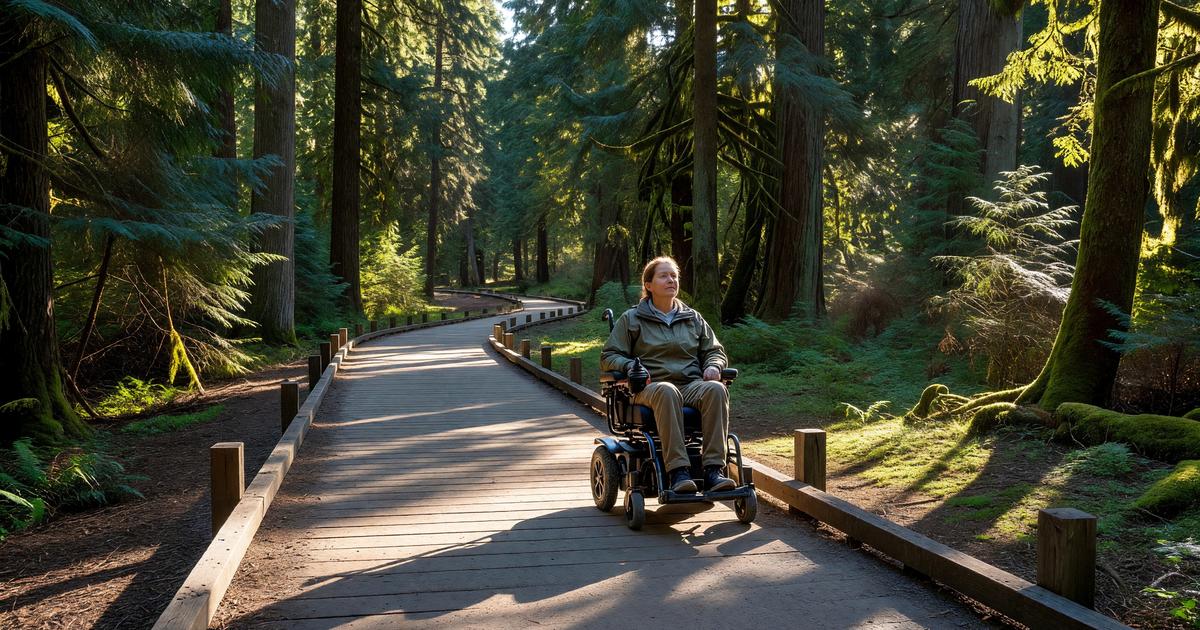
Visiting a national park with a disability is entirely possible at most major parks — but “accessible” covers an enormous range of real situations. A manual wheelchair user on flat pavement has different needs than someone using a rollator on gradual grades, which is different again from a visitor using a power scooter on a mixed surface, which is different from a visitor with low vision who needs audio description to understand what they’re seeing. Calling a park simply “accessible” or “not accessible” is nearly useless for planning.
This guide is specific. For each of the twelve parks below, you will find what is actually paved and level, what requires a firm but unpaved surface, what is accessible only by vehicle, what shuttle services serve visitors who cannot drive or walk distances, and what sensory accommodations — audio guides, tactile exhibits, ASL-interpreted ranger programs — are available or available by advance request.
The Legal Foundation: ADA, Section 504, and the Architectural Barriers Act
The NPS operates under three overlapping federal frameworks. The Architectural Barriers Act of 1968 requires federally funded facilities constructed or altered after 1969 to be accessible — that is why newer visitor centers are reliably accessible while some older trailhead facilities are not. Section 504 of the Rehabilitation Act of 1973 prohibits discrimination by federal agencies and requires that programs and services be accessible even when facilities cannot be fully modified. Title II of the Americans with Disabilities Act extends those requirements systemwide.
In 2018, NPS Director’s Order #42 formally codified accessibility as a core NPS commitment — not a compliance checklist but a design principle for all new construction, renovation, and programming. The practical result is that parks built or significantly renovated after the mid-1990s have meaningfully better accessible infrastructure than parks where visitor centers and trailhead facilities date from the 1960s.
The NPS maintains a central accessibility page at nps.gov/aboutus/accessibility.htm, and each park’s individual website includes an accessibility section with current trail surface conditions, accessible facility listings, and program schedules. Conditions change seasonally — confirm specifics directly with each park before your visit.
The Access Pass: Free Lifetime Entry for Visitors with Permanent Disabilities
Before planning your visit, obtain the Access Pass if you qualify. It is a free lifetime version of the $80 America the Beautiful Interagency Annual Pass, available to US citizens and permanent residents with permanent disabilities. The pass covers the entrance fee holder and up to three adults (children 15 and under are always free) at over 2,000 federal recreation sites — national parks, national forests, national wildlife refuges, and Bureau of Land Management areas.
Eligibility: You must have a permanent disability. Temporary disabilities or medical conditions do not qualify. Documentation requirements are flexible — the pass can be obtained with documentation of disability from a federal agency (Social Security Administration, Department of Veterans Affairs, or any federal agency), a physician’s certification on official letterhead, or documentation from a state agency that issues disability benefits. There is no single required form.
How to get it: Apply online at store.usgs.gov (there is a small processing fee for online/mail orders — check the USGS Store for the current amount) or obtain it free in person at any federal fee-collection site — any national park entrance station, visitor center, or ranger station that collects entrance fees can issue the pass at no charge. Bring your documentation. The in-person route is the zero-cost option.
What it covers: Entrance fees and standard amenity fees. It does not cover concession-operated services such as lodging, boat tours, horse trips, or campsite reservations. For campsite reservations at the parks below, the Access Pass provides a 50% discount at many federal campgrounds — but not all, and not at concessioner-operated campgrounds. Confirm discount eligibility when booking through Recreation.gov.
For a full overview of all America the Beautiful pass variants, including the Annual Pass and the Senior Pass, see our complete guide to national parks passes.
12 National Parks Ranked for Accessibility
1. Cuyahoga Valley National Park, Ohio
Who it works for: Wheelchair users, walker/rollator users, power scooter users, visitors with limited endurance.
Cuyahoga Valley sits between Cleveland and Akron with no entrance fee and extensive paved infrastructure. The Towpath Trail — 20 miles of paved surface following the historic Ohio & Erie Canal — is the park’s backbone, with multiple flat access points and parking areas distributed along its length. The entire paved section is accessible for manual and power wheelchairs. The Brandywine Gorge Trail boardwalk is accessible from the Brandywine Falls parking area to the first overlook platform above the 65-foot falls — approximately 0.3 miles of level boardwalk. The complete loop involves unpaved terrain; the overlook is the accessible destination.
What is not accessible: The gorge descent below the boardwalk overlook, the unpaved sections of the Towpath Trail north of the main visitor corridor, and several backcountry access points.
Sensory access: The park’s Canal Exploration Center in Valley View has tactile exhibits interpreting the canal era. Ranger programs are available with advance notice; contact the park directly for ASL-interpreted programs.
Accessible lodging: No in-park lodging. Gateway options in Brecksville, Peninsula, and Hudson include accessible chain hotel properties within 15–30 minutes. Stanford House Hostel (inside the park) is partially accessible — contact the park for current room configuration.
NPS page: nps.gov/cuva
2. Acadia National Park, Maine
Who it works for: Wheelchair users (paved sections), walker users, visitors in vehicles touring the Park Loop Road.
The 27-mile Park Loop Road is fully drivable and serves as the primary accessible experience of Acadia’s primary scenic corridor — Thunder Hole, Sand Beach, the Otter Cliff area, and Jordan Pond are all reachable directly from the road. The Ocean Path (3.5 miles, paved and flat, between Sand Beach and Otter Point) is accessible for wheelchairs and rollators. Jordan Pond Path — the flat 3.3-mile loop around the pond — is partially accessible: the western shore section is paved and level; the eastern section involves unpaved, sometimes uneven surface.
Sand Beach has a beach access mat and paved path from the parking area. A seasonal beach wheelchair is available for loan from the Sand Beach Entrance Station (first-come, first-served; no reservation).
Free Island Explorer bus: The summer shuttle serving Acadia’s major trailheads and visitor centers is fully accessible — all buses are lift-equipped. The Island Explorer connects Bar Harbor, the Hulls Cove Visitor Center, Jordan Pond House, Sand Beach, and several campgrounds. No vehicle required.
What is not accessible: The Cadillac Mountain summit trail (steep, rocky), most of the carriage road network for power wheelchair users (too narrow and loose-surface for mobility devices wider than a standard manual chair), and the Jordan Pond eastern shore section.
Sensory access: The Hulls Cove Visitor Center has an orientation film with audio description and closed captions. Ranger-led programs at the park amphitheater can be arranged with ASL interpretation — contact nps.gov/acad at least two weeks in advance.
Accessible lodging: Bar Harbor has multiple accessible hotel properties (Bar Harbor Inn, Atlantic Eyrie Lodge, and others). The Jordan Pond House (concessioner-operated) is accessible at ground level. No in-park lodging is managed directly by NPS.
3. Bryce Canyon National Park, Utah
Who it works for: Visitors in vehicles, power wheelchair users on paved rim sections, visitors with low vision (audio tour available).
Bryce Canyon’s rim viewpoints are the primary accessible experience. Most major viewpoints — Sunrise Point, Sunset Point, Inspiration Point, and Bryce Point — are accessible directly from parking areas via paved paths. The Rim Trail between Sunrise Point and Sunset Point is 0.5 miles of paved, level surface — the best accessible trail at Bryce. The trail extending further south becomes unpaved and uneven.
Free accessible shuttle: The park’s summer shuttle (May–October) serves all major viewpoints from the Shuttle Stop at Ruby’s Inn. All shuttle buses are lift-equipped. A shuttle from the main visitor area to Inspiration Point covers the widest range of accessible viewpoints without driving between multiple lots.
What is not accessible: Any trail descending into the canyon — including Queen’s Garden and Navajo Loop — involves steep switchbacks, loose gravel, and significant grade changes that are impassable for wheelchairs and extremely difficult for walkers. The canyon floor is not accessible.
Sensory access: Bryce Canyon has a mobile audio tour available through the NPS App (free download). The visitor center film has closed captioning and audio description. Large-print trail guides are available at the visitor center.
Accessible lodging: Bryce Canyon Lodge (inside the park, operated by Forever Resorts) has accessible rooms — call to confirm specific room configurations and reserve early. Nearby Ruby’s Inn (gateway property) also has accessible rooms.
NPS page: nps.gov/brca
4. Mount Rainier National Park, Washington
Who it works for: Wheelchair users at Paradise, walker users, visitors in vehicles.
Paradise is the most developed area of Mount Rainier and the most accessible. The Paradise Visitor Center (Henry M. Jackson Memorial Visitor Center) is fully accessible, with an accessible entrance, restrooms, and exhibit space. Several paved segments of the Skyline Trail originate from the visitor center — the first 0.5 miles of paved trail are accessible, providing views of the Tatoosh Range and the Nisqually Glacier. The Nisqually Vista Loop (1.2 miles) begins paved near the visitor center and provides expansive meadow and glacier views — the first section to the first viewpoint is accessible, though the full loop involves some unpaved trail.
What is not accessible: The full Skyline Trail loop, Panorama Point, and essentially all of Mount Rainier’s summit and backcountry trails involve grades or surfaces that are not accessible.
Sensory access: The Paradise Visitor Center has tactile relief maps of Mount Rainier. Large-print brochures available at the visitor center. ASL-interpreted ranger programs can be arranged with advance notice — contact nps.gov/mora at least two weeks before your visit.
Accessible lodging: Paradise Inn (inside the park, operated by Rainier Guest Services) has accessible rooms on the ground floor — confirm room configuration when booking. The inn is open late May through early October.
5. Crater Lake National Park, Oregon
Who it works for: Visitors in vehicles (Rim Drive), walker users, wheelchair users at Rim Village.
Rim Drive (33 miles) provides access to the lake’s primary viewpoints by vehicle. The Crater Lake rim is not walkable for most visitors with significant mobility limitations due to elevation and grade; the accessible approach is to drive between pull-offs. Rim Village — the hub area with the Crater Lake Lodge, gift shop, and café — has paved, accessible pathways between facilities. The Rim Village Trail is a short (approximately 1 mile) paved path along the caldera rim from the visitor center area; the western section near the visitor center is fully accessible.
What is not accessible: The Garfield Peak Trail, the Discovery Point Trail, and any trail descending toward the lake involve significant grade changes that are not accessible. The Cleetwood Cove Trail (the only trail to the water’s edge) is extremely steep — not accessible.
Accessible lodging: Crater Lake Lodge (inside the park) has accessible rooms on the ground floor. Reservations through the concessioner (Forever Resorts). Mazama Village campground has accessible campsites.
NPS page: nps.gov/crla
6. Yellowstone National Park, Wyoming/Montana/Idaho
Who it works for: Wheelchair users, walker users, power scooter users at major basin boardwalks.
Yellowstone has some of the most extensive accessible boardwalk infrastructure in the NPS system. The Old Faithful complex boardwalk is fully accessible — paved and level paths circle the Upper Geyser Basin, and the main viewing areas for Old Faithful are reachable by paved boardwalk from the Old Faithful Visitor Education Center. The full Upper Geyser Basin loop (approximately 2.5 miles) is accessible, connecting Castle Geyser, Grand Geyser, Morning Glory Pool, and Riverside Geyser. The Grand Prismatic Spring overlook trail (1.6 miles round trip from the trailhead parking area) is paved and accessible.
Norris Geyser Basin has partially accessible boardwalks — the Back Basin loop (1.5 miles) is mostly boardwalk but involves some uneven terrain. The Porcelain Basin overlook near the parking area is accessible.
Accessible shuttle at Old Faithful: Seasonal accessible shuttles operate between the Old Faithful area parking lots and the visitor center complex. The Old Faithful Inn (the historic 1903 lodge) has accessible rooms in the newer annex wing — the historic cabin section has no elevator and limited accessibility.
What is not accessible: Virtually all backcountry trails. The majority of the park’s thermal features are accessible by vehicle from pullouts on the Grand Loop Road rather than by extended trail walking.
NPS page: nps.gov/yell
7. Sequoia National Park, California
Who it works for: Wheelchair users, walker users, and visitors in vehicles.
The General Sherman Tree — the world’s largest tree by volume — is accessible via a paved 0.5-mile path from the accessible parking area in the Wolverton Road lot. Visitors without accessible parking permits park in the main lot and can access General Sherman via free park shuttle during summer (the shuttle has lift-equipped accessible vehicles). The route from the accessible parking area to the tree is paved with a gradual descent — manageable for manual wheelchair users with assistance; power wheelchairs and scooters handle it independently.
The Big Trees Trail (1.3-mile paved loop near Round Meadow) is fully accessible — flat, paved, and passing through giant sequoias. This is the most accessible standalone trail in the park and the best option for visitors who want a complete accessible sequoia grove experience without the General Sherman shuttle logistics.
What is not accessible: The Congress Trail loop (partly unpaved), the High Sierra Trail, Moro Rock, and essentially all backcountry access.
Sensory access: Audio description guides are available for the Giant Forest Museum. Large-print trail guides at the Lodgepole Visitor Center. The Giant Forest Museum is fully accessible with tactile exhibits.
NPS page: nps.gov/seki
8. Grand Canyon National Park, Arizona (South Rim)
Who it works for: Wheelchair users, walker users, visitors in vehicles. The South Rim has the most extensive accessible trail infrastructure of any canyon park.
The South Rim Trail (also called the Rim Trail) runs 13 miles from South Kaibab Trailhead east to Hermits Rest. The paved, fully accessible section runs from Mather Point (at the main visitor center complex) through the Village area to Hermits Rest — approximately 7.5 miles. This continuous paved route passes every major South Rim viewpoint: Mather Point, Yavapai Point, Bright Angel Trailhead, and Hopi Point. Electric-assist bikes and power wheelchairs can cover the full length; manual wheelchair users typically cover the Village section (2–3 miles) with assistance.
Accessible shuttle: The South Rim shuttle system (Village Route, Kaibab/Rim Route, and Hermits Rest Route) is fully accessible — all buses have lifts. The Hermits Rest Route covers the western rim from the Village to Hermits Rest (9 viewpoints total); all stops are accessible from the shuttle. No personal vehicle is permitted on Hermits Rest Road in-season.
Yavapai Geology Museum at Yavapai Point is fully accessible and provides one of the best interpretive views of the canyon’s geology from an accessible indoor platform.
What is not accessible: Every trail descending into the canyon — Bright Angel, South Kaibab, Hermit — involves steep switchbacks and is not accessible. The North Rim has no accessible alternatives comparable to the South Rim.
Sensory access: Tactile relief maps of the canyon are available at the Yavapai Geology Museum and the Grand Canyon Visitor Center. Audio description for the Yavapai exhibits. ASL-interpreted ranger programs by advance request — contact nps.gov/grca accessibility coordinator.
Accessible lodging: El Tovar Hotel (inside the park, operated by Xanterra) has accessible rooms — call to confirm configurations. Bright Angel Lodge and Maswik Lodge also have accessible rooms. Reserve well in advance; in-park lodging at Grand Canyon is among the most competitive in the system.
9. Death Valley National Park, California
Who it works for: Visitors in vehicles, wheelchair users at boardwalk features.
Death Valley is largely an automotive experience — the distances involved and the climate make it essential to have a vehicle. The Badwater Basin boardwalk (approximately 0.5 miles round trip to the main salt flat perspective) is flat, paved, and accessible — the lowest point in North America at 282 feet below sea level is reachable by wheelchair. The Artists Drive (9-mile one-way scenic road through the Artists Palette colored hills) is fully drivable. Mesquite Flat Sand Dunes are accessible for parking-lot viewing; the dunes themselves are not accessible.
What is not accessible: Zabriskie Point (involves stairs — there is a paved path to a viewpoint that stops short of the summit overlook), Mosaic Canyon, and all backcountry areas.
Sensory access: The Furnace Creek Visitor Center is fully accessible with accessible exhibits. Large-print materials available.
NPS page: nps.gov/deva
10. Joshua Tree National Park, California
Who it works for: Walker users, wheelchair users on paved loops, visitors in vehicles.
Cap Rock Nature Trail (0.4-mile paved loop) is the primary accessible trail in Joshua Tree — flat, paved, passing through the park’s signature boulder formations and Joshua trees. The loop is accessible for manual and power wheelchairs. Keys View (the primary panoramic overlook) is accessible directly from the parking area — paved path to the viewpoint railing, approximately 100 meters. Cottonwood Spring and its oasis area has a flat, firm-surface trail (0.3 miles) that is accessible for walker users and sturdy wheelchairs, though it is not paved.
What is not accessible: Ryan Mountain Trail, the Skull Rock Nature Trail (partial paved section near parking but the loop is uneven), and all backcountry.
NPS page: nps.gov/jotr
11. Zion National Park, Utah
Who it works for: Wheelchair users, walker users, and visitors using the accessible shuttle system.
Zion’s Riverside Walk (approximately 2 miles round trip, paved, flat) is among the best accessible trails in any national park — it runs through the Narrows gateway canyon along the North Fork of the Virgin River to the beginning of the Zion Narrows, entirely on a paved surface. All wheelchair types can complete it; the grade is minimal throughout. The Pa’rus Trail (approximately 3.5 miles round trip, paved) connects the South Campground to Canyon Junction — flat, paved, open to bikes and pedestrians, with direct views of the Watchman formation. Both trails are accessible year-round when weather permits.
Zion Canyon shuttle: All buses on the Zion Canyon Shuttle (required for private vehicles in-season) are lift-equipped with accessible space. The shuttle connects the visitor center to eight stops along the scenic road, serving every major trailhead and viewpoint. This is one of the NPS system’s best examples of accessible mass transit integration — visitors who cannot walk long distances access all major canyon areas by shuttle.
What is not accessible: Angels Landing, the Narrows (the canyon narrows above the Riverside Walk terminus), Emerald Pools upper tier, and essentially all canyon-wall hiking.
Sensory access: The Zion Human History Museum and main visitor center are fully accessible with accessible exhibits. Large-print trail guides and the NPS App audio tour are available. Ranger programs at the Zion Lodge amphitheater are held seasonally — ASL-interpreted programs available with advance notice.
NPS page: nps.gov/zion
12. Yosemite National Park, California
Who it works for: Wheelchair users, walker users, visitors using the Valley shuttle.
Yosemite Valley has the most complete accessible trail system of any NPS wilderness park. The Lower Yosemite Falls Trail (1-mile loop, paved, flat) is fully accessible — the paved loop leads to the base of North America’s tallest waterfall. The Bridalveil Fall Trail (0.5-mile round trip, paved) is accessible from the parking area with a gradual incline; the last 100 feet to the falls base are on packed gravel — accessible for most wheelchairs with assistance. The Valley Floor Trail between visitor facilities is paved and accessible throughout the Village area.
Free Yosemite Valley Shuttle: All Valley shuttle buses are lift-equipped and serve 21 stops throughout Yosemite Valley — connecting campgrounds, lodges, trailheads, visitor centers, and viewpoints. This is the primary accessible transportation system for the Valley. Personal vehicles are parked at day-use lots or campsites; the shuttle handles all internal movement.
What is not accessible: All trails with significant elevation gain — Half Dome, the Mist Trail above Vernal Fall footbridge, Glacier Point Road trails, and Tuolumne Meadows are not accessible by trail. Glacier Point is reachable by road (accessible parking, viewpoint paved) but involves a separate drive from the Valley.
Sensory access: The Valley Visitor Center is fully accessible with accessible exhibits and an audio-described orientation film. Large-print and Braille materials available. ASL-interpreted ranger programs are offered several times per season — check the current-season schedule at nps.gov/yose or call the Valley Visitor Center. Accessible audio tours are available through the NPS App for the Valley Floor and several major sites.
Accessible lodging: Yosemite Valley Lodge (now called Yosemite Valley Lodge at the Falls) has accessible rooms with roll-in showers available. The Ahwahnee Hotel has accessible rooms. Both are operated by Yosemite Hospitality (Aramark) — call to confirm specific accessible room configurations when booking.
How to Arrange Accessible Ranger Programs in Advance
Most parks offer ASL-interpreted ranger programs by advance request, but the lead time and contact process varies by park. The standard approach:
- Identify the program you want — check the park’s current “Things to Do” page on nps.gov for the program schedule.
- Contact the park’s accessibility coordinator (listed on each park’s accessibility page on nps.gov) or the main visitor center at least two weeks before your visit. For complex requests (sign language interpretation for multiple programs, tactile tours, guided audio-described walks), four weeks is more realistic.
- Confirm the accommodation in writing — request an email confirmation so there is no miscommunication on arrival.
Most parks also offer Junior Ranger programs adapted for visitors with disabilities — including tactile activity booklets and take-home activity options for visitors who cannot participate in standard programs. Ask at any park visitor center.
Accessible Shuttle Checklist
The parks with the most reliable accessible shuttle infrastructure are: Zion (in-season, required, all buses lift-equipped), Yosemite Valley (year-round in Valley, free, lift-equipped), Grand Canyon South Rim (all routes, free, lift-equipped), Bryce Canyon (seasonal May–October, free, lift-equipped), and Acadia (Island Explorer, seasonal, free, lift-equipped).
When confirming shuttle accessibility, ask specifically: (1) Is the boarding area paved and level? (2) Is the lift currently operational at all buses on the route? (3) Is there a specific accessible boarding location at your origin stop? Lift malfunctions are occasional — have a backup plan if driving is an option.
Frequently Asked Questions
How do I get the free Access Pass for national parks?
The Access Pass is available free to US citizens and permanent residents with permanent disabilities. Obtain it in person (no processing fee) at any federal fee-collection site — any national park entrance station or visitor center that charges entrance fees can issue it. Bring documentation of your permanent disability: a federal agency letter (Social Security, VA), a physician’s certification, or a state disability agency document. Alternatively, apply online or by mail through the USGS Store at store.usgs.gov — a small processing/shipping fee applies for online and mail orders. The pass is good for your lifetime.
Which national park has the best wheelchair-accessible trails?
Zion National Park offers the most substantial accessible trail mileage for wheelchair users: the paved Riverside Walk (approximately 2 miles round trip) and the paved Pa’rus Trail (approximately 3.5 miles round trip), both flat and fully accessible. Yosemite Valley is comparable, with paved accessible loops at Lower Yosemite Falls and Bridalveil Fall plus an extensive free accessible shuttle. Grand Canyon South Rim has the longest accessible paved rim trail in the system at over 7 continuous miles.
Are national park shuttles wheelchair accessible?
Yes — at the parks that operate major shuttle systems, all buses are required to be lift-equipped. The most reliable accessible shuttle systems are at Zion, Yosemite Valley, Grand Canyon South Rim, Acadia (Island Explorer), and Bryce Canyon. Confirm current operational status with each park before your visit, as lift malfunctions do occur and seasonal schedules vary.
Can visitors with low vision or blindness get accessible programming at national parks?
Yes. Most major parks offer audio-described orientation films at visitor centers, NPS App audio tours for major features, large-print and Braille materials at visitor centers, and tactile relief maps or hands-on exhibits. ASL-interpreted ranger programs are available by advance request (typically two weeks’ notice) at virtually every park on this list. Contact each park’s accessibility coordinator — listed on the park’s nps.gov accessibility page — to arrange specific accommodations.
Does the Access Pass cover campsite reservations?
The Access Pass provides a 50% discount on federal campground fees at many — but not all — Recreation.gov campgrounds. The discount does not apply at concessioner-operated campgrounds inside some parks (Xanterra-operated campgrounds at Yellowstone, for example, have their own reservation and pricing structure). When booking through Recreation.gov, select “Access Pass” as your discount during checkout — you will need your pass number.
For detailed information on accessible trails at specific parks, the NPS Accessibility Page has current-season accessibility guides for every unit in the system. Wheelchair Travel (wheelchairtravel.org) maintains first-person accessibility reviews of national parks and other travel destinations from a wheelchair user’s perspective — a useful complement to official NPS documentation. For planning a visit with a mobility limitation, Zion’s guide on accessible visitor services, available through nps.gov/zion/planyourvisit/accessibility.htm, is one of the most detailed park-level accessibility planning resources in the system. Senior travelers planning park visits — whether or not mobility is a factor — will find additional pacing guidance, lodge rankings, and altitude advice in Best National Parks for Senior Travelers.